Product comparison
One Piece vs Two Piece Toilet: Which Is Better?
Choosing between a one piece vs two piece toilet may seem like a simple design decision, but the differences go beyond appearance. Installation, cleaning, maintenance, purchase cost and transportation can all influence which toilet is the better choice.
For homeowners, the decision often comes down to bathroom style, budget and everyday convenience. For bathroom distributors, hotel developers and wholesale buyers, additional factors such as product consistency, replacement parts, installation requirements and long-term maintenance costs become equally important.

Quick answer
A one-piece toilet combines the tank and bowl into a single ceramic unit, creating a streamlined appearance with fewer exterior joints to clean. A two-piece toilet has a separate tank and bowl, typically offering a more economical purchase option and greater flexibility in handling and replacing ceramic components.
Neither design is automatically superior in flushing performance or durability. The right choice depends on the actual product specifications and how the toilet will be used—compare one-piece toilet models, two-piece toilet models, or the full MICAWA ceramic toilet range.
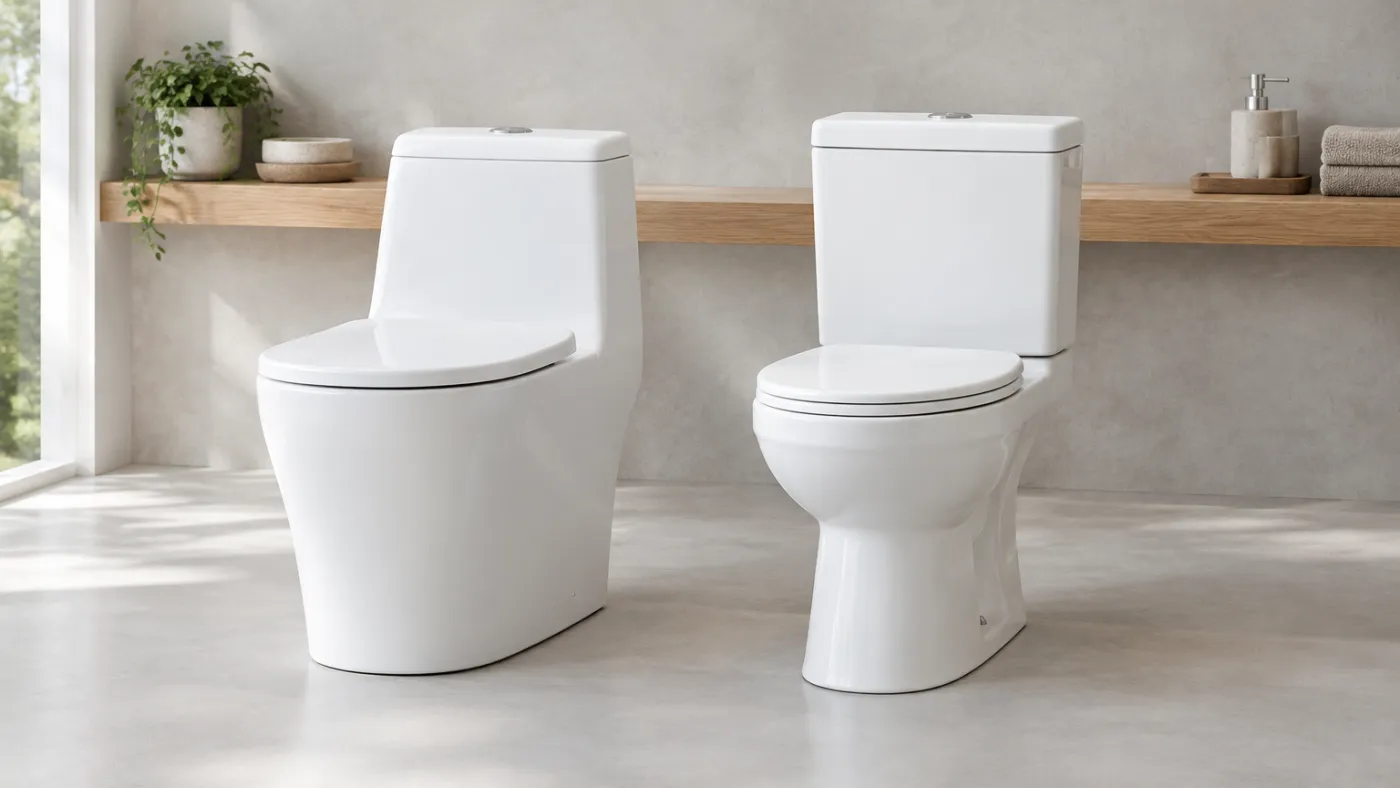
What Is a One-Piece Toilet?
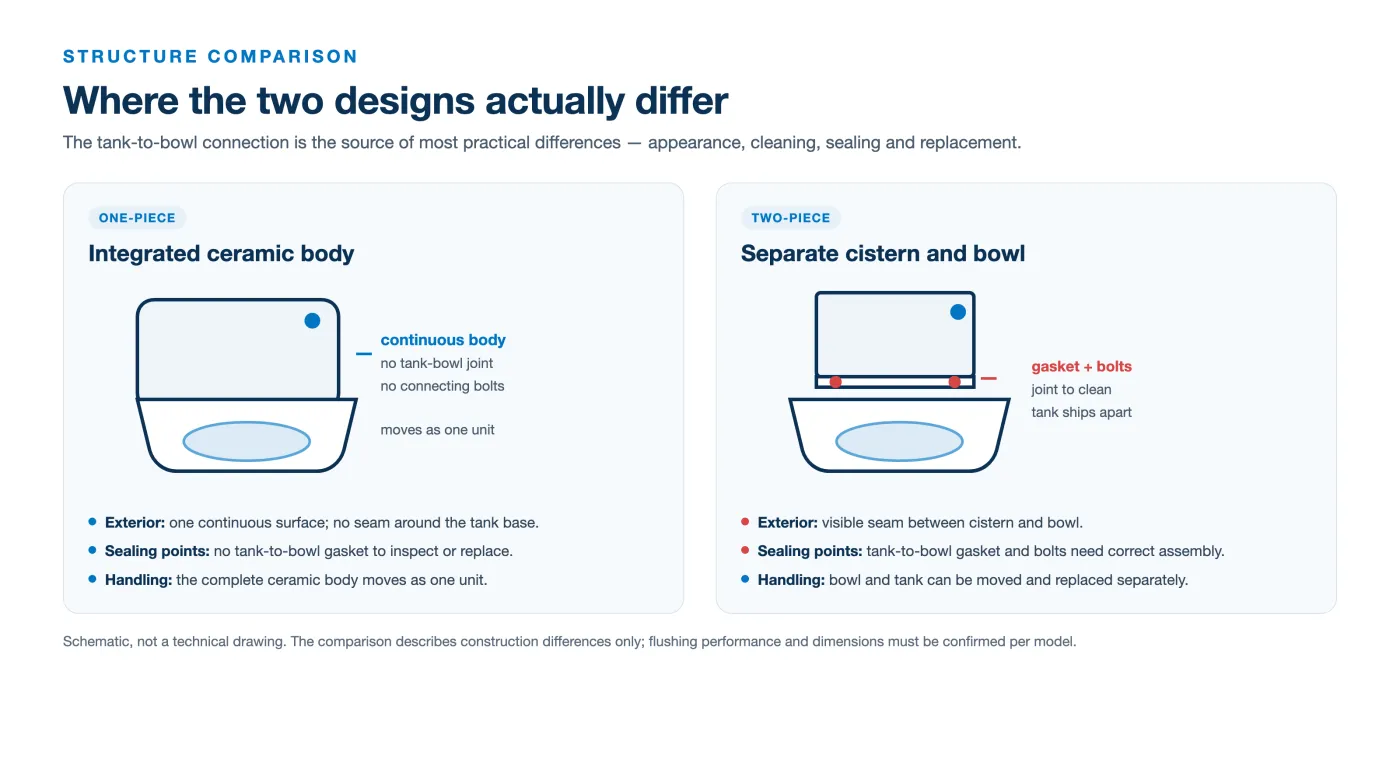
A one-piece toilet is a toilet in which the tank and bowl are formed as one integrated ceramic structure. Unlike traditional two-piece toilets, there is no separate tank-to-bowl connection. This creates a continuous exterior that gives the toilet a clean, streamlined appearance.
One-piece toilets are commonly selected for contemporary bathrooms, apartments, hotels and residential developments where visual consistency and easy cleaning are important.
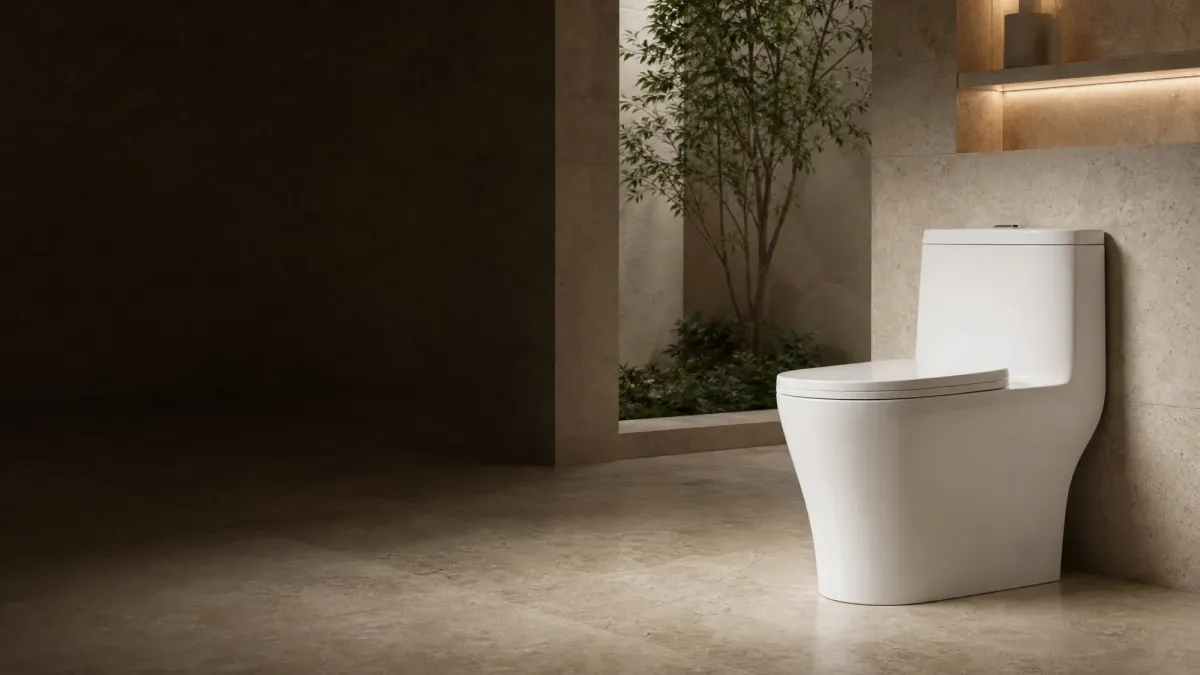
Advantages of one-piece toilets
- Easier exterior cleaning: the integrated structure eliminates the external joint between tank and bowl, reducing areas where dust and dirt accumulate.
- Modern appearance: the continuous ceramic body creates a streamlined look that suits contemporary bathroom designs.
- Fewer tank-to-bowl connections: no tank-to-bowl gasket or connecting bolts that require periodic inspection.
- Simplified ceramic assembly: the tank and bowl do not need to be joined during installation.
- Suitable for coordinated collections: one-piece models can provide a consistent visual style across hotels, apartments and retail ranges.
Disadvantages of one-piece toilets
- Generally higher initial cost: integrated ceramic production and design can make some one-piece models more expensive than comparable two-piece toilets.
- Heavier to handle as one unit: moving and positioning an integrated toilet requires additional care during installation.
- Limited ceramic replacement flexibility: if the tank or bowl is seriously damaged, the integrated body may require replacing the entire fixture.
- Shipping considerations: the complete ceramic unit requires appropriate protective packaging and careful handling.
These characteristics make one-piece toilets particularly attractive when appearance and cleaning convenience are priorities. Buyers can explore the MICAWA one-piece toilet collection for available models, dimensions and installation configurations.
What Is a Two-Piece Toilet?
A two-piece toilet consists of two separate ceramic components: the toilet bowl and the water tank, also called the cistern. The tank is attached to the bowl during installation using connecting hardware and a sealing gasket. Together, the two components form a complete flushing system.
Two-piece toilets have long been used in residential bathrooms, rental properties and commercial developments because of their practical structure and wide range of available configurations.
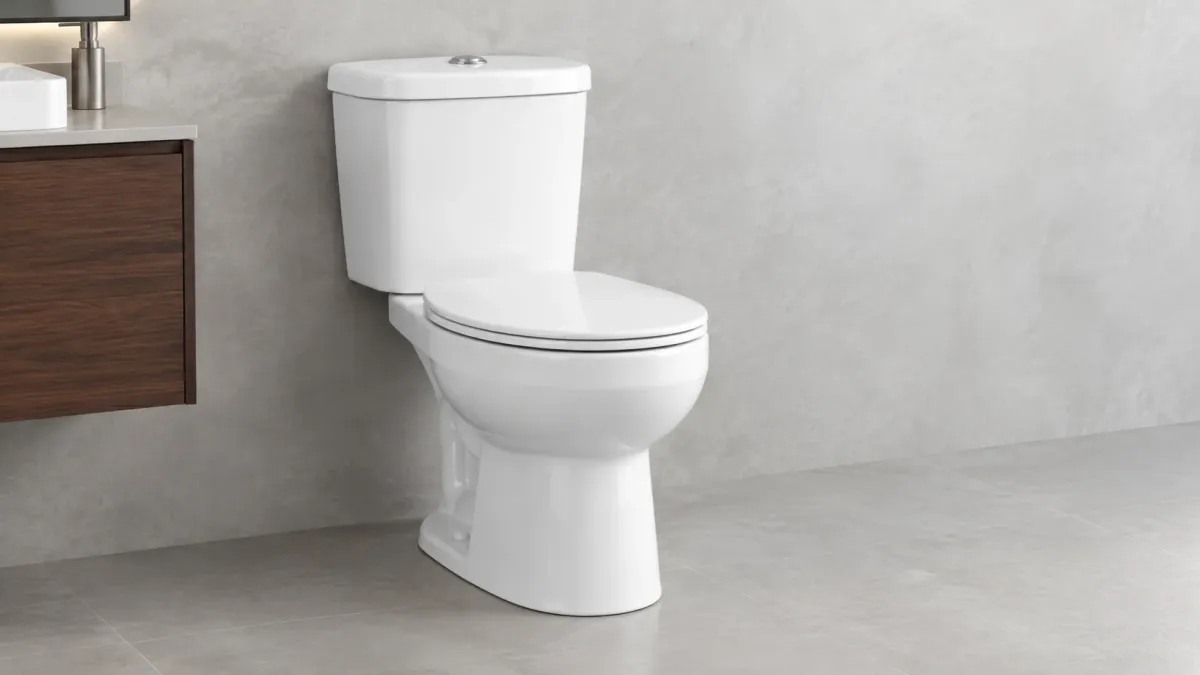
Advantages of two-piece toilets
- Cost-effective options: two-piece designs are often available at lower initial price points, making them attractive for budget-conscious projects.
- Easier component handling: the bowl and tank can be moved separately, which can help through narrow doorways or staircases.
- Flexible ceramic replacement: a damaged tank or bowl may be replaced independently if an exactly compatible component is available.
- Practical for standardised projects: well suited to residential developments, rental apartments and volume distribution.
- Accessible tank components: many designs provide straightforward access to the flushing mechanism for inspection and servicing.
Disadvantages of two-piece toilets
- Additional cleaning areas: the connection between tank and bowl introduces joints and narrow spaces that require extra attention.
- More assembly steps: the tank must be correctly attached to the bowl during installation.
- Additional sealing points: the tank-to-bowl gasket and connecting hardware may need maintenance over time.
- Less seamless appearance: the visible separation between tank and bowl may not suit every modern design.
For projects where purchase cost, component handling and maintenance flexibility are major considerations, two-piece toilets can be a practical solution. Explore the MICAWA two-piece toilet collection for current models and technical specifications, or compare all formats in the toilet product range.
One Piece vs Two Piece Toilet: Key Differences at a Glance
The following comparison highlights the main differences between the two designs before examining each factor in detail.
| Feature | One-piece toilet | Two-piece toilet |
|---|---|---|
| Structure | Integrated tank and bowl | Separate tank and bowl |
| Appearance | Streamlined, continuous exterior | Visible tank-to-bowl connection |
| Exterior cleaning | Generally easier | Requires cleaning around the joint |
| Initial purchase cost | Often higher | Often more economical |
| Installation | No tank-to-bowl assembly, but heavier as one unit | Additional assembly, but components easier to handle |
| Leakage points | No separate tank-to-bowl gasket | Includes a tank-to-bowl seal |
| Ceramic replacement | Integrated body may require complete replacement | Individual ceramic sections may be replaceable |
| Flushing performance | Depends on flushing system and design | Depends on flushing system and design |
| Transportation | Single larger ceramic unit | Two components handled separately |
| Typical applications | Contemporary homes, hotels, premium projects | Apartments, rentals, residential developments, distribution |
General structural differences, not guaranteed performance characteristics. Confirm dimensions, flush volume, installation requirements and quality for the selected model.
1. Design and Appearance
A one-piece toilet has a continuous ceramic structure connecting the water tank and bowl. This integrated appearance is popular in modern bathrooms where simple lines and coordinated fixtures are important. Some one-piece models also feature concealed trapways or smooth exterior surfaces that further reduce visible contours. However, not every one-piece toilet has a concealed trapway, and the actual appearance varies by model.
A two-piece toilet has a separate cistern positioned above the bowl. Although this creates a more traditional profile, modern two-piece toilets are available in streamlined designs that can also complement contemporary bathrooms.
For projects requiring many identical units, the choice should reflect the intended interior style, available product range and budget. A one-piece toilet is often preferred for a seamless, contemporary look, but a well-designed two-piece model can provide a similar overall aesthetic at a different price point.
2. Cleaning and Hygiene
Are one-piece toilets easier to clean?
Generally, yes. Because the tank and bowl are integrated, there is no external seam where two separate ceramic components meet. This makes the surrounding exterior easier to wipe and reduces the number of narrow areas that require detailed cleaning. For hotels and serviced apartments, where cleaning routines repeat frequently, an accessible exterior can be an advantage.
However, overall toilet hygiene also depends on bowl design, glazing quality, flushing coverage and maintenance procedures.
Are two-piece toilets harder to clean?
Two-piece toilets typically require additional attention around the tank-to-bowl connection. Dust, moisture or cleaning residue can accumulate around this joint if it is not cleaned regularly. This does not make two-piece toilets inherently unhygienic. With appropriate cleaning and maintenance, both designs can be kept in good condition.
For bathrooms with demanding cleaning schedules, fewer exterior joints can be a useful selection factor. For a broader maintenance-oriented view, see the toilet and basin sourcing checklist.
3. Installation, Weight and Rough-In
A one-piece toilet arrives with the ceramic tank and bowl already integrated. This eliminates the need to join two separate ceramic sections during installation. However, the complete unit can be heavy and awkward to position, particularly in small bathrooms. Installers must carefully check the toilet dimensions, waste outlet, water supply position and floor conditions before installation.
A two-piece toilet allows the tank and bowl to be handled separately. This can simplify movement through narrow spaces and make positioning the bowl more manageable. However, installation requires an additional assembly step: the tank must be securely attached using the correct gasket, bolts and installation procedure. Improper assembly may lead to water leakage or damage to the ceramic components.
Why rough-in dimensions matter more than toilet type
Regardless of whether you choose a one-piece or two-piece toilet, the waste outlet must match the bathroom drainage layout. For floor-outlet toilets, the rough-in is typically measured from the finished wall to the center of the floor waste outlet. For example, selected MICAWA ceramic toilet models are available with 300 mm or 400 mm rough-in configurations, depending on the model. These measurements should not be assumed to be interchangeable with other market conventions without checking the installation drawing.
| Installation input | What to confirm before ordering |
|---|---|
| Rough-in distance | Measured from finished wall to waste centre, with the reference method stated |
| Outlet type | Floor outlet (S-trap) or wall outlet (P-trap), and the exact configuration |
| Overall dimensions | Length, width, height, plus clearance to door swing, vanity and shelves |
| Water inlet | Supply position and height, so the connection is not strained |
| Installation clearances | Space for handling the unit and for future servicing |
| Destination market | Plumbing conventions, documentation and applicable requirements |
One-piece toilets eliminate tank assembly, while two-piece toilets offer easier handling of separate components. Actual installation difficulty depends on the model, bathroom layout and installer experience.
4. Flushing Performance and Water Efficiency
A common question is whether a one-piece toilet flushes better than a two-piece toilet. Toilet construction alone does not determine flushing performance. Both designs can use effective flushing technologies, including siphonic and washdown systems, depending on the product.
Flushing system, flush volume and trapway
Siphonic toilets use water movement through a designed trapway to create waste-removal action. Washdown systems rely on the force of flushing water to move waste directly through the outlet. The appropriate system depends on product design, application and destination-market requirements. The difference is explained in the siphonic vs washdown toilet guide.
Water consumption is determined by the flushing mechanism and product configuration, not simply by whether the toilet has one or two ceramic pieces. Both designs can be equipped with water-efficient flushing systems. Buyers should compare the actual litres per flush or gallons per flush and review relevant test documentation.
For reference, the U.S. EPA WaterSense programme for residential toilets sets 1.28 gallons per flush (about 4.8 litres) as the maximum for a labelled toilet. A model must be certified to carry the label; meeting the number alone does not make it WaterSense-certified. Independent flush-performance testing, such as the MaP testing programme, reports grams of waste removed per flush and is a more useful comparison than the toilet type.
Trapway geometry, glazing, water distribution and bowl shape all influence waste removal and cleaning performance. These characteristics should be evaluated using product-specific technical information.
Example: MICAWA one-piece toilet MB-1860A
MICAWA lists the MB-1860A with a dual-flush configuration of 4.8 L for full flush and 3.3 L for reduced flush. This is a specification for that particular model, not a universal figure for all one-piece toilets. Neither design has an automatic advantage; compare the exact flushing system, measured water consumption, relevant testing results and applicable destination-market requirements.
5. Durability, Leakage and Maintenance
The integrated structure of a one-piece toilet removes the separate tank-to-bowl joint, eliminating one potential connection point for leakage. However, one-piece toilets still have other components that require maintenance, including fill valves, flush valves, water supply connections, seats and waste seals. Many internal parts can be replaced without changing the ceramic body, provided compatible components are available. If the integrated ceramic body itself develops major structural damage, replacement may be more complicated.
Two-piece toilets include a sealing connection between the tank and bowl. Correct assembly and periodic inspection help maintain this connection. An advantage of the two-piece design is that a damaged ceramic tank or bowl may sometimes be replaced independently — but replacement components must match the original model. Tanks and bowls from different models should not be assumed to be interchangeable.
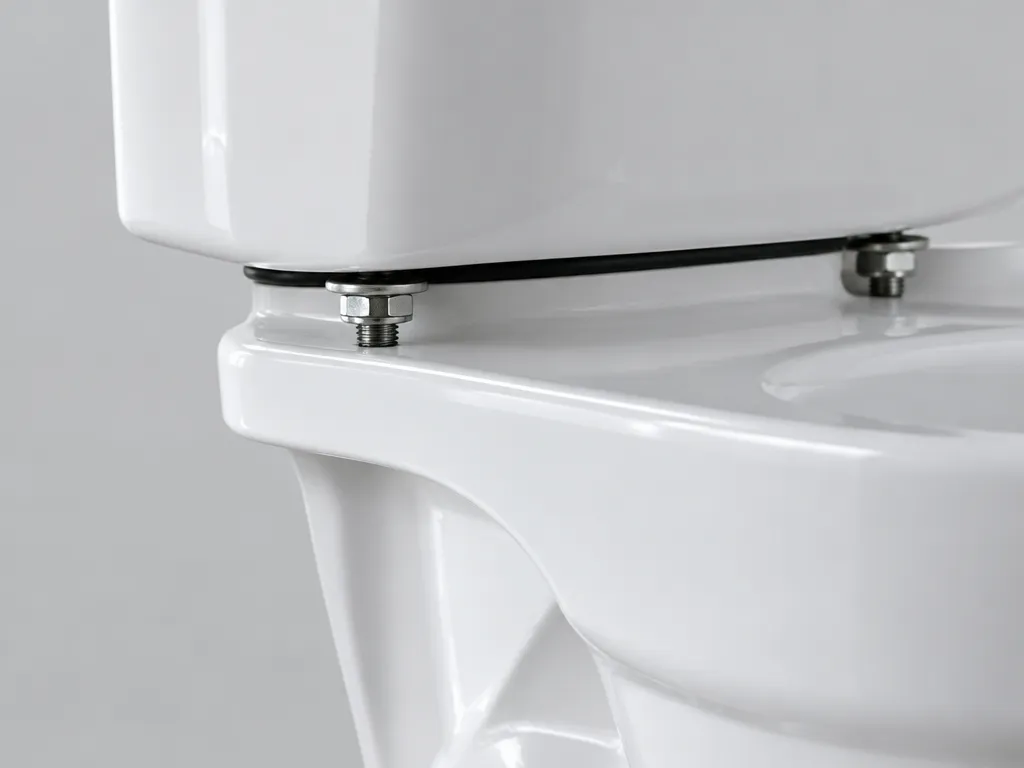
Neither type is necessarily more durable based on its structure alone. Ceramic manufacturing quality, glazing, installation accuracy, component quality, water conditions and ongoing maintenance all affect service life. For distributors and property managers, access to compatible replacement components may be as important as the original toilet design. Sample inspection criteria are covered in the toilet sample inspection guide.
6. Price and Total Cost of Ownership
Two-piece toilets are often considered the more economical option, but purchase price is only one part of the comparison. Two-piece toilets can offer a lower entry price, making them attractive for large residential developments and budget-focused product lines. One-piece toilets may carry a higher initial price because of their integrated construction, design and manufacturing requirements. The actual difference depends on the model, materials, flushing components, order quantity and supplier.
| Cost factor | One-piece | Two-piece |
|---|---|---|
| Unit purchase price | Often higher | Often lower |
| Handling at installation | Single heavier unit | Two lighter components |
| Assembly labour | No tank assembly | Tank must be assembled and sealed |
| Cleaning labour | Fewer exterior joints | Joint needs regular attention |
| Replacement parts | Internals replaceable; body is not | Bowl or tank may be replaced separately |
| Shipping density | Lower pieces per container | Higher sets per container |
| Damage risk in transit | One large ceramic body | Two ceramics in matched cartons |
When comparing long-term cost, consider the frequency and convenience of cleaning, availability of replacement components, access to the flushing mechanism, risk of damage during installation and handling, future maintenance requirements, and the cost of replacing damaged ceramic components. For hotels, apartments and commercial properties, comparing these factors across hundreds of bathrooms may be more useful than focusing only on the initial unit price.
7. Shipping, Packaging and Wholesale Procurement
Ceramic toilets are vulnerable to impact damage if they are not properly protected during transportation. A one-piece toilet has an integrated ceramic body that must be protected as a complete unit; its shape, weight and overall dimensions influence carton design, cushioning, pallet configuration and container loading. Since the tank and bowl cannot be separated, handling damage can affect the entire fixture.
Two-piece toilets provide more flexibility in handling because the bowl and tank are separate components. Depending on the manufacturer packaging design, this can simplify individual component handling and improve container density. However, buyers should confirm whether the components are packed together or separately and how matched tank-and-bowl sets will be identified. Poorly coordinated packaging can create installation problems even when the ceramic components arrive undamaged.
| Published loading reference | Model type | Indicative 40HQ loading |
|---|---|---|
| MB-1843 | One-piece | ~260 pcs / 40HQ |
| MB-1860A | One-piece | ~280 pcs / 40HQ |
| MB-2803 | Two-piece, split carton | ~380 sets / 40HQ |
| MB-2804 | Two-piece, split carton | ~400 sets / 40HQ |
Published catalog references for orientation only. Container loading depends on the exact carton, pallet or crate configuration, mix and route; confirm the loading plan in the order documents.
What wholesale buyers should confirm
- Export carton dimensions and gross weight.
- Protective packaging materials and drop-test standard.
- Pallet and container loading arrangements.
- Packaging configuration for one-piece or split-carton two-piece products.
- Model and component identification, including how tank-and-bowl sets stay matched.
- Spare-part packaging and quantities.
- Applicable pre-shipment inspection requirements.
There is no universal winner in shipping. Two-piece toilets may provide handling flexibility and higher container density; one-piece toilets eliminate the need to match separate ceramic sections during installation. Compare actual packing specifications and the total landed cost of each model, not just the unit price.
Which Toilet Is Better for Your Application?
| Application | Usual lean | Why |
|---|---|---|
| Modern residential bathroom | One-piece | Streamlined look and easier exterior cleaning; two-piece remains viable where cost dominates |
| Hotels and hospitality | Either, by room tier | One-piece suits contemporary guest bathrooms; two-piece suits standardised replacement and budget control |
| Rental apartments and volume housing | Two-piece | Lower entry price, separate handling and component replacement flexibility |
| Distributors and wholesale | Both in one range | Two-piece for price-led volume, one-piece for mid and premium retail tiers |
| Accessible or specialised bathrooms | Model-specific | Clearances and installation requirements govern the choice more than toilet type |
Hotels typically need toilets that are easy to clean, reliable, visually consistent and suitable for repeated daily use. One-piece toilets can be attractive for guest bathrooms with contemporary interiors, while two-piece toilets may be appropriate for projects prioritising standardised replacement components and controlled fixture budgets. The final choice should consider the hotel room design, maintenance strategy and approved product specifications. See hotel and commercial washroom solutions for project-level planning.
For either option, standardising models across a project can simplify installation planning, future maintenance and replacement-part management. A balanced distributor range could include economical two-piece toilets for cost-sensitive markets, contemporary one-piece toilets for mid-range and premium collections, and selected water-efficient models where supported by product-specific documentation. More assortment planning is covered in the importer and distributor resources.
One Piece vs Two Piece Toilets: Real MICAWA Product Examples
To show how product selection works in practice, the following examples are taken from MICAWA's published ceramic toilet collections. A key point: one-piece toilets are not automatically smaller than two-piece toilets. Even within the same category, total dimensions vary significantly.
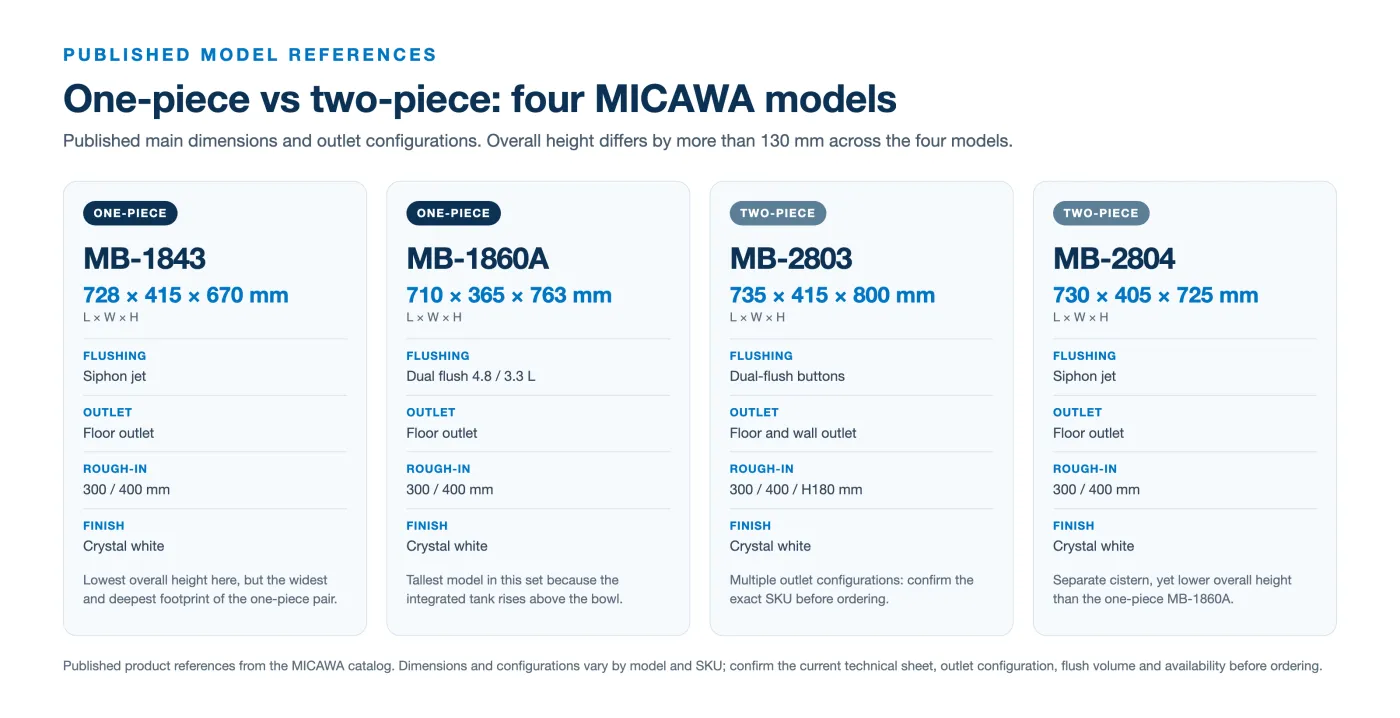
| Model | Type | Dimensions (L × W × H) | Published features |
|---|---|---|---|
| MB-1843 | One-piece | 728 × 415 × 670 mm | Siphon jet dual flush 4.8 / 3.3 L; 300 / 400 mm floor rough-in |
| MB-1860A | One-piece | 710 × 365 × 763 mm | Dual flush 4.8 / 3.3 L; 300 / 400 mm floor rough-in; seat tested to 50,000+ damping cycles |
| MB-2803 | Two-piece | 735 × 415 × 800 mm | Siphon jet dual flush 4.8 / 3.0 L; floor or wall outlet by configuration (300 / 400 / H180 mm) |
| MB-2804 | Two-piece | 730 × 405 × 725 mm | Siphon jet dual flush 4.8 / 3.0 L; 300 / 400 mm floor rough-in |
Published model references. Final specifications, outlet configurations, availability and applicable documents must be confirmed against the current technical sheet before ordering.
Buyers comparing the MB-1860A and MB-2804 should consider total height, bowl dimensions, outlet configuration and installation requirements rather than making a decision based only on toilet type. The MB-2803 also illustrates a practical procurement point: its floor and wall outlet options may correspond to different order configurations, so confirm the exact SKU and technical drawing before approving a bulk order. Explore the complete MICAWA toilet product range to compare currently listed models.
Toilet Sourcing Checklist for Distributors and Project Buyers
Before confirming a wholesale toilet order, prepare a detailed product specification. The following checklist helps reduce misunderstandings during sampling, production and delivery.
| Step | What to confirm |
|---|---|
| 1. Target market | Destination country and applicable plumbing, water-efficiency, safety or certification requirements |
| 2. Rough-in and outlet | Drainage drawings, floor or wall outlet, and the measured rough-in |
| 3. Product dimensions | Complete length, width, height and installation clearances |
| 4. Flushing specification | Flushing system, water consumption and performance documentation |
| 5. Ceramic quality | Glazing, visible defects, deformation and inspection criteria |
| 6. Components | Seat, flushing mechanism, inlet valve, outlet seals and supplied accessories |
| 7. Packaging | Packing method, carton information and protective materials |
| 8. Spare parts | Compatible replacement seats, valves and components for future servicing |
| 9. Sample approval | Physical sample, dimensions, finish, flush performance and installation compatibility |
| 10. Commercial terms | Model, quantity, customisation, inspection, destination and delivery schedule |
A complete purchasing brief makes it easier for suppliers to recommend appropriate models and prepare accurate quotations. The toilet and basin sourcing checklist expands these points into a document you can send to a supplier.
MICAWA Toilet Manufacturing and OEM/ODM Solutions
Choosing the right toilet manufacturer involves more than comparing product styles. Manufacturing capability, quality control, sample validation and long-term supply coordination are important for international buyers.
Founded in 2000, MICAWA (Foshan MICAWA Ceramics Co., Ltd.) supplies ceramic sanitary ware and coordinated bathroom products to distributors, bathroom brands and commercial project buyers. According to MICAWA's published factory information, its operations include a 200,000 m² production base and annual sanitary ceramic production capacity of 600,000 pieces.
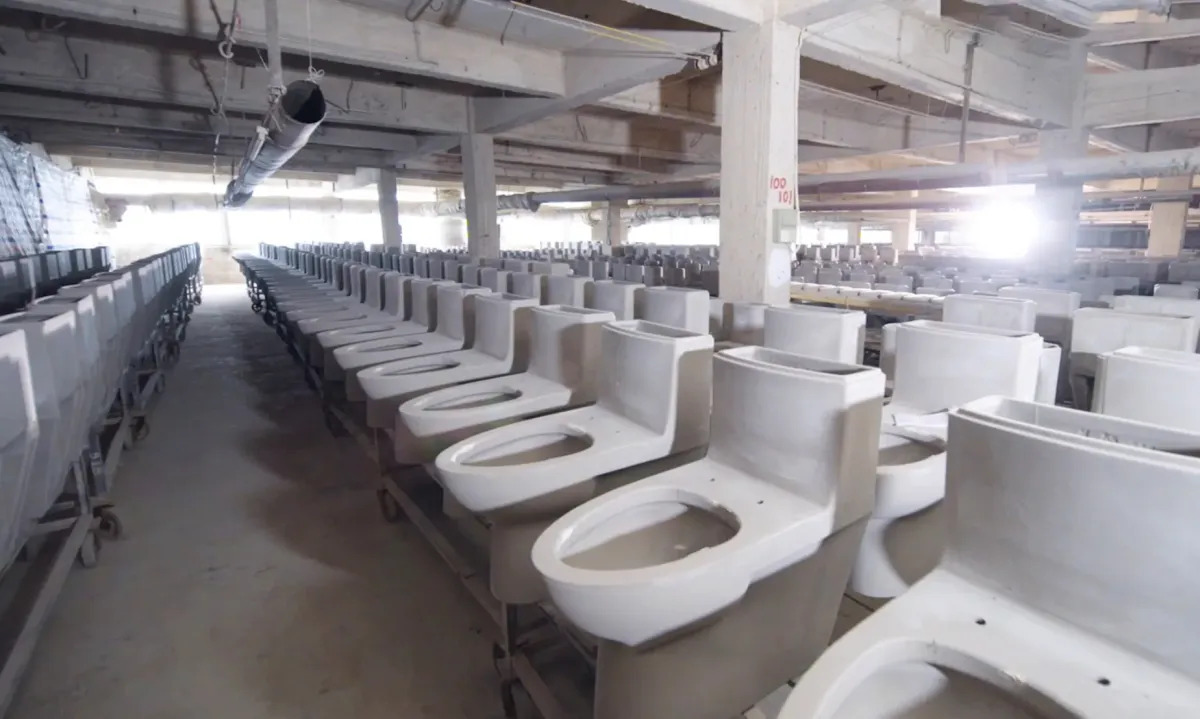
Its ceramic manufacturing process covers raw material preparation, forming, glazing, high-temperature firing, inspection, grading, packaging and shipment preparation. The factory also reports operating two 123-meter automatic high-temperature ceramic tunnel kilns, with a documented firing process of 1,280°C for 18 hours. Quality control covers ceramic surface appearance and glaze quality, dimensional inspection, water retention and leakage evaluation, flushing verification, component inspection, and final product and packaging inspection. The relevant testing requirements and acceptance criteria depend on the selected model and destination market.
MICAWA supports OEM and ODM development discussions for bathroom product buyers. Depending on the selected toilet model and approved project requirements, potential cooperation may involve existing-model selection, branding, packaging, product development, sampling and production coordination. For brands planning a private-label collection, specify the target market, product positioning, expected quantities, required documentation and branding requirements. Learn more about MICAWA OEM and ODM bathroom manufacturing, the factory and the quality process.
Final verdict: one-piece or two-piece toilet?
There is no single design that is best for every bathroom. Choose a one-piece toilet if you prioritise a streamlined appearance, easier exterior cleaning and fewer tank-to-bowl connections. Choose a two-piece toilet if you prioritise economical product options, separate component handling and the possibility of replacing a matching ceramic tank or bowl independently.
For distributors, bathroom brands and project developers, the final decision should also consider rough-in compatibility, flushing performance, available replacement components, packaging, applicable documentation and long-term supply reliability. The most effective approach is to compare specific models rather than treating all one-piece or all two-piece toilets as identical.
Technical references
- U.S. EPA WaterSense — Residential Toilets
- MaP Testing — Maximum Performance toilet testing
- IAPMO — Plumbing and mechanical codes and standards
Requirements vary by destination market and may change. Confirm current official requirements and product-specific documentation before commercial approval.
Continue reading
Toilet Rough-In Size Guide
Match 250/300/305/400 mm rough-in centerlines and S-trap vs P-trap interfaces.
Wall-Hung Toilet & Carrier Guide
Coordinate 180/230 mm bolt pitch, EN 997 load testing and concealed frames.
Siphonic vs Washdown Toilets
Choose the flush system by market, plumbing and buyer expectations.
Toilet and Basin Sourcing Checklist
Interfaces, rough-in, drawings, samples, packaging and quantities.
Standard vs Comfort Toilet Heights
Finished seat heights, ADA ranges and how to measure without ambiguity.
Complete Bathroom Package Checklist
Quantity maths and documents across the whole bathroom package.