Toilet procurement · Market selection
Siphonic vs Washdown Toilets: How to Choose for Your Market
Quick answer: A siphonic toilet uses a siphon to help pull waste through the trapway; a washdown toilet uses incoming water to push it through. Start with siphonic models when your channel expects a larger water spot, and consider washdown when a wider trapway is a priority. Confirm those features on the actual model, then check installation fit, cleaning and market documents before ordering.
Siphonic vs Washdown: Which Should You Choose?
For importers, distributors and private-label buyers, the siphonic vs washdown toilet comparison has two decisions: what your customers will accept, and what you can approve for supply. A familiar flush system can help a range sell, but an incompatible outlet or unsupported performance claim can stop the order.
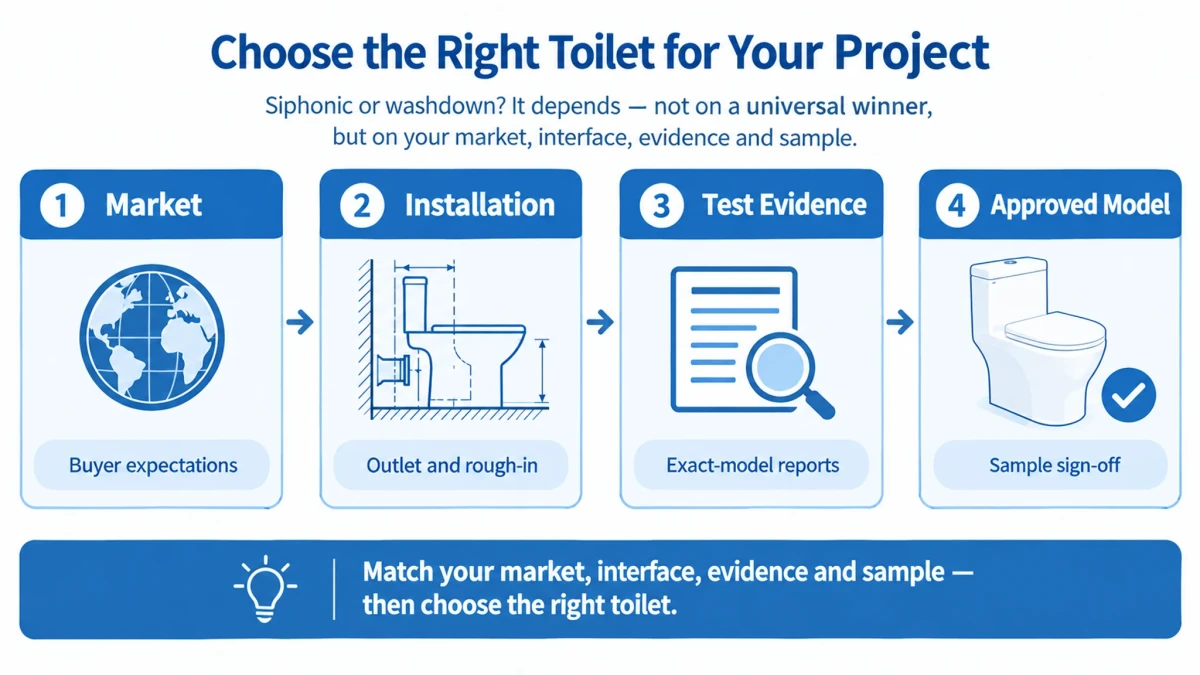
Use the flush principle to build a shortlist. Use drawings, matching test reports and an approved sample to choose the model. The distinction matters most when comparing export quotations: two toilets that look similar can have different trapways, water spots, outlet positions and cistern settings.
How the Flush Systems Work
Siphonic: Pull Through the Trapway
The trapway is the curved passage between the bowl and the drain. In a siphonic toilet, the flush creates a siphon in that passage, helping pull the bowl contents into the building drain. The bowl, water delivery and trapway must work together to establish that action. In the gravity-fed tank toilets compared here, the cistern supplies the water; siphonic describes how the bowl evacuates it.
Washdown: Push Through the Trapway
A washdown toilet moves waste through the trapway with the water discharged into the bowl, without establishing a siphon. MaP's explanation of toilet types describes the difference. MaP means Maximum Performance, a toilet testing programme. Both systems retain water in the trap to separate the room from drainage gases. The size of the visible water surface is a separate feature to inspect; it is not a measure of the seal depth.
Do Not Confuse Flush and Outlet
Treat flushing principle, outlet arrangement and body style as separate specification fields. S-trap and P-trap labels concern the trap or outlet arrangement; they do not establish whether a bowl is siphonic or washdown. “Rimless” describes the rim design, while “one-piece” describes the bowl-and-tank body. Ask for a hydraulic description and an installation drawing instead of classifying a toilet from a photograph.
Compare the Buying Trade-Offs
Water Spot and Bowl Cleaning
MaP describes a practical trade-off: washdown bowls typically have wider trapways but smaller water spots than siphonic bowls. A wider passage may reduce susceptibility to clogging, while a smaller water surface can leave more exposed ceramic where streaking occurs. Neither tendency predicts the result for every model. If your customers complain about cleaning, examine the water spot and rinse coverage together rather than choosing by trapway size alone.
| Factor | Siphonic tendency | Washdown tendency | Verify by model |
|---|---|---|---|
| Waste movement | Siphon assists removal | Water pushes waste through | Flush description and test report |
| Trapway / water spot | Often smaller passage, larger water spot | Often larger passage, smaller water spot | Section drawing and sample |
| Bowl cleaning | Depends on water coverage | Depends on water coverage | Bowl-wash results and residue checks |
| Noise / water use | No automatic advantage | No automatic advantage | Measured settings and test conditions |
| Installation | Outlet must fit the site | Outlet must fit the site | Current installation drawing |
Clearance, Noise and Water Use
A wider passage does not guarantee freedom from blockages. Ask for waste-removal results at the quoted flush settings, then review bowl washing separately: removing the load and rinsing the ceramic are different jobs. A strong-looking swirl is not a test result. For a dual-flush model, record both settings and their intended use.
Noise and Delivered Cost
There is no defensible universal noise ranking from the words siphonic and washdown alone. Compare the complete cycle, including cistern refill, under the same room and water-supply conditions. A hotel buyer may care about refill noise as much as the short flush sound. Ask what the supplier measured and how, rather than comparing recordings made in different rooms.
Likewise, neither principle establishes a lower purchase price. Compare quotations with the same seat, flushing components, connectors, packaging and document scope. A cheaper bowl can become a more expensive supply programme if it needs a different connector, extra approval work or replacement components. Record those differences beside the unit price; do not assign an invented cost premium to either system.
Match Your Destination Market
Choose the destination and sales channel before choosing the flush system. Regional habits help you identify likely candidates, but the installation and approval requirements belong to the actual country and project.
North American Channel Expectations
MaP describes siphonic toilets as common in North America. That makes them a useful initial shortlist for many distributors, not a purchasing mandate. Check local requirements, channel preferences and the exact certification scope.
European and Australian Preferences
MaP describes wider washdown use in Europe and Australia. Confirm each destination's installation and approval requirements separately. Familiar local geometry can help acceptance, but regional popularity does not establish a model's compliance.
| Buyer condition | Initial shortlist | Approval gate |
|---|---|---|
| North American channel | Consider documented siphonic models | Local fit, current listings, sample results |
| Channel familiar with washdown | Consider documented washdown models | Outlet drawing, bowl wash, market evidence |
| Fixed renovation interface | Either principle, if installation fits | Outlet location and connection clearances |
| Several destination markets | Separate model configurations | Country-specific approval records |
Mixed-Market Product Ranges
Do not assume one export model covers every country. Build separate schedules where outlet, flush setting or required evidence differs. Use MICAWA's toilet product range to begin enquiries, then narrow the configuration.
For a distributor range, document the reason each model is included. A market-facing name such as “standard,” “comfort height” or “water-saving” does not replace a hydraulic description. Keep the destination, rough-in, flush volume and approval path beside the SKU in your range plan. This prevents a buyer or sales team from moving a familiar bowl into a different country without rechecking the interface.
Where one project serves several markets, separate the approval sample from the display sample. The display can show the intended style; the approval sample must represent the bowl, cistern, valve, seat and outlet that will be shipped. Record any substitute component before quotation, because a different cistern or valve can change the tested flush behaviour.
Score the Shortlist Against the Brief
Use a simple weighted score so the most familiar design does not win by habit. Give the highest weight to the constraints that can stop an order: outlet and rough-in fit, required market documents, and the exact flush configuration. Then score bowl cleaning, noise, water use, appearance and commercial scope against the same evidence standard. Mark an item “unverified” rather than awarding a neutral score when a supplier has not supplied the document or sample. This makes the next supplier question clear and keeps a low price from hiding an approval or installation risk.
Verify the Quoted Configuration
Drawings and Installation Interfaces
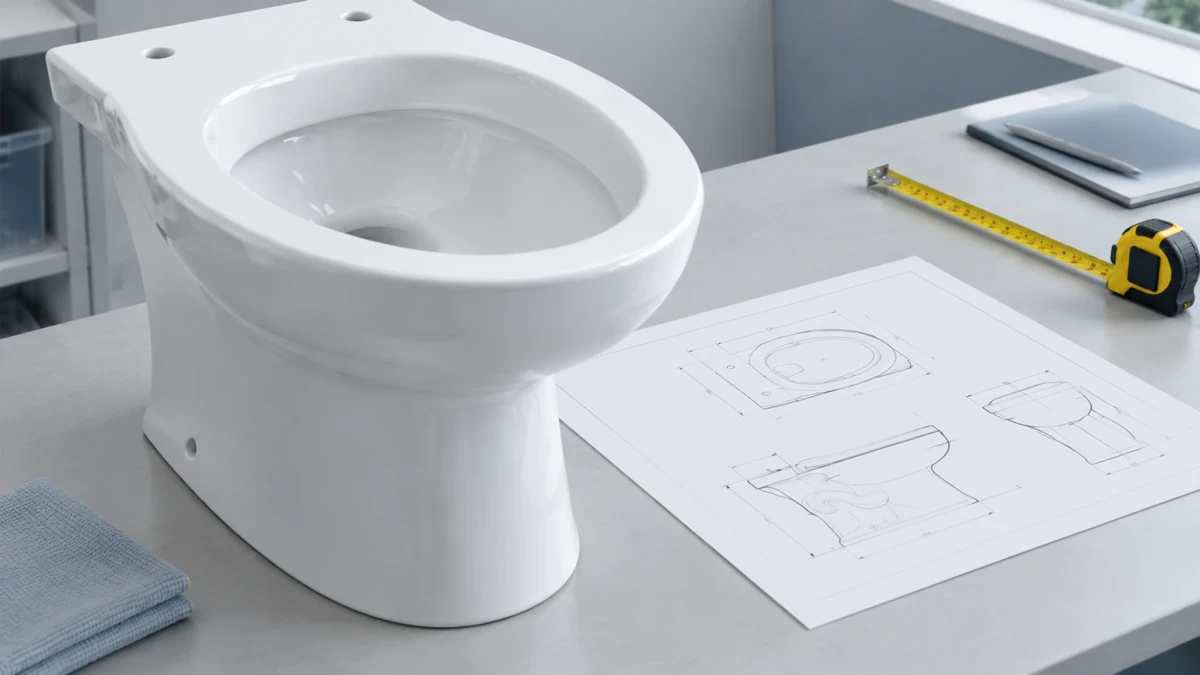
Request dimensions, outlet location, connector details and seat clearances. Rough-in is the installation reference distance to the drain connection; confirm how the supplier measures it. Use the one-piece toilet range to request candidate models and their current drawings. Identify the exact outlet version in the quotation and approved sample record. A range-level statement about available rough-ins does not establish the dimensions of the unit you will receive.
Test Reports and Market Documents
Match each report to the bowl, cistern, valve and flush settings. MaP's testing protocol uses soybean paste and toilet paper to assess waste removal. Such evidence does not prove transport through every downstream drain.
EPA's WaterSense guidance requires independent certification. As checked on October 9, 2026, EPA states that Version 1.2 remains in effect while Version 2.0's effective date is paused. Check the applicable specification and the exact model listing rather than inferring eligibility from a claimed flush volume. Request product-specific evidence before making a WaterSense claim in your own catalogue.
Samples and Cleaning Checks
Set the acceptance questions before the sample arrives. Have the supplier document the test setup and distinguish a practical buyer review from a formal laboratory test. A sample demonstration is useful for understanding operation, but it does not confer certification.
- Identify the unit. Record the bowl, cistern, valve, seat, outlet version and drawing revision. Photograph the markings and keep the packing label.
- Confirm the setup. Follow the installation instructions, use the specified fill level and check the flush settings. Record the water-supply conditions where they affect operation.
- Review separate outcomes. Record waste removal, remaining residue, water coverage, splash, refill and seat access separately. Do not reduce all of them to “good flush.”
- Close the gaps. Request missing reports, agree corrective changes and approve the final configuration in writing. Keep an identified reference sample for order comparison.
Record bowl wash, remaining residue, flush and refill noise, seat fit and access for cleaning. Use agreed repeatable conditions. For the wider document request, follow the toilet and basin sourcing checklist.
Ask who owns the test record and when it was issued. A report with no model revision, test setup or flush setting cannot be matched confidently to a quotation. Photograph the identification mark on the sample, save the drawing with the same revision, and add a sign-off line for the buyer and supplier. If the sample is changed after approval, repeat the checks that depend on the changed part.
Questions to Ask Your Supplier
Lock the Model and Evidence
- What exact model, revision and flush principle are quoted?
- Which bowl, cistern, valve and settings were tested?
- Can you supply outlet drawings and matching test reports?
- Which current market documents cover this configuration?
- How will we agree and record sample acceptance?
Confirm the Commercial Scope
- Which seat, connectors and fittings are included?
- What packaging and spare parts are offered?
- What are the minimum order and delivery terms for this version?
Keep approved samples and configuration records together. Any proposed component change should trigger a review of fit and evidence before order release.
Also ask how the supplier will identify cartons and spare parts for each configuration. For a multi-market order, packing marks should distinguish rough-in, outlet and electrical or valve variants where relevant. Agree the document pack that travels with the shipment, including the final drawing, care information and any market-specific declaration the buyer needs for customs or listing.
Frequently Asked Questions
Is a siphonic toilet always better than a washdown toilet?
No. The right choice depends on the market and the exact model. Compare bowl wash, waste clearance, water use and installation fit. A flush label is not a performance score or a market approval.
Does washdown mean P-trap, and siphonic mean S-trap?
No. Outlet arrangement and flushing principle are different choices. Ask for the outlet drawing and a written flush description separately. Do not classify a bowl from its floor or wall connection alone.
Which design should a North American distributor shortlist?
Siphonic models are a reasonable starting point, not an automatic winner. MaP describes their wide use in North America. Check channel expectations, local requirements and the exact product documents before selecting your range.
Does a low flush volume prove a toilet is WaterSense certified?
No. A volume claim does not establish WaterSense certification. Check the current listing for the exact model. EPA requires independent certification; its tank-type specification covers performance as well as water efficiency.
Can a bowl-clearance test prove drainline performance?
No. Clearing the bowl and moving waste downstream are different checks. Review drain layout, pipe conditions and the project brief separately. Do not treat a laboratory waste-removal result as proof for every building.
Does a rimless toilet have to be washdown?
No. Rim design and flushing principle describe different features. Rimless describes the upper bowl design. Ask how water is delivered and whether the trapway creates a siphon. Check bowl-wash coverage on the actual sample instead of treating rimless as a cleaning guarantee.
Can one toilet model serve several export markets?
Only when each quoted configuration meets its destination requirements. Confirm outlet position, rough-in, flush settings, installation instructions and applicable product documentation for each market. Keep separate configuration records when the bowl, cistern or supplied components differ.
How do I request siphonic and washdown options from MICAWA?
Ask for the exact models available for your market and installation. Include the requested flush principle in the enquiry and ask for confirmation against each proposed model. Review the current drawing, component list, sample and available market evidence before selecting either option.
What should I send MICAWA for a model-level comparison?
Send the market, installation drawing and acceptance checklist first. Add expected quantities, water-use targets, required documents, seat and accessory choices. Ask for a written comparison of the proposed configurations, not just catalogue photos.
Build Your MICAWA Shortlist
Shortlist the flush system that matches your channel, then reject candidates that fail the installation or documentation checks. Compare the remaining models on bowl wash, waste removal, noise and delivered cost. Start with the MICAWA toilet range and request a configuration proposal for your destination.
Send MICAWA your market and installation brief to request a configuration comparison, drawings and available evidence before sample approval.