Sanitary ware procurement guide
Toilet and Basin Sourcing Checklist for B2B Buyers
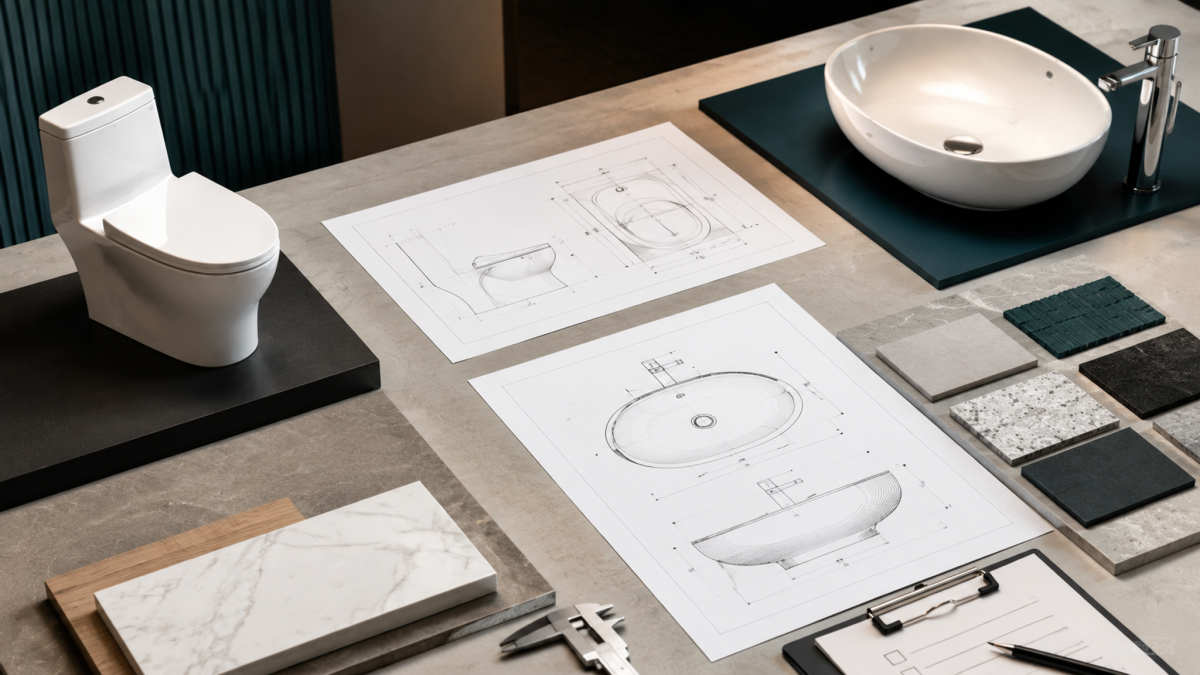
Turn a style reference into a comparable, model-level RFQ. This checklist helps importers, distributors, and project teams define toilets, urinals, and ceramic basins by installation interface, evidence, sample, quantity, and packaging—not by catalogue appearance alone.
The short answer
A dependable toilet and basin sourcing checklist has four linked records: a model schedule, an interface schedule, an evidence register, and an approval record. If one is missing, quotations that look comparable may be based on different assumptions.
Use this sequence: define the destination and application → assign an RFQ code to each item → lock installation interfaces → request model-level drawings and evidence → approve samples and packaging → release the order against one controlled revision.
1. Define the toilet, urinal, and basin scope
Start with the buying program, not the supplier catalogue. Record the destination country, sales channel or project type, installation stage, room types, required shipment window, and decision owner. These inputs determine which questions matter and which evidence must be requested.
A distributor replenishing retail models can prioritize assortment continuity, replacement parts, packaging, and market documents. A hotel buyer may prioritize repeated layouts, mock-up approval, countertop coordination, and spare units. A public-project team may need a formal submittal trail, accessibility review, installation drawings, and controlled substitutions.
Buyer decision rule
Do not ask, “Which toilet is best?” Ask, “Which current model fits this installation, market, approval process, order volume, and service plan?”
Use the broader sanitary ware category to establish scope, then separate the schedule into toilets, urinals and ceramic basins. They should not share one vague specification line because their interfaces and approval checks differ.
2. Build a model schedule before requesting prices
Assign a stable RFQ code to every required item. Keep that code on the quotation, drawing, sample label, inspection record, packaging approval, and purchase order. Supplier model numbers can change during shortlisting; your RFQ code should not.
| RFQ code | Category | Application | Quantity basis | Approval basis |
|---|---|---|---|---|
| WC-01 | One-piece toilet | Guestroom / apartment | By room schedule | Drawing + sample |
| UR-01 | Urinal | Public washroom | By floor | Plumbing drawing + submittal |
| BS-01 | Countertop basin | Hotel vanity | By room type | Basin + countertop mock-up |
| BS-02 | Undermount basin | Apartment vanity | By unit type | Cut-out + cabinet coordination |
For every field, mark the requirement as fixed, preferred, or open to recommendation. This prevents a supplier from treating a project constraint as an optional preference—or quoting a costly feature the buyer never required.
3. Collect toilet and urinal quotation inputs
Toilet selection starts with the site interface. Describe the product type, installation condition, drainage arrangement, rough-in or project drawing where applicable, water-inlet condition, dimensional envelope, required seat or cover, included components, and destination market.
- Product form: one-piece, wall-hung, smart, or another project-defined type.
- Drainage: floor, wall, S-trap, P-trap, or drawing-defined condition as applicable.
- Rough-in: required dimension and measurement reference, not a number copied from an unrelated project.
- Water inlet: site location, connection condition, access, and clearance.
- Configuration: seat, fixing kit, flush components, and accessories included in the quoted set.
- Evidence: current drawing, installation instructions, requested market documents, and packaging information.
Treat urinals as a separate line. Record mounting condition, inlet arrangement, waste outlet, flush-control scope, fixing method, accessible mounting requirement when applicable, and coordination with the plumbing design. A product photo does not show whether these conditions align.
If the requested product is electrically powered, build a separate model-level compliance file using the smart toilet certification checklist. Do not generalize electrical ratings or certificate scope from one named model to another.
4. Collect ceramic basin and countertop inputs
A basin is usually part of an assembly. Specify the basin type, dimensional limits, installation method, tap-hole arrangement, overflow requirement where applicable, waste interface, countertop condition, vanity relationship, faucet position, and quantity by room or model.
| Basin type | Critical coordination | Approval evidence |
|---|---|---|
| Countertop | Footprint, stability, faucet reach, waste, wall clearance | Product drawing + countertop layout |
| Undermount | Cut-out, rim support, fixing method, cabinet clearance | Cut-out information + mock-up |
| Pedestal | Wall/floor fixing, supply and waste routing, wall position | Installation drawing + site check |
When basin and vanity form one coordinated set, approve them together. Cabinet drawers, traps, water supplies, countertop thickness, faucet fixings, and maintenance access can compete for the same space. A dimensionally correct basin can still create an unusable assembly if these relationships are ignored.
5. Verify five installation interfaces before model approval
Interface review is what makes a procurement guide more useful than a product list. Confirm these relationships on a drawing or physical mock-up before surrounding construction is released.
- Toilet ↔ drainage: verify outlet type, site position, finished surfaces, and rough-in reference against the current model drawing.
- Toilet ↔ water inlet: check connection location, access, clearance, and whether it remains serviceable after installation.
- Basin ↔ countertop: coordinate footprint or cut-out, support, sealant line, edge distance, and fabricator tolerances.
- Basin ↔ faucet: confirm tap holes, deck thickness, spout reach, water trajectory, handle clearance, and access to fixings.
- Basin ↔ vanity and plumbing: protect drawer travel, trap space, supply routes, maintenance access, and usable storage.
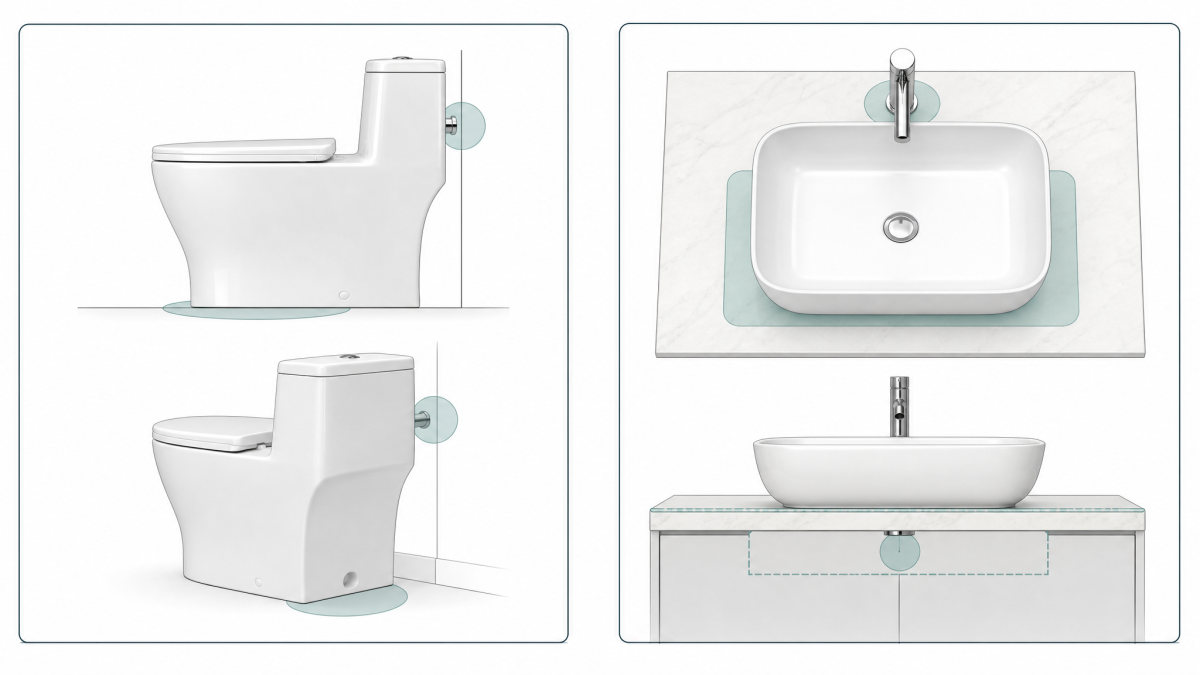
The review level should match the application. Repeated layouts in hotel and commercial washrooms make a coordinated mock-up valuable because one error may repeat across many rooms. Public engineering washrooms may add formal accessibility, submittal, durability, or maintenance requirements.
6. Confirm target-market documents by exact model
“Certified” is not a complete procurement answer. Ask which current document applies to the exact model, configuration, and destination market; who issued or owns it; which standard or program it references; and whether its scope can be verified.
For example, the U.S. Environmental Protection Agency publishes WaterSense information for residential toilets. It is a U.S. program reference, not a universal requirement or evidence that every toilet model qualifies. Where U.S. accessibility requirements apply, the U.S. Access Board’s plumbing-elements guidance addresses water closets, urinals, and lavatories, but the project team must determine how the rules apply to the facility and installation.
Evidence order
Destination market and application → applicable requirement → exact product and configuration → current evidence → unresolved conditions recorded in the quotation.
Keep category-level statements separate from model-level evidence. A supplier may manufacture a category without every model carrying the same dimensions, functions, testing, certification, or installation conditions. The quotation should state what is confirmed, what is pending, and what remains the buyer’s or consultant’s responsibility.
7. Evaluate samples and quality evidence
A sample is a controlled approval tool, not just a showroom piece. Before it arrives, create a checklist tied to the RFQ code and drawing revision. After review, photograph and record the approved configuration, deviations, and required corrections.
Toilet / urinal sample
- Model identity, appearance, and key dimensions
- Drainage, inlet, fixing, and site interfaces
- Included seat, fittings, and accessories
- Functions required by the project
- Markings, instructions, and requested evidence
- Inner protection and export packaging
Basin sample
- Shape, surface, rim, and bowl geometry
- Tap-hole and overflow configuration
- Waste, countertop, and support interface
- Faucet clearance and water trajectory
- Vanity and plumbing mock-up fit
- Packaging restraint and contact points
Do not turn one sample observation into a broad production claim. Use the approved sample alongside the signed drawing, written specification, agreed inspection criteria, and pre-shipment records. If a change affects an interface or evidence scope, reopen approval.
8. Prepare quantity, packaging, and quotation inputs
A supplier cannot build a reliable offer from a total project quantity alone. Give quantity by RFQ code, expected order pattern, sample quantity, spare-unit policy where applicable, private-label scope, packaging requirement, destination, and shipment window.
Ask the supplier to identify the packaging unit, included components, quoted currency and trade basis, validity, lead-time basis, minimum-order conditions, sample treatment, labeling assumptions, document availability, and exclusions. For mixed sanitary ware, request loading or consolidation assumptions so comparisons use the same scope.
A useful supplier response should show
- The proposed supplier model matched to each buyer RFQ code.
- Confirmed requirements, deviations, alternatives, and open questions.
- The drawings, documents, samples, and packaging information available.
- Exactly what the price includes and which assumptions it uses.
- Which decisions must be completed before production release.
9. Compare offers on risk, not unit price alone
Normalize every offer before ranking suppliers. A lower unit price may exclude the seat, fixing kit, branded packaging, market documents, sample corrections, or an interface requirement included elsewhere. Put each deviation beside the price rather than leaving it in email threads.
| Comparison area | Question to resolve | Commercial consequence |
|---|---|---|
| Model fit | Does the drawing match every fixed interface? | Redesign, site alteration, or substitution risk |
| Evidence | Which requested documents cover the exact model? | Testing, approval, or launch delay |
| Included scope | Are fittings, seats, accessories, labels, and cartons included? | Hidden landed-cost differences |
| Approval path | Can drawings, samples, and revisions meet the decision dates? | Mock-up and production schedule risk |
| After-order support | How are replacement parts, claims, and model changes handled? | Service cost and assortment continuity |
Classify unresolved points by release gate: information needed before quotation comparison, before sample approval, before purchase order, or before production. A condition that can wait until the sample stage should not block initial pricing; a drainage mismatch should. This keeps the process rigorous without making every early RFQ unnecessarily slow.
For the final commercial comparison, calculate landed implications separately from the product unit price. Packaging volume, mixed loading, sample and tooling charges, document gaps, replacement stock, and site modification can outweigh a small factory-price difference.
10. Copyable toilet and basin RFQ template
Copy this structure into a spreadsheet or procurement form. Use one product block for every RFQ code.
Project and buyer information
- Project / buyer / sales channel:
- Destination country and delivery location:
- Application, room type, sample date, and shipment window:
Product block
- Buyer RFQ code and category:
- Reference image / preferred style:
- Required dimensional envelope:
- Installation and drainage condition:
- Water inlet / waste condition:
- Countertop / vanity / faucet interface:
- Required configuration and accessories:
- Quantity and packaging scope:
Approval and evidence
- Drawing and installation instructions required:
- Sample / mock-up required and approval owner:
- Destination-market documents requested:
- Inspection or project-submittal requirements:
- Supplier to list deviations and open items: Yes
The goal is not the longest checklist. It is a quotation basis specific enough that several suppliers—or several model alternatives—can be compared without hidden differences in product, interfaces, documents, packaging, and commercial scope.
Final sourcing checklist before order release
- Every item has a buyer RFQ code and exact quoted model.
- Destination market and application are recorded.
- Current drawings match the quoted configuration.
- All installation interfaces are resolved.
- Required evidence is logged by exact model.
- Samples have controlled approval records.
- Quantity is broken down by model or room type.
- Packaging, labels, parts, and spares are agreed.
- Supplier deviations and exclusions are written.
- The order references final approved revisions.
Frequently asked questions
What information is needed for a toilet quotation?
Provide the destination market, product type, application, drainage and rough-in condition where applicable, water-inlet condition, quantity by model, required accessories, packaging needs, and requested documents. Attach the plumbing drawing when the site condition is fixed.
Can a buyer approve a basin before the countertop or vanity is selected?
Only when the remaining interfaces are genuinely flexible. For a coordinated assembly, approve the basin, cut-out or support condition, faucet position, waste, countertop, cabinet clearances, and plumbing route together.
Is a catalogue photo enough to choose a sanitary ware model?
No. A photo communicates appearance, but it does not reliably define dimensions, installation interfaces, included components, current model revision, packaging, or destination-market evidence.
Do toilet certifications apply in every country?
No. Requirements vary by product type, destination market, sales route, and project. Identify the applicable requirement first, then request current evidence that covers the exact quoted model and configuration.
When should a toilet or basin sample be requested?
Request a sample before a private-label launch, project mock-up, or volume order when dimensions, interfaces, appearance, accessories, markings, packaging, or documents need physical confirmation.
Request a model-level toilet and basin quotation
Send your destination country, product list, RFQ codes, quantities, application, reference images, and available plumbing or countertop drawings. MICAWA can review the scope, propose current models, and identify the drawings, samples, packaging inputs, and evidence still needed before approval.
Send your sourcing requirements