Material & Manufacturing Spec Guide
Vitreous China vs Porcelain & Fireclay: Sanitary Ware Engineering & OEM Spec Guide
On international sanitary ware RFQs, comparing vitreous china vs porcelain often breaks down before tooling or sampling ever starts—because importers write “porcelain toilet” as casual trade shorthand while plumbing standards enforce a strict 0.5% boiling water absorption boundary between true vitrified china and porous non-vitreous ware.
Written from inside a commercial tunnel-kiln factory, this specification guide clarifies what separates vitreous china, sintered porcelain slabs, fine fireclay, and low-fired ceramic across firing physics, linear shrinkage tolerances, plaster mold economics, defect modes, and pre-shipment quality inspection.

Quick Specification Decision Rules
- Toilets, urinals & 400–700 mm basins → Specify Vitreous China (≤0.5% water absorption): Because submerged traps and carrier bolt loads cannot rely solely on glaze integrity, demand ASME A112.19.2 / EN 997 vitreous classification—though internal kiln absorption targets (often 0.1%–0.2% on toilets and basins) also require model-level verification.
- Oversized (≥800 mm) thick flat-apron or trough sinks → Evaluate Fine Fireclay: Refractory grog lets thick straight vertical walls resist kiln slump better than standard vitreous slip—at the cost of higher shipping weight and complete dependency on an unbroken engobe and glaze seal; narrow compact oval bowls remain cheaper and sharper in vitreous china.
- Vanity countertops & zero-radius integrated slabs → Separate Dry-Pressed Sintered Porcelain from Slip-Cast Clay: Large-format 12 mm vanity slabs come from dry-pressed stone/porcelain rollers rather than gypsum bowl casting, so confirm adhesive seam specs separately when pairing with undermount ceramic basins.
- Low-cost “ceramic / porcelain” bids with no absorption spec → Flag Immediately: Un-vitrified earthenware fired below full vitrification temperature frequently exceeds 0.5% absorption, risking internal water wicking and glaze crazing in humid commercial washrooms.
Master Sanitary Ceramic Material Comparison Matrix
The engineering table below compares the four distinct ceramic classes buyers encounter when auditing sanitary ware submittals and supplier quotes. Performance thresholds reference the ASME co-published standard ASME A112.19.2 / CSA B45.1 alongside European framework principles under CEN.
| Property / Decision Factor | Vitreous China (Sanitary Standard) | Sintered / True Hard Porcelain Slab | Fine Fireclay (Refractory Body) | Low-Fired Non-Vitreous Ceramic |
|---|---|---|---|---|
| Core Body Formulation | Ball clay, kaolin, quartz silica, feldspar fluxes cast in slip form. | Refined kaolin, feldspar, quartz & mineral pigments dry-pressed under high tonnage. | Refractory clays blended with pre-fired grog (chamotte) for heavy walls. | Lower-purity clay body with reduced flux fusion. |
| Typical Kiln / Sinter Temp | High-temp vitrification (~1,200–1,280°C; MICAWA uses 1,280°C / 18 h curve). | >1,200°C roller hearth sintering (vanity slabs / architectural sheets). | Long high-temperature cycle (typically ~1,200°C) with slow thermal ramp. | Lower firing curve (often ≤1,150°C) to cut fuel cost and speed throughput. |
| Water Absorption (ASME A112.19.2) | ≤0.5% max by weight (boiling water test); factory bodies often reach 0.1%–0.2%. | Near-zero open surface porosity (≤0.5% sintered sheet metric). | Higher porous body (~3%–10%+ depending on grog mix). | >0.5% by weight (fails ASME vitreous classification). |
| Linear Shrinkage & Tolerance | ~10%–13% linear firing shrinkage; basins typically held to ±1.5 mm via jig QC. | CNC-calibrated post-sinter slab sizing (flat tolerances down to ±1 mm on 12 mm tops). | Lower shrinkage (~6%–9%) resists sag across wide vertical aprons. | Inconsistent kiln zones cause base rocking and tight rough-in variance. |
| Geometric & Span Limits | Ideal for complex internal trapways & 400–700 mm bowls; wide flat decks tend to warp. | Flat slabs & mitred square troughs only—cannot mold hollow siphon trapways. | Maintains crisp 90° walls on 750–1,200 mm double troughs and apron basins. | Unreliable on thin minimalist edges or heavy cantilevered wall brackets. |
| Glaze Dependency | Glaze adds hygiene & gloss; core body remains waterproof if surface chips. | Through-body dense matrix resists staining even at machined cut edges. | Critical: relies completely on intact glaze + intermediate engobe slip layer. | Critical: pinholes or hairline crazing wick moisture & odor into body. |
| Unit Mass & Freight Impact | Moderate-heavy wall section; optimizes pallet stack & 40HQ container density. | Dense flat crating required vertically to prevent transit flex snapping. | Significantly heavier thick-walled casting; raises ocean freight & wall-stud load. | Similar green weight, higher transit breakage rate from lower vitrified strength. |
| Primary B2B Fixture Match | One-piece, two-piece & wall-hung toilets, commercial urinals, standard & undermount basins. | Vanity countertops paired with undermount vitreous bowls or integrated top slabs. | Farmhouse kitchen aprons, deep clinical utility sinks, wide architectural slabs. | Decorative vanity trinket ware only—unsuited for commercial plumbing tenders. |
| Key Procurement Red Flag | Un-glazed raw rim bottoms or un-glazed inner trapway bottlenecks. | Mitred silicon sink seams yellowing without factory UV-grade epoxy joinery. | Assuming heavy wall weight equals low water absorption without glaze checks. | Lowest FOB quote omitting water-absorption test method or kiln curve data. |
1. Why “porcelain” means three different things on sanitary ware quotes
When a B2B buyer compares vitreous china vs porcelain, confusion almost always starts with trade vocabulary rather than chemistry. A wholesaler asking factories for “Grade A porcelain toilets” and an interior designer specifying a “porcelain vs vitreous china sink” are often describing three unrelated product families:
- Meaning A — Retail Shorthand for Vitreous China: Nearly every modern commercial toilet, urinal, and slip-cast washbasin called “porcelain” in distributor catalogs is technically vitreous china. Here, vitrification—melting silica and feldspar fluxes during kiln firing to close internal pores—produces a non-porous sanitary core.
- Meaning B — Porcelain-Enameled Cast Iron or Steel: Many North American heritage tubs and vintage utility sinks marketed as “porcelain” are actually iron or pressed steel coated in fused glass enamel, not solid ceramic. See our bathtub materials comparison guide for load-weight and chip-repair differences.
- Meaning C — Dry-Pressed Sintered Stone / Porcelain Vanity Tops: Contemporary hotel vanities frequently pair 12 mm CNC-cut sintered porcelain slab decks (for marble veining and flat edges) with separate glazed undermount vitreous china basins suspended underneath.
2. Inside the 1,280°C tunnel kiln: vitrification, shrinkage & plaster mold tooling
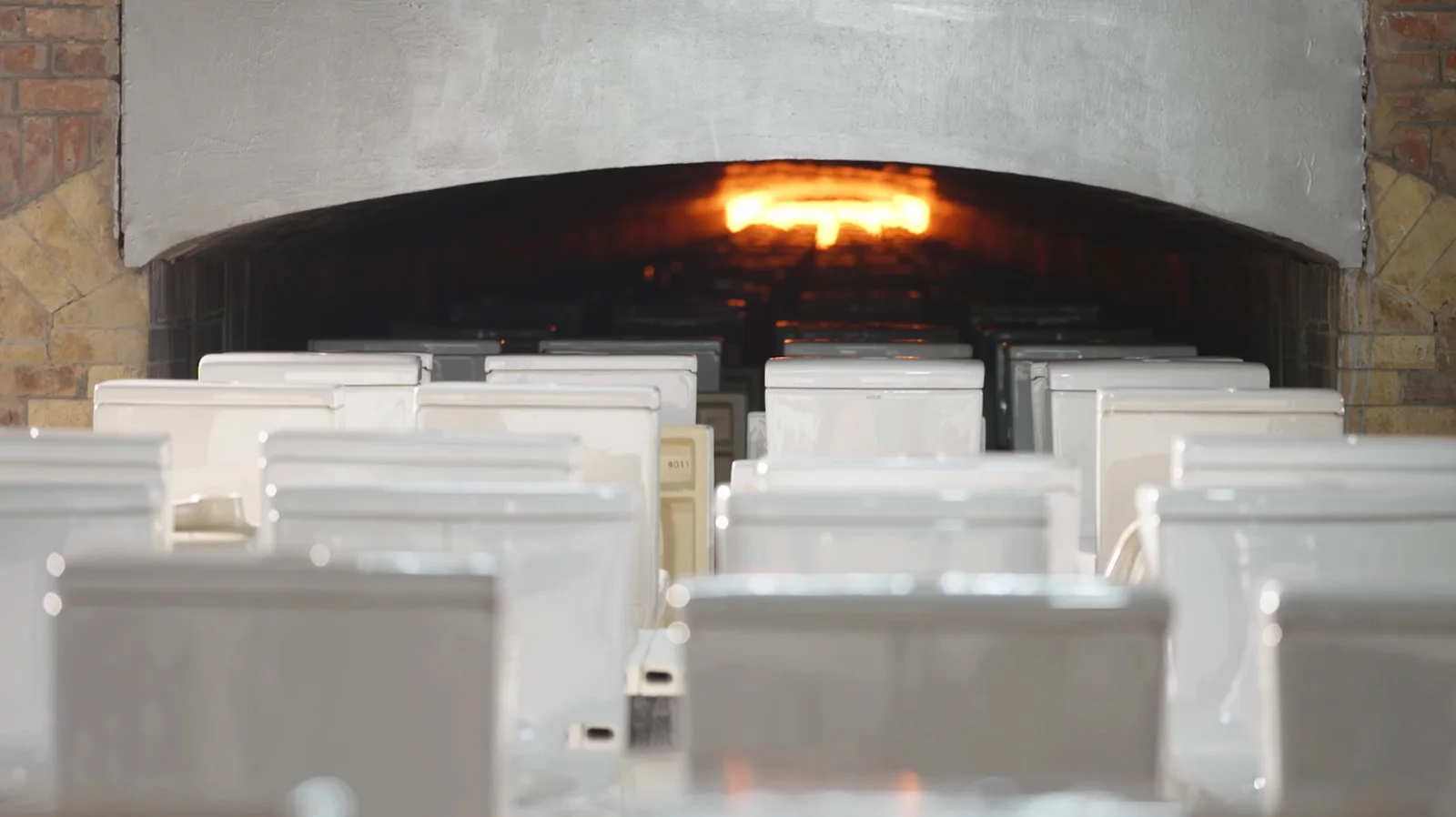
In automated sanitary ware manufacturing, the divide between vitreous china and lower-grade porcelain comes down to thermal work and tooling discipline. Inside MICAWA’s 200,000 m² Foshan production base (part of a facility operating since 2000 with company-reported capacity of up to 600,000 ceramic sanitary ware pieces annually across two 123-meter tunnel kilns), greenware fixtures move through an 18-hour firing curve peaking at 1,280°C.
That thermal profile drives three critical consequences every OEM buyer, distributor, and project specifier must design around before approving OEM / ODM custom sanitary ware:
1. Linear Shrinkage (~10%–13%) Locks Tooling
Unlike CNC-machined brass or dry-pressed sintered countertops, wet slip-cast clay loses drying moisture and shrinks substantially during 1,280°C vitrification. Every millimeter of a floor outlet rough-in (300 mm vs 400 mm), carrier bolt centerline (180 mm vs 230 mm), or undermount basin rim is scaled inversely into the wet plaster master mold before the first trial piece ever reaches the kiln. On single-body one-piece toilets, changing rough-in means casting a separate mold—not bolting on a different adapter (see our one-piece vs two-piece guide).
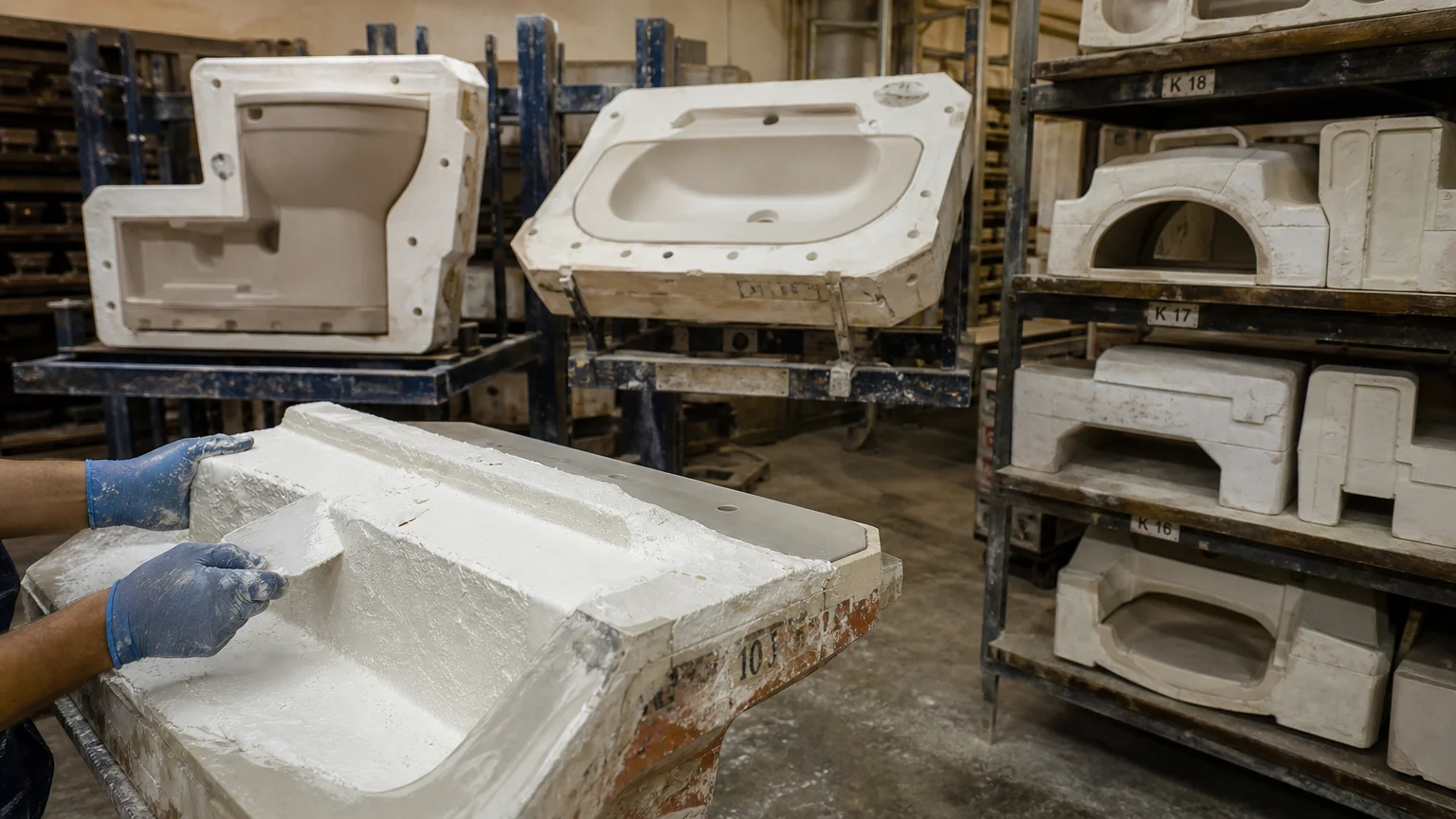
2. Plaster Mold Wear vs Repeat Order Consistency
Conventional gypsum slip-casting molds gradually erode with repeated casting cycles, slightly thickening rim radii and shifting green weight unless molds are retired on schedule and verified with dimensional gauges. Across ceramic washbasins, tight process and jig controls maintain tolerances around ±1.5 mm in published category standards—vital when dozens of basins sit flush under pre-cut CNC stone vanity countertops.
3. Fixture-by-fixture selection: toilets, undermount sinks & urinals
Knowing the difference between vitreous china, sintered porcelain, and fine fireclay translates directly into specifying the right body for each line on your sanitary ware bill of quantities:
Water Closets (One-Piece & Wall-Hung Toilets) — Always Vitreous China
Toilets hold standing trap seals continuously, experience cantilevered carrier loads on wall frames, and cast concealed rim channels and siphon trapways (≥50 mm passage diameter on category specs). Neither sintered slabs nor porous non-vitreous bodies work here. In MICAWA’s category manufacturing data, one-piece and smart toilet bodies are fired at 1,280°C with 0.1% water absorption and multi-layer glazed trapways—while buyers still confirm individual rough-in, flush volume, and destination performance testing (such as EPA WaterSense or IAPMO cUPC) per SKU.
Lavatories & Sinks (Ceramic Basins) — Match Span & Rim Profile
When buyers evaluate porcelain vs vitreous china sink quotes for hospitality vanities, bowl size decides whether vitreous china or fine fireclay wins. Compact and medium 400–650 mm oval undermount or wall-hung bowls—like MICAWA’s MP-4807 (556 × 435 × 200 mm) or MP-4862 (460 × 380 × 213 mm)—perform best in vitreous china (0.5–1.0 mm glaze, ≤0.2% absorption, ±1.5 mm dimensional tolerance in published category specs) because thin smooth rims clamp cleanly beneath quartz or sintered tops. Reserve heavier fine fireclay strictly for wide flat-bottom architectural troughs (≥800 mm) or apron utility sinks where grog stiffness resists belly sag.
Commercial Urinals — High-Pressure Vitreous Slip
High-traffic public washroom urinals face constant acidic urine exposure and chemical descaling agents. Porous non-vitreous bodies rapidly absorb odor once glaze erodes. Category manufacturing benchmarks specify high-pressure slip-cast vitreous bodies fired at 1,280°C with ≤0.5% water absorption and ≥0.22 kN flexural load resistance on units such as the MN-6805G (830 × 490 × 368 mm).
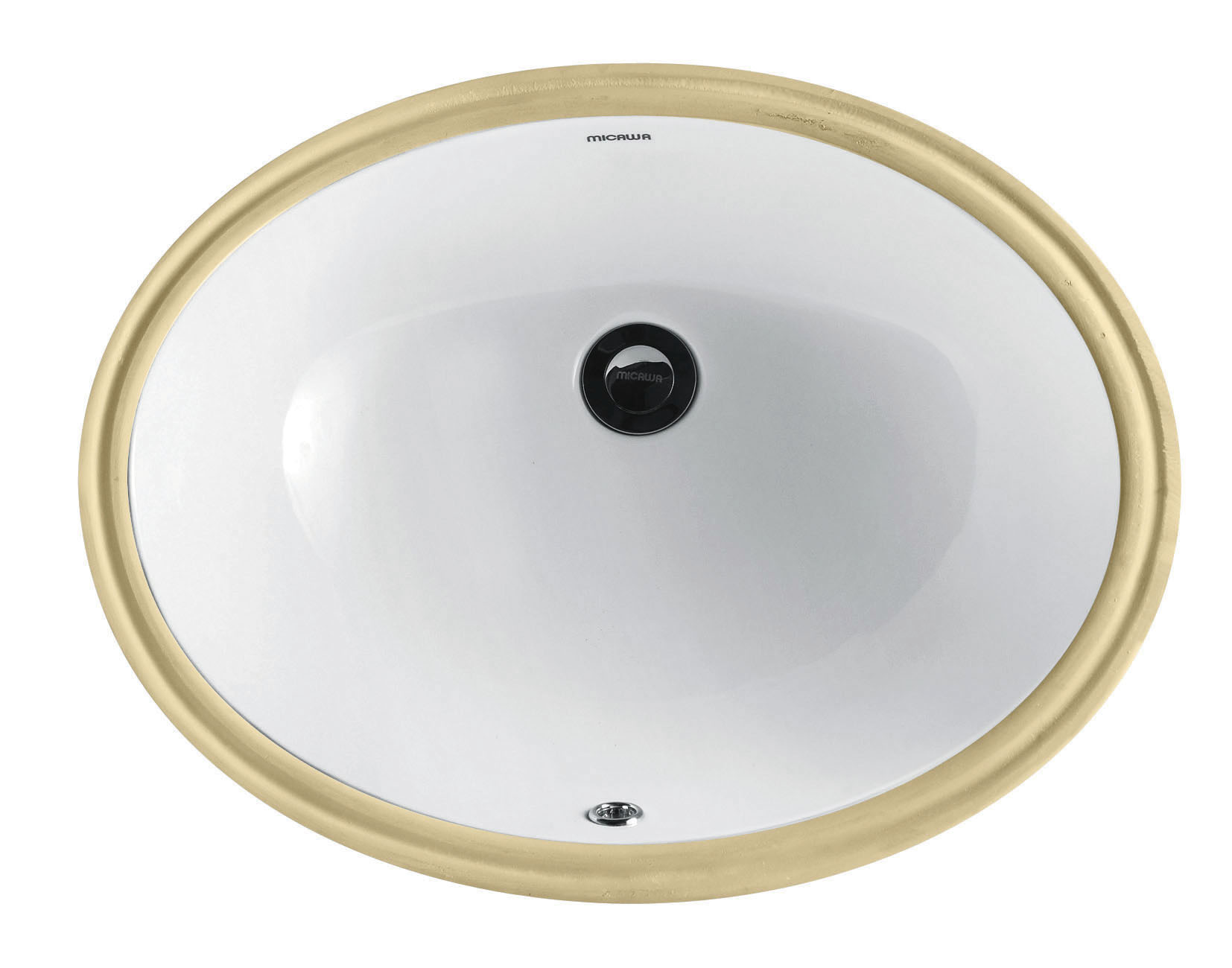
556 × 435 × 200 mm): Classic oval undermount basin requiring clean rim flatness beneath CNC stone cutouts—a core strength of vitrified ceramic tooling.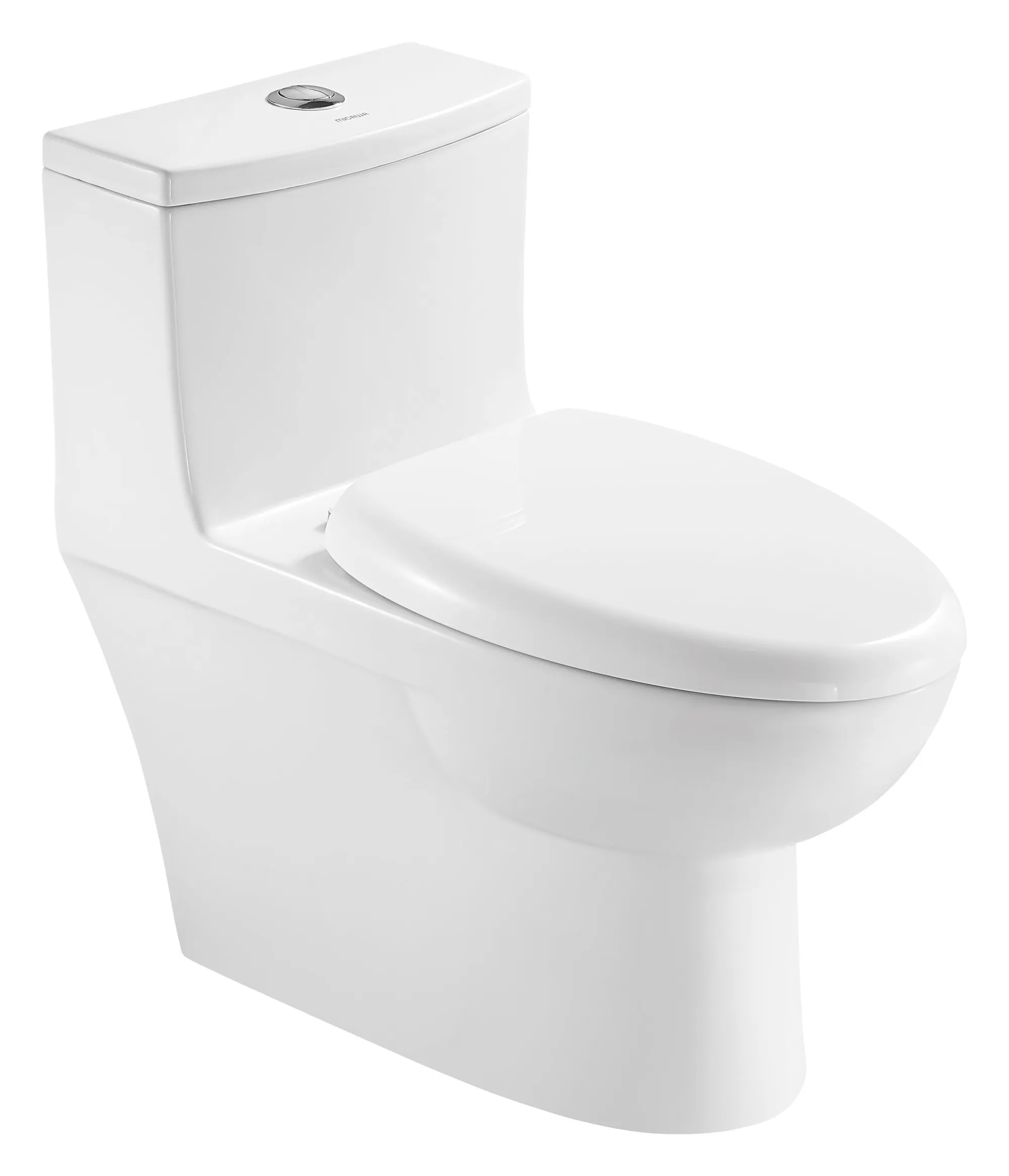
700 × 400 × 685 mm): Fully skirted one-piece body pairing vitreous china casting with dedicated 300 mm / 400 mm plaster rough-in tooling.Factory Material & Tooling Review
Send your target sink or toilet drawings for OEM ceramic feasibility review
Share model profiles, cutout tolerances, rough-in centerlines, or water-absorption targets. MICAWA’s engineering team confirms whether vitreous china or fireclay casting fits best—along with sample schedules and container quotes.
4. BOM cost drivers, kiln yield & five pre-shipment ceramic defects
Why do two visually identical white basins or toilets arrive with a 25%–40% FOB unit price gap? Beyond brand markup, ceramic unit cost is driven by four factory-floor realities—and cutting corners on any of them surfaces later as defect claims:
- Clay & Feldspar Purity: High-whiteness kaolin and low-iron feldspar raise raw slip cost but cut black iron-spot rejects after firing.
- Tunnel Kiln Fuel & Cycle Yield: Holding 1,280°C through an 18-hour soak consumes significantly more gas and kiln-car capacity per batch than rushing ware through at 1,150°C—and heavy single-body one-piece toilets experience higher firing scrap rates than smaller two-piece bowls.
- Plaster Mold Lifecycle & Manual Fettling: Retiring worn gypsum molds early preserves sharp corner lines and minimizes hand-patching seams.
- Double-Glaze & Internal Trapway Application: Applying composite glaze internally throughout flush passages costs glaze material and labor, while protecting against organic build-up and siphon friction.
Five Ceramic Defects to Screen Before Shipment
Inspect first-article samples and pre-shipment AQL lots against documented quality protocols and our toilet sample inspection protocol for these five structural failures:
| Defect Mode | Manufacturing Root Cause | Field / Buyer Risk | Pre-Shipment QC Check |
|---|---|---|---|
| 1. Under-fired core (>0.5% absorption) | Insufficient kiln temperature or fast firing curve leaving open clay capillaries. | Fails ASME/EN vitreous tests; water wicks into clay; odor & spalling. | Ink dye / boiling water absorption test on broken sherd coupon. |
| 2. Delayed glaze crazing | Thermal expansion mismatch between glaze coefficient and clay body contraction. | Spiderweb hairline cracks appear 3–12 months post-installation. | Alternating hot-and-cold cycle / autoclave thermal shock test. |
| 3. Rim & base warpage | Uneven kiln car airflow or inadequate setter support under wide flat decks. | Undermount sinks leave unsightly silicone gaps; floor toilets wobble on tile. | Granite flat-table feeler gauge check against dimensional drawing tolerances. |
| 4. Un-glazed trapway throat | Incomplete internal pouring during trapway glazing pass. | Sandpaper-rough channel snags waste paper and ruins MaP flush scores. | Endoscope / gloved-finger sweep into rear and lower S-bend passage. |
| 5. Pinholes, crawling & iron spots | Dust contamination on greenware, trapped air in slip, or iron specks in raw clay. | Fails Grade A visual inspection; exposes micro-pits in high-light surfaces. | Lux-controlled visual booth inspection at 600–800 mm viewing distance. |
5. Seven supplier questions & pre-order material checklist
Attach these seven verification prompts directly to your toilet and basin RFQ checklist before confirming tooling or releasing a deposit:
- Written Vitreous Classification: Confirm the ceramic body meets ≤0.5% water absorption (ASME A112.19.2 / EN method), and ask for the factory’s target firing temperature curve (e.g., 1,280°C kiln spec).
- Separate Undermount vs Apron Specs: On lavatory lines, clarify whether compact bowls use vitreous china and wide thick-wall troughs use fine fireclay (with verified engobe + glaze system).
- Flatness & Cutout Tolerance: Confirm rim flatness and outer-dimension tolerances (e.g., ±1.5 mm benchmark range on ceramic basins) against your CNC countertop fabrication shop drawings.
- Trapway Glazing Scope: Verify whether internal toilet trapways receive complete composite glazing (≥50 mm passage diameter targets where applicable) and ask for sample cutaways or inspection video.
- Rough-In Tooling Confirmation: Lock exact rough-in spacing (300 mm vs 400 mm floor outlet; 180 mm vs 230 mm wall-hung bolts) as distinct mold SKUs before ordering.
- Model-Matched Destination Certificates: Never substitute factory ISO 9001 certificates for SKU-level cUPC, WaterSense, WaterMark, or CE test reports when required by project code.
- Approved Golden Sample & Packaging Spec: Seal a signed pre-production sample covering glaze color, flatness, accessory compatibility, MOQ, and export carton drop protection (request terms per order via MICAWA).
Need verified technical sheets, glaze samples, or custom tooling?
Send your model list, basin cutout drawings, or OEM private-label brief to FOSHAN MICAWA CERAMICS CO., LTD. We confirm exact model specs, sample availability, MOQ, lead times, and coordinated container quotes directly from our Foshan factory.
Authoritative Standards & Manufacturing Sources
- ASME — Co-publisher of ASME A112.19.2 / CSA B45.1 Ceramic Plumbing Fixtures (defining the ≤0.5% boiling water absorption boundary between vitreous china and nonvitreous/fireclay ceramic bodies).
- IAPMO — Uniform Plumbing Code & cUPC Product Listing Authority (third-party North American plumbing fixture compliance and testing protocols).
- U.S. EPA WaterSense — Tank-Type Toilets Specification (independent model-level flush efficiency and waste-extraction criteria distinct from raw clay absorption).
- CEN-CENELEC — European Committee for Standardization (standardization framework governing EN 997 WC pans and EN 14688 ceramic washbasins).
- MICAWA Ceramic Manufacturing Knowledge Base (
FOSHAN MICAWA CERAMICS CO., LTD.— Since 2000; 200,000 m² base, two 123 m kilns, 1,280°C / 18-hour vitrification curve, and published category-level ceramic QC benchmarks).
Related Sanitary Ware Sourcing Guides
How to Inspect Toilet Samples Before Ordering
Dimensional verification, glaze checks, trapway inspection, and written sample sign-off rules.
Toilet and Basin Sourcing Checklist for B2B Buyers
Structure rough-in interfaces, flushing specs, packaging, and drawings for accurate factory quotes.
One Piece vs Two Piece Toilet: 7 Key Differences
Compare single-body casting yield, kiln footprint, container loading efficiency, and hotel maintenance.
What Are Bathtubs Made Of? 7 Materials Compared
Contrast glazed ceramic fixtures against porcelain-enameled steel, cast iron, acrylic, and stone resin.