Product guide
What Are Bathtubs Made Of? Complete Materials Guide
If you are planning a bathroom renovation or comparing bathtub products, you may wonder: What are bathtubs made of?
The answer depends on the bathtub's construction, intended application, and price range.

If you are planning a bathroom renovation or comparing bathtub products, you may wonder: What are bathtubs made of?
The answer depends on the bathtub's construction, intended application, and price range.
Modern bathtubs are manufactured from several materials, including acrylic, fiberglass, enameled cast iron, enameled steel, solid-surface composites, natural stone, and copper.
Each material has different characteristics that influence the bathtub's weight, appearance, maintenance requirements, installation, and long-term performance.
For homeowners, choosing the right material can affect comfort and cleaning.
For bathroom distributors, hotel developers, and wholesale buyers, material selection also influences packaging, transportation, product positioning, and replacement planning.
Quick Answer: What Are Most Bathtubs Made Of?
Comparing reinforced acrylic build specs for a project or wholesale range? See MICAWA’s 5-layer fiberglass-reinforced acrylic bathtubs (≥4.2 mm sheet, 304 stainless steel frame).
Many modern residential bathtubs are made from acrylic or fiberglass-reinforced materials.
Other common options include porcelain-enameled cast iron and porcelain-enameled steel.
Premium bathtub designs may use solid-surface composites, natural stone, copper, or other specialty materials.
Acrylic bathtubs are popular because they are relatively lightweight and can be formed into many shapes.
Cast iron bathtubs are known for their substantial construction and durable enamel surfaces, while fiberglass products often provide economical lightweight options.
However, no material is automatically the best choice for every bathroom.
The quality of the complete bathtub construction matters just as much as the material name.
This guide compares seven bathtub material categories and explains how to choose the right one.
1. Common Bathtub Materials Compared
Before examining each material, the following table summarizes their general characteristics.
Bathtub Materials Comparison Chart
| Material | General Weight Tendency | Main Advantages | Main Considerations |
|---|---|---|---|
| Acrylic | Relatively light | Versatile shapes, smooth surface, practical maintenance | Reinforcement and surface quality vary |
| Fiberglass | Relatively light | Economical, flexible manufacturing | Surface wear and finish quality require attention |
| Enameled cast iron | Heavy | Rigid construction, durable enamel finish | Transportation, structural loading, enamel damage |
| Enameled steel | Moderate, depending on construction | Rigid metal body, smooth enamel surface | Noise, insulation, coating protection |
| Solid surface / stone resin | Moderate to heavy | Premium appearance, varied shapes and finishes | Weight, composition, repair method |
| Natural stone | Heavy | Distinctive natural appearance | Structural loading, sealing, maintenance |
| Copper | Varies by thickness and construction | Distinctive appearance, specialty design | Surface patina, care requirements, cost |
*These are general material tendencies. Actual weight, durability, thermal behavior, and cost depend on the specific product and construction.*
Why Bathtub Construction Matters
A bathtub is not always made from one material.
For example, an acrylic bathtub may have an acrylic surface supported by fiberglass and resin reinforcement.
A porcelain-enameled bathtub has a metal body covered by a glass-like enamel surface.
A solid-surface bathtub may use a composite of mineral fillers and resin.
Therefore, a complete material specification should describe both the visible surface and the underlying structure.
2. Acrylic Bathtubs
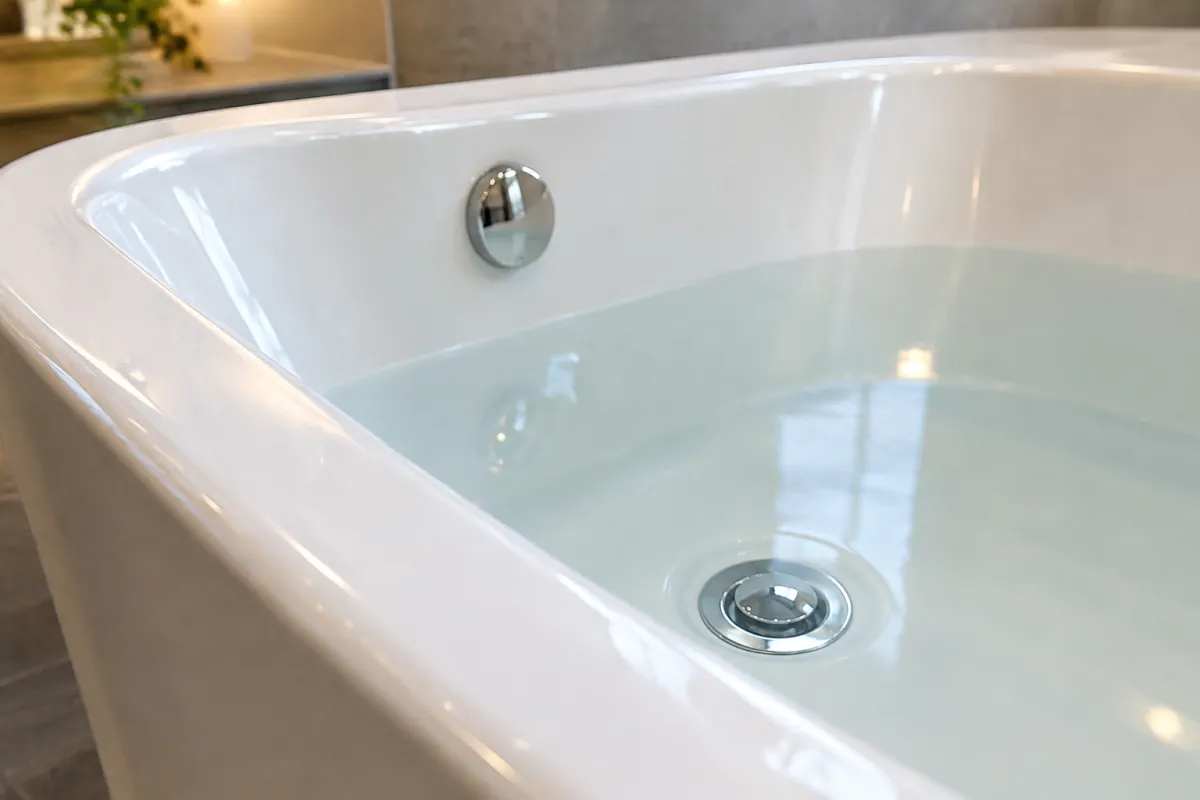
Acrylic is one of the most widely used materials in contemporary bathtub manufacturing.
Acrylic bathtubs are commonly produced by heating an acrylic sheet and forming it into the required shape.
The formed shell is then reinforced to provide structural support.
What Is an Acrylic Bathtub Made Of?
A typical reinforced acrylic bathtub includes an acrylic bathing surface and a supporting structure.
Depending on the manufacturer, the construction may include fiberglass-reinforced resin, additional reinforcement layers, and a supporting frame.
The exact construction varies by product.
This distinction is important because two products described as acrylic bathtubs may have different sheet thicknesses, reinforcement methods, and structural performance.
Advantages of Acrylic Bathtubs
Lightweight construction
Acrylic bathtubs are generally lighter than traditional cast iron bathtubs.
This can simplify transportation and handling during installation.
Flexible design options
Acrylic can be formed into many shapes.
This makes it suitable for freestanding, skirted, built-in, and selected specialty bathtub designs.
Smooth bathing surface
Acrylic provides a smooth surface that can be comfortable to touch and relatively easy to clean.
Practical maintenance
Some superficial marks may be repairable using manufacturer-approved methods.
However, the appropriate repair process depends on the acrylic surface and the extent of the damage.
Disadvantages of Acrylic Bathtubs
Acrylic surfaces can be scratched or damaged by unsuitable cleaning products.
The structural performance of the bathtub also depends on the quality of its reinforcement and support system.
A poorly supported bathtub may flex excessively during use.
Buyers should therefore compare the complete construction rather than selecting a product based only on the word "acrylic."
Where Are Acrylic Bathtubs Commonly Used?
Acrylic bathtubs are frequently selected for residential bathrooms, apartments, hotels, and contemporary bathroom collections.
They are particularly useful when a project requires a balance between design flexibility, manageable weight, and practical installation.
3. Fiberglass Bathtubs
Fiberglass bathtubs are another common lightweight option.
They are typically manufactured using fiberglass-reinforced resin with a surface coating, often called gelcoat.
What Is a Fiberglass Bathtub Made Of?
Fiberglass refers to glass fibers used to reinforce a resin structure.
In a typical fiberglass bathtub, the reinforced body is formed using a mold.
A gelcoat surface provides the visible finish.
This construction differs from a bathtub that uses a separately formed acrylic sheet as its bathing surface.
However, both acrylic and fiberglass bathtubs may contain fiberglass reinforcement.
Advantages of Fiberglass Bathtubs
Fiberglass bathtubs can be relatively economical to manufacture.
They are generally lightweight and can be formed into different configurations.
This makes them attractive for selected budget-conscious residential applications.
Some surface damage can also be repaired by professionals using suitable materials.
Disadvantages of Fiberglass Bathtubs
The gelcoat surface may show wear, scratches, or discoloration over time.
The degree of wear depends on the product quality, cleaning methods, and usage conditions.
Some fiberglass constructions may also feel less rigid than heavier alternatives.
This is not a universal characteristic of every fiberglass bathtub.
Reinforcement design and installation support are important.
4. Acrylic vs Fiberglass Bathtubs
Acrylic and fiberglass bathtubs are often compared because both can be relatively lightweight.
However, they are not identical.
Acrylic vs Fiberglass Comparison
| Feature | Acrylic Bathtub | Fiberglass Bathtub |
|---|---|---|
| Typical visible surface | Formed acrylic sheet | Gelcoat |
| Supporting construction | Often fiberglass/resin reinforcement | Fiberglass-reinforced resin |
| Weight | Generally lightweight | Generally lightweight |
| Design flexibility | High | High |
| Surface maintenance | Depends on acrylic finish | Depends on gelcoat finish |
| Repair method | Product-specific | Product-specific |
| Price tendency | Often higher | Often more economical |
Which Material Is Better?
Acrylic may be preferred when buyers want a smooth, formed surface and a broad selection of contemporary designs.
Fiberglass may be attractive when initial cost is a major consideration.
However, the correct choice depends on the actual product.
A high-quality fiberglass bathtub may perform better than a poorly constructed acrylic bathtub in a particular application.
For wholesale sourcing, compare the complete material structure, sample quality, reinforcement, and installation requirements.
5. Cast Iron Bathtubs
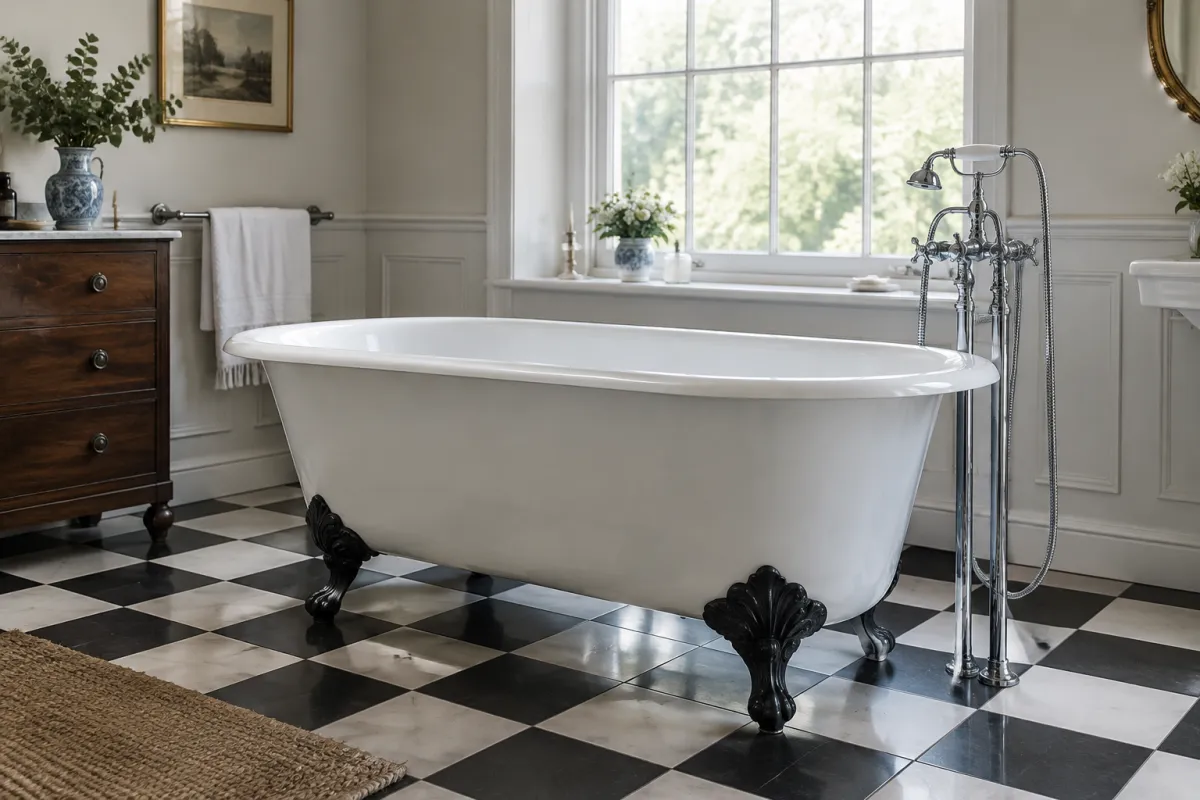
Cast iron is a traditional bathtub material known for its heavy and rigid construction.
Cast iron bathtubs are typically manufactured by casting the metal body into the required shape.
The surface is then finished with porcelain enamel.
What Is a Cast Iron Bathtub Made Of?
A traditional enameled cast iron bathtub consists of a cast iron body covered with a durable enamel coating.
The enamel provides the smooth visible bathing surface.
The metal structure provides rigidity and substantial weight.
Advantages of Cast Iron Bathtubs
Rigid construction
Cast iron provides a strong and stable bathtub body.
Durable enamel surface
A properly manufactured enamel finish can provide good resistance to everyday wear.
Traditional appearance
Cast iron bathtubs are often associated with classic and premium bathroom designs.
Substantial feel
The weight and rigidity can create a solid, stable bathing experience.
Disadvantages of Cast Iron Bathtubs
The most significant consideration is weight.
A cast iron bathtub can be much heavier than an acrylic bathtub of similar external dimensions.
This affects transportation, installation, and structural planning.
The enamel surface can also chip if subjected to sufficient impact.
Repairing damaged enamel may require specialized methods.
Are Cast Iron Bathtubs Better Than Acrylic?
Not necessarily.
Cast iron may be attractive when rigidity, enamel durability, and traditional appearance are priorities.
Acrylic may be more practical when weight, design flexibility, and transportation are important.
The best choice depends on the bathroom structure, installation conditions, and project requirements.
6. Porcelain-Enameled Steel Bathtubs
Steel bathtubs are commonly manufactured using formed steel covered with a porcelain-enamel surface.
They are sometimes described as porcelain-on-steel bathtubs.
What Are Steel Bathtubs Made Of?
A steel bathtub has a formed metal body.
The surface is coated with porcelain enamel, which creates a hard, smooth finish.
Some products also use additional backing or insulation materials.
Advantages of Steel Bathtubs
Steel provides a rigid structure.
Porcelain enamel creates a smooth bathing surface.
Depending on the construction, steel bathtubs can be lighter than traditional cast iron products.
They may also be suitable for standardized residential installations.
Disadvantages of Steel Bathtubs
The enamel surface can chip if damaged by a strong impact.
Some steel bathtubs may produce more noticeable sound when water strikes the surface.
Insulation and supporting construction can influence this behavior.
Thermal performance also depends on the complete bathtub design rather than the steel material alone.
Is a Porcelain Bathtub Made Entirely of Porcelain?
Usually not.
In bathtub product descriptions, "porcelain" often refers to the enamel surface applied over a metal body.
The underlying structure may be cast iron or steel.
This is why buyers should ask whether a bathtub is porcelain-enameled cast iron or porcelain-enameled steel.
7. Solid Surface and Stone Resin Bathtubs
Solid-surface and stone-resin bathtubs are often selected for premium contemporary bathrooms.
These products are generally manufactured using composite materials.
What Is a Stone Resin Bathtub Made Of?
Stone-resin bathtubs commonly combine mineral fillers with resin binders.
The exact composition varies by manufacturer.
Some products use a mineral-rich cast body, while others use different composite constructions or surface finishes.
The terms "stone resin" and "solid surface" are not always used consistently across manufacturers.
Therefore, the exact composition should be confirmed from the product specification.
Advantages of Stone Resin Bathtubs
Stone-resin bathtubs can provide a substantial appearance and a smooth, contemporary finish.
They may be available in matte or glossy surfaces.
The casting process can support different shapes and design details.
Some solid-surface products also allow limited surface restoration using manufacturer-approved methods.
Disadvantages of Stone Resin Bathtubs
Weight can be a major consideration.
Depending on the material composition, a stone-resin bathtub may be considerably heavier than an acrylic model.
The cost is also often higher.
Maintenance requirements vary according to the surface chemistry and finish.
A cleaning product suitable for one solid-surface bathtub may not be appropriate for another.
Stone Resin vs Acrylic
Acrylic generally offers a lighter construction and a wide range of formed designs.
Stone resin may be preferred for certain premium finishes and sculptural forms.
However, neither material guarantees better durability or thermal performance without product-specific evidence.
For project purchasing, compare actual weight, surface properties, structural requirements, and repair procedures.
8. Natural Stone Bathtubs
Natural stone bathtubs are made from materials such as marble, granite, or other suitable stone.
They are usually associated with premium or highly customized bathroom designs.
Advantages of Natural Stone
Natural stone provides distinctive colors, patterns, and textures.
Each bathtub may have unique visual characteristics.
The material can also create a substantial architectural appearance.
Disadvantages of Natural Stone
Natural stone bathtubs can be extremely heavy.
This makes structural assessment and delivery planning important.
Some stone surfaces may require sealing or special maintenance.
The appropriate cleaning method depends on the stone type and finish.
Natural stone bathtubs are generally less suitable for projects where low weight and economical volume distribution are the main priorities.
9. Copper Bathtubs
Copper bathtubs are a specialty option.
They are typically formed from copper sheet and may use different construction and finishing methods.
Advantages of Copper Bathtubs
Copper provides a distinctive appearance that can suit traditional or luxury bathroom designs.
Its surface can develop a natural patina over time.
Some buyers value this changing appearance as part of the material's character.
Disadvantages of Copper Bathtubs
Copper bathtubs can be expensive.
Their appearance may change through oxidation and exposure to water or cleaning products.
Buyers who want a consistent original finish should understand the manufacturer's care requirements.
The actual weight depends on the copper thickness, construction, and bathtub size.
Copper is generally a specialty material rather than a standard option for large residential developments.
10. Which Bathtub Material Retains Heat Best?
Heat retention is a common consideration when comparing bathtub materials.
However, it is important to distinguish between the thermal properties of a material and the performance of a complete bathtub.
Material vs Complete Bathtub Construction
The rate at which bathwater cools depends on several factors.
These include the initial water temperature, water volume, room temperature, bathtub surface area, insulation, and material construction.
A bathtub with additional insulation may perform differently from another bathtub made from the same basic material.
Acrylic Bathtubs
Acrylic and reinforced composite constructions can provide practical thermal comfort.
However, the actual heat-retention performance depends on the complete shell and reinforcement system.
Cast Iron Bathtubs
Cast iron has substantial thermal mass.
It can absorb a significant amount of heat when first filled with hot water.
Once warmed, its thermal behavior differs from that of a lightweight bathtub.
However, this does not mean every cast iron bathtub will keep water warmer for longer than every acrylic bathtub.
Stone Resin Bathtubs
Stone-resin products also vary significantly.
Their thermal behavior depends on the resin, mineral composition, wall thickness, and overall design.
The most reliable comparison uses product-specific test conditions rather than a universal ranking of bathtub materials.
11. Which Bathtub Material Is the Most Durable?
Durability depends on how the bathtub is used and maintained.
Different materials have different failure modes.
Scratch Resistance
Surface hardness and finish quality influence scratch resistance.
Acrylic, enamel, and solid-surface materials respond differently to abrasive contact.
Impact Resistance
A bathtub may resist scratches but still be vulnerable to impact damage.
For example, porcelain enamel can chip under sufficient impact.
Structural Stability
The bathtub must support water and user loads.
For acrylic and fiberglass products, reinforcement and support design are particularly important.
Long-Term Maintenance
Cleaning products, water chemistry, temperature exposure, and installation quality can affect long-term appearance.
A durable bathtub is not simply the one with the hardest surface.
It is the one whose construction and maintenance requirements match the intended application.
12. How Much Does Bathtub Material Affect Weight?
Weight is one of the most important differences between bathtub materials.
Acrylic and fiberglass products are generally lighter than traditional cast iron bathtubs.
Natural stone and some solid-surface products can also be heavy.
However, exact weight depends on the bathtub's dimensions and construction.
Empty Weight vs Installed Load
When evaluating a bathtub, distinguish between its empty weight and the load when filled with water and occupied.
For example, 160 liters of water has a mass of approximately 160 kilograms.
This is an illustrative water quantity, not the published capacity of a specific MICAWA bathtub.
The total load also includes the bathtub, users, and any additional equipment.
Structural suitability should be assessed according to the project requirements.
Why Weight Matters for Wholesale Buyers
Bathtub weight affects packaging, handling, transportation, and installation.
For international distributors, the actual product weight and packed dimensions should be reviewed before confirming container loading arrangements.
A lightweight bathtub may simplify some handling operations, but the final logistics plan must still account for packaging protection and product shape.
13. How to Identify Bathtub Material
If you are unsure what a bathtub is made of, the most reliable method is to check its product documentation.
Check the Manufacturer's Technical Sheet
The technical sheet should identify the surface material and construction.
For composite products, request the relevant material description and reinforcement information.
Review the Product Label
Some bathtubs include model or material information on a label.
This can help identify the manufacturer and product family.
Inspect the Construction
The underside or an accessible unfinished area may reveal reinforcement or substrate materials.
However, appearance alone is not sufficient to identify the complete construction.
Avoid Relying on Sound or Touch Alone
Informal methods such as tapping the bathtub or judging whether the surface feels warm can be misleading.
Different reinforcement systems and installation conditions can change how a bathtub sounds or feels.
For purchasing decisions, written product specifications are more reliable.
14. MICAWA Bathtub Materials and Product Examples
MICAWA supplies bathtub products for residential, hospitality, and wholesale applications.
Its published bathtub category includes acrylic configurations and several installation styles.
MICAWA Bathtub Product Examples
| Model | Published Product Type | Dimensions (L × W × H) | Material Information |
|---|---|---|---|
| M-1750ZQ | Full-skirt acrylic soaking bathtub | 1750 × 800 × 600 mm | One-piece thermoformed acrylic with integrated overflow |
| M-1609ZQ | Classical freestanding bathtub | 1600 × 700 × 800 mm | Acrylic sheet ≥4.2 mm with Barcol hardness ≥40, five-layer fiberglass-reinforced core |
| M-1753ZQ | Full-skirt freestanding bathtub | 1700 × 800 × 600 mm | Matte acrylic with a five-layer composite core |
| MC-1608 | Hydrotherapy massage bathtub | 1600 × 850 × 680 mm | Sanitary acrylic shell, structural fiberglass backing and galvanized steel frame |
*These are current published product references. Basin capacities, packed weights, drain configurations and component specifications differ by model and must be confirmed on the current technical sheet. See the MICAWA bathtub catalog.*
MICAWA Acrylic Bathtub Construction
MICAWA's published bathtub manufacturing information describes selected acrylic configurations using reinforced construction.
The company identifies category-level capabilities involving acrylic sheets, composite reinforcement, surface inspection, and structural support.
These capabilities should not be assumed to apply identically to every bathtub model.
MICAWA's published bathtub information states that its bathtubs use sanitary-grade acrylic sheet of at least 4.2 mm, with Barcol hardness of at least 40, backed by a five-layer fiberglass and resin composite. The M-1609ZQ is one published example of that construction.
Those figures describe the manufacturer's published acrylic specification. Buyers should still confirm sheet thickness, reinforcement, load rating and drain configuration on the technical sheet for the exact model being ordered.
What Should Buyers Verify?
For an acrylic bathtub, request the material structure, reinforcement details, support system, product weight, and relevant inspection information.
For a massage bathtub, also confirm the electrical and mechanical components.
For a freestanding bathtub, review the material, finish, installation method, and drainage arrangement.
Explore the MICAWA bathtub product range for current models, and the bathtub sizes and dimensions guide for footprint planning.
15. How to Choose the Best Bathtub Material
The best bathtub material depends on the bathroom application.
For Small Residential Bathrooms
A lightweight acrylic or fiberglass bathtub may be practical when transportation and installation are important considerations.
However, the final selection should also consider size, support, and maintenance.
For Family Bathrooms
Durability, cleaning convenience, and practical replacement options are important.
Acrylic, fiberglass, and enameled metal bathtubs can all be suitable when properly specified.
For Luxury Bathrooms
Solid surface, natural stone, copper, and selected premium acrylic designs may be considered.
The choice depends on the desired appearance, budget, and installation conditions.
For Hotels
Hotels should evaluate material durability, cleaning requirements, maintenance access, replacement planning, and consistent product specifications.
The selected bathtub should match the room design and expected operating conditions.
For Wholesale Distribution
Distributors should consider the target market, price positioning, packaging requirements, product assortment, and available technical documentation.
A balanced product range may include several bathtub configurations rather than relying on one material for every customer.
16. Bathtub Material Checklist for B2B Buyers
Before placing a wholesale bathtub order, confirm the following information.
| Requirement | What to Verify |
|---|---|
| Surface material | Acrylic, gelcoat, enamel, solid surface, or other |
| Supporting structure | Reinforcement, backing, or metal body |
| Material thickness | Applicable technical specification |
| Product weight | Empty product weight |
| Load requirements | Installation and structural conditions |
| Surface performance | Relevant product-specific testing |
| Cleaning | Approved cleaning and maintenance instructions |
| Repair | Available repair methods and limitations |
| Dimensions | Exact length, width, height, and interior space |
| Drainage | Drain and overflow configuration |
| Packaging | Protection, carton dimensions, and handling |
| Documentation | Applicable product and destination-market requirements |
| Samples | Approved material, finish, and construction |
| Quantity | Required models and order configuration |
These details help buyers compare products using measurable requirements rather than general material descriptions.
17. MICAWA Bathtub Manufacturing and OEM/ODM Support
MICAWA is a bathroom products manufacturer based in Foshan, China.
Its current company information describes bathtub production, product development, sampling, inspection, and export packaging.
MICAWA reports annual bathtub production capacity of 10,000 sets within its manufacturing operations.
The company also supports OEM and ODM development discussions for bathroom brands, distributors, and project buyers.
Product Development
Buyers can provide their target market, product positioning, preferred bathtub configuration, and expected quantity.
The manufacturer can then review suitable existing models or discuss development requirements.
Material and Sample Approval
Before volume production, the selected material, finish, dimensions, and construction should be confirmed.
A physical sample or approved representative product can help verify appearance and installation compatibility.
Quality Review
Bathtub inspection should be based on the approved model and specification.
Relevant checks may include surface appearance, dimensions, assembly interfaces, drainage components, and packaging protection.
Product-specific test results and applicable compliance documents should be reviewed separately.
Learn more about MICAWA quality control and OEM/ODM bathtub development.
Conclusion: What Are Bathtubs Made Of?
Bathtubs are made from several materials, including acrylic, fiberglass, enameled cast iron, enameled steel, solid surface, natural stone, and copper.
Each material offers different advantages.
Acrylic provides lightweight construction and design flexibility.
Fiberglass can offer economical options.
Cast iron provides substantial rigidity and a durable enamel surface.
Steel, stone resin, natural stone, and copper offer additional choices for different bathroom applications.
However, material names alone do not determine bathtub quality.
The complete construction, reinforcement, finish, installation, and maintenance requirements should all be considered.
For homeowners, the best material is the one that matches the bathroom and daily usage.
For distributors and project buyers, product-specific technical information and approved samples are essential.
Looking for an Acrylic Bathtub Manufacturer?
MICAWA supplies bathtub products for bathroom distributors, private-label brands, hotels, and residential developments.
Share your target market, preferred bathtub material, required dimensions, estimated quantity, and customization requirements to discuss suitable product options.
Sources and standards
- IAPMO — publishes the ANSI Z124 standards for plastic bathtub units, including ANSI Z124.1.2.
- European Committee for Standardization (CEN) — EN 198, sanitary appliances: baths made from acrylic sheets.
- ASTM International — ASTM F462, standard consumer safety specification for slip-resistant bathing facilities.
- ISO — ISO 9001 quality management systems, the framework behind factory inspection and traceability requirements.
Related guides
Bathtub Sizes & Dimensions: Standard Size Guide
Alcove, freestanding, skirted and corner footprints, plus published MICAWA model dimensions.
Faucet, Bathtub and Shower Screen Sourcing Guide
Matching fittings and enclosures to the selected tub.
MICAWA Bathtub Catalog
Current models and configurations.