Tankless Smart Toilet Buying Guide
Tankless Smart Toilets: How They Work, Water Pressure and Buying Guide
A tankless smart toilet eliminates the tall exposed rear cistern, delivering a compact silhouette powered either by a direct-valve mains flush or by a concealed built-in reservoir with pump assistance hidden inside the ceramic skirt. Before ordering or installing one, verify two distinct site constraints: hydraulic supply pressure and flow for reliable flushing and bidet washing, and a dedicated bathroom-protected electrical circuit within cord reach.
If building water pressure is low or unstable, switching from a direct-valve tier to a built-in-tank tier inside MICAWA’s tankless and zero-water-pressure smart toilet range can mitigate peak mains-pressure drops without changing the exterior silhouette. By contrast, a compliant electrical supply remains mandatory for every smart toilet—hydraulic changes cannot solve a missing power point.

What Is a Tankless Smart Toilet and How Does It Work?
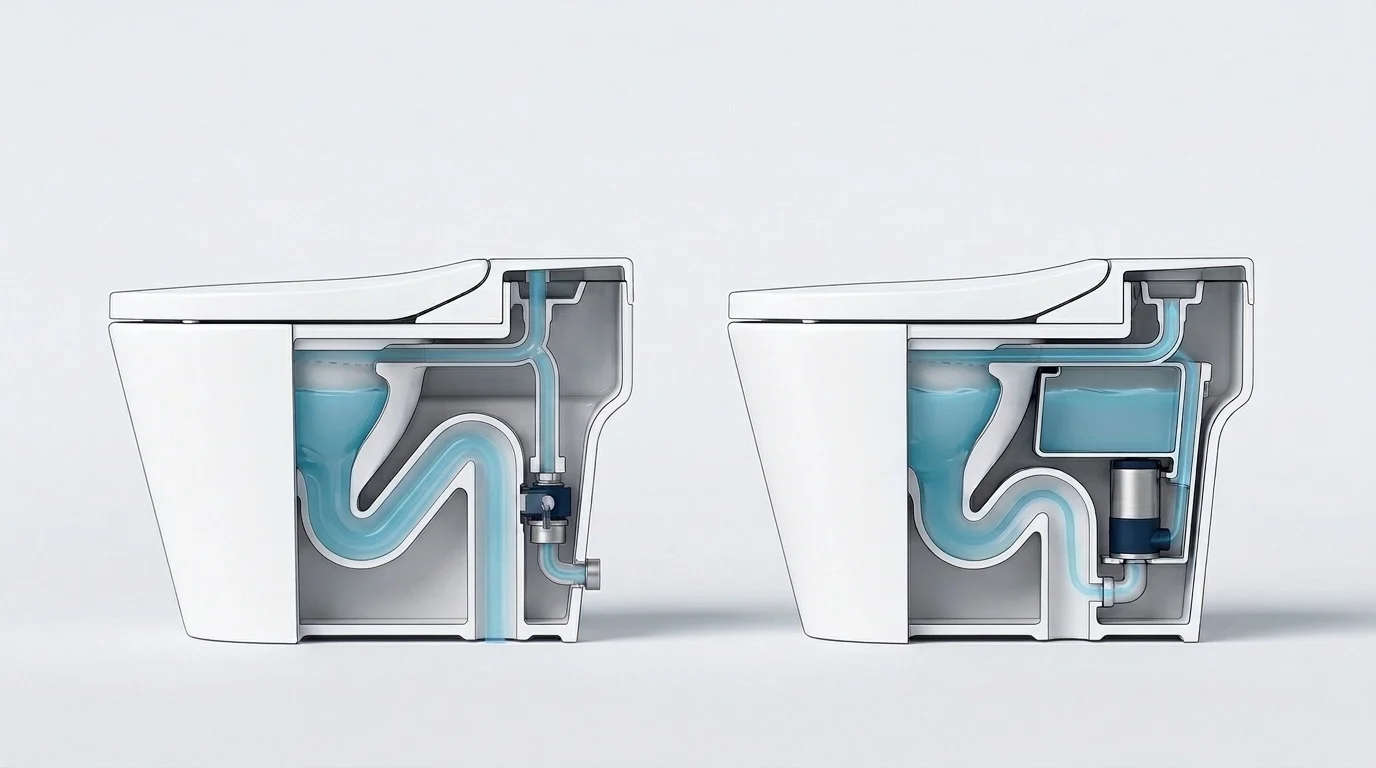
In market terminology, “tankless” describes the outside profile—an integrated toilet with no exposed porcelain tank—rather than guaranteeing that zero water storage exists inside the ceramic body. Across commercial and residential projects, a tankless smart toilet routes flushing energy through one of three internal setups, while washing water is typically heated on demand rather than held in a warm-water storage tank.
- 1. Direct-valve tankless (no internal flush reservoir): When flushed, an electronically controlled inlet valve admits mains supply water directly into the rim and siphon jet channels. Only this design is truly tankless inside as well as outside (
MB-1865A,MB-1960FP/FPJ/AM/AMJ,MB-1871FP/AM). - 2. Concealed built-in-tank / dual-pump smart toilet: A compact internal reservoir hides inside the rear skirt of the ceramic pan and feeds an internal pump or dual-pump drive—often marketed as a “zero-water-pressure” feature (
MB-1865AS/AJS,MB-1960FS/FSJ/AS/ASJ,MB-1871FS/AS,MB-1876B). - 3. Wall-hung smart toilet with concealed carrier: The tankless bowl mounts onto a structural in-wall steel carrier frame containing a hidden gravity cistern and concealed power junction (
MB-2889ASJ).
Tankless vs Built-In Tank Smart Toilets: Which Flushing System Is Better?
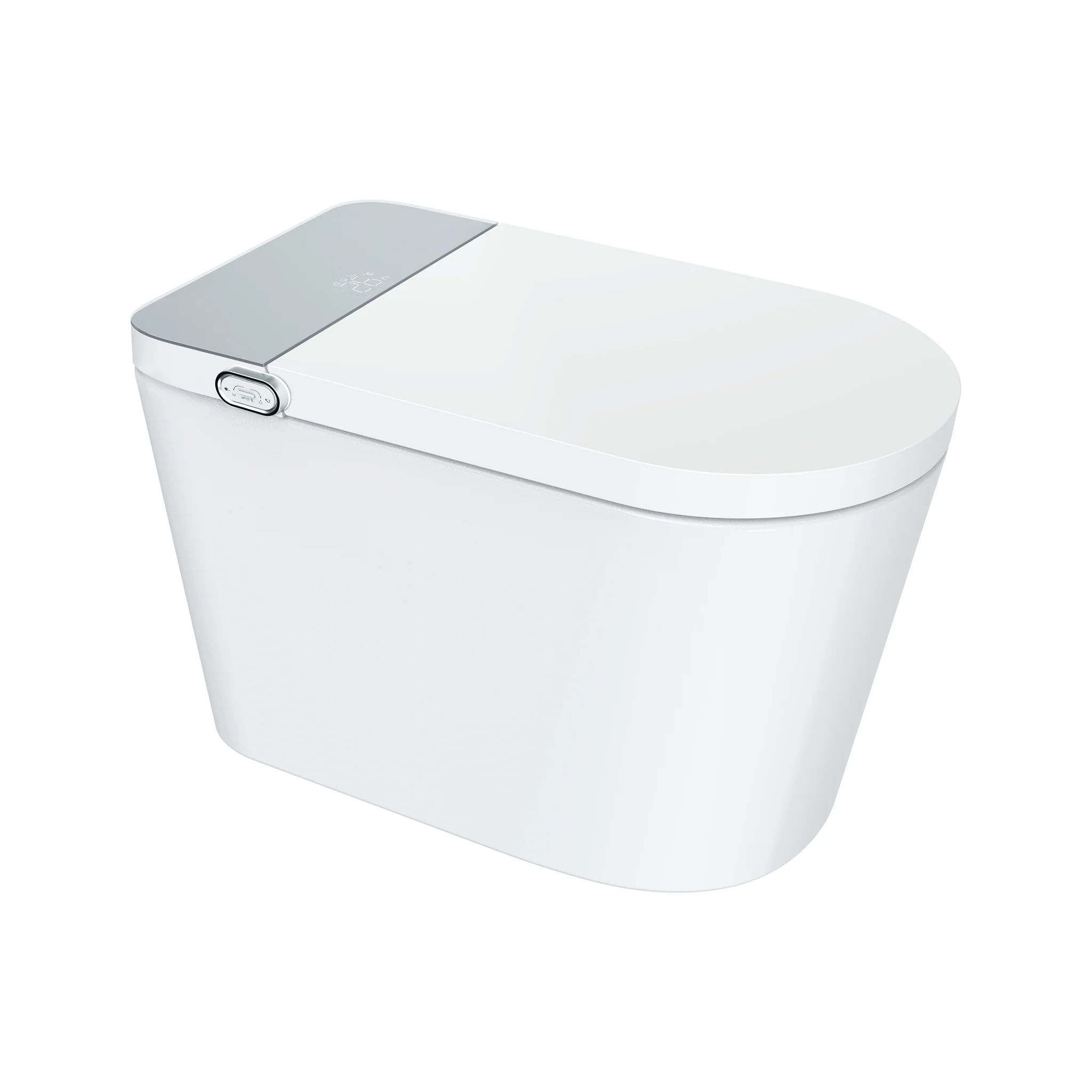
Neither system wins everywhere: when comparing a direct-valve tankless vs tank smart toilet (concealed built-in reservoir), direct-valve designs are mechanically simpler when building supply flow is high, whereas built-in-tank designs isolate single-flush power from low or fluctuating riser pressure at the cost of extra internal components and refill intervals.
| Engineering Factor | Direct-Valve Tankless | Built-In Tank Smart Toilet |
|---|---|---|
| Flush water source | Instantaneous building water supply | Internal concealed reservoir + booster/pump system |
| Dependence on instantaneous mains supply | High — drops directly if mains pressure or pipe flow sags | Lower for the single flush cycle (still relies on supply to refill) |
| Low-pressure adaptability | Requires strict site flow & dynamic pressure verification | Generally better suited to low-pressure risers or gravity tanks |
| Consecutive-flush limit | Governed by continuous building supply capacity | Governed by internal reservoir volume and refill rate |
| Internal components | Inlet filter, solenoid/flush valve, piping & bidet heater/PCB | Adds internal water tank, pump assembly, level sensing & check/air-gap hardware |
| Internal packaging space | Less congested inside the rear ceramic cavity | Tighter internal layout requiring careful hose and pump packaging |
| Primary maintenance focus | Inlet mesh filter cleaning and solenoid/valve servicing | Pump assembly, reservoir components, inlet valves & sensors |
| Power-outage flushing | Depends on battery backup / manual override (e.g., 9V on MB-1865A) | Depends on higher-capacity battery / override (e.g., 12V on MB-1865AS/AJS) |
| Typical site fit | Stable pressurized buildings with clean, adequate branch piping | Low-flow risers, roof tanks, upper hotel floors (verify refill spec) |
A common procurement pitfall: because MB-1865A (direct valve) and MB-1865AS (built-in reservoir) share the same 685 × 407 × 436 mm outer shell, unboxed units look nearly identical to site plumbers. Always write the full model suffix on the room schedule, specify suffix-marked cartons and pallets, and verify incoming cartons at unloading rather than after installation.
Tankless Smart Toilet Pros and Cons
Weighing tankless smart toilet pros and cons comes down to whether your project values compact geometry, continuous instant-warm washing, and touchless automation more than mechanical simplicity and zero electrical dependence.
Advantages
- Lower physical profile:
436–500 mmoverall height eliminates bulky rear cisterns under mirrors, ledges, and tight powder rooms. - Continuous instant-heated washing: Demand heating avoids lukewarm tank depletion and standby reservoir heat loss.
- Hands-free hygiene tiers: Off-seat auto flush, foot sensors, microwave/radar lids, UV nozzle care, and
360°foam shields where specified. - Fewer exposed dirt traps: Smooth skirted exteriors and optional rimless bowls simplify housekeeping wipe-downs.
Trade-Offs & Limitations
- Mandatory electrical rough-in: Every unit requires a properly positioned, code-compliant bathroom power outlet.
- Hydraulic sensitivity: Direct-valve models fail on weak flow; even built-in-tank units need verified refill and bidet water supply.
- Proprietary service parts: PCBs, inlet valves, pumps, and sensors cannot be replaced at a local hardware store—spares must be planned.
- Power-outage dependence: Heated seat, wash, and sensors drop offline during blackouts; emergency flush depends on battery condition.
| Selection Option | Installation Complexity | Core Strengths | Where It Fits Best |
|---|---|---|---|
| Regular Gravity Toilet | Lowest (no wiring) | Works in outages; generic fill valves & flappers | Utility washrooms, budget rentals, dry-outage zones |
| Regular Toilet + Bidet Seat | Moderate (needs side power outlet) | Heated seat & warm wash with easy seat swap-out | Retrofits retaining an existing ceramic bowl |
| Integrated Tankless Smart Toilet | Highest (hydraulic + power + exact rough-in) | Low-profile aesthetics, auto flush/lid, Lite-to-Flagship tiers | Master baths, apartments, hotels & hospitality suites |
Room-tiering rule of thumb: assign full wash-and-dry units to master bathrooms and executive hotel suites where guests use them daily, and consider heated-seat Lite models (such as MB-1960FS or MB-1871FS, which omit the wash wand) or standard ceramic toilets in secondary or high-turnover rooms.
What Water Pressure Does a Tankless Smart Toilet Need?
Evaluating tankless toilet water pressure requirements requires checking both static pressure and live dynamic flow—because published numbers vary sharply across brands and models. In MICAWA’s current specifications, direct-valve MB-1865A lists 0.1–0.75 MPa static, while MB-1960 direct models list 0.15–0.75 MPa paired with strictly > 3.8 L in 15 seconds (roughly 15.2 L/min or 4.0 GPM). By comparison, high-demand direct-supply commercial units from other manufacturers—such as the Kohler Veil K-5401, whose spec sheet calls for a minimum supply flow rate of 9 GPM (~34.1 L/min)—demonstrate why a single flow figure cannot be treated as a universal benchmark across all tankless toilets.
| Technical Parameter | Engineering Meaning | Why It Matters on Site |
|---|---|---|
| Static Pressure | Resting line pressure when zero fixtures are drawing water | Establishes baseline supply limits (e.g., upper 0.75 MPa cap requiring a PRV) |
| Dynamic Pressure | Actual pressure remaining at the valve while water is actively flowing | Reveals friction and pressure drops during flush or peak hotel demand |
| Flow Rate | Water volume delivered per unit time (L/min, GPM, or L / 15 s) | Determines whether a direct flush receives enough water mass in seconds |
| Reservoir Capacity | Usable water stored inside a built-in-tank smart toilet | Governs single-flush volume independence from mains surges |
| Refill Time | Seconds needed to replenish the concealed tank after a flush | Determines how soon a second consecutive flush runs at full strength |
| Flushing Performance | Actual waste clearing, trapway transport & bowl wash efficacy | Validates the complete ceramic + hydraulic system, not supply PSI alone |
Preliminary 15-Second Bucket Flow Check (And Its Limits)
When assessing an MB-1960 direct-pipe site—where the datasheet specifies strictly greater than 3.8 L in 15 seconds (> 3.8 L) rather than “at or above”—a timed bucket check at the open bathroom angle stop provides a practical preliminary site screening. Test during peak morning demand rather than on an empty floor: if flow fails to exceed > 3.8 L, direct-pipe MB-1960 models should not be specified. Remember two boundaries: (1) a 15-second bucket test does not by itself qualify final installation across other models or brands that require higher flow (such as 9 GPM) or narrower dynamic pressure curves, and (2) install a pressure-reducing valve if static pressure can exceed 0.75 MPa.
Instant Heating Power Balance: Why Winter Inlet Water Affects Wash Flow
Low water pressure is not the only supply constraint on a tankless smart toilet: incoming water temperature directly caps continuous instant bidet heating through the steady-state thermodynamic balance P = ṁ · cp · ΔT (where P is thermal heating power in watts, ṁ is water mass flow rate in kg/s, cp is water’s specific heat capacity at 4,184 J/(kg·K), and ΔT is temperature rise from cold inlet to target spray temperature).
This physics explains why a smart toilet feels warmer in summer than in sub-zero winters: at 10°C inlet water and 0.6 L/min, heating to 38°C requires 1,172 W of pure thermal transfer before thermal losses—109% of a 1,080 W budget. (Note: this is a theoretical heat-balance example ignoring heat loss, not MICAWA lab data, and catalogued 1080W ratings cover rated whole-unit input rather than isolated net heater output.) In winter climates, verify heater staging and spray flow behavior on a cold-water sample test.
Built-In Tank Refill and Consecutive Flushing
In a built-in-tank smart toilet, the first flush draws water already waiting inside the concealed reservoir, while consecutive back-to-back flushes depend on reservoir volume, live inlet refill speed, and debris clearance at the inlet filter. Understanding this refill cycle prevents specifying a pump-assisted unit into a high-traffic zone without checking recovery time.
- Initial vs. consecutive flushes: Even when a mains riser momentarily drops while adjacent showers run, the first flush uses stored reservoir water. Immediately triggering a second flush, however, waits for the tank to refill through the inlet valve.
- Why inlet screens fail first: Fine mesh inlet screens protect valves, pumps, and instant heaters from pipe scale. In renovated buildings with galvanized piping, restricted screens slow reservoir refill and weaken bidet spray—position the shutoff valve where staff can clean the screen in minutes.
- Sample test before bulk sign-off: During sample inspection at your project’s lowest expected supply condition, time one complete refill cycle and run consecutive flush checks alongside bidet washing to confirm the hydraulic package meets site expectations.
Can a Tankless Smart Toilet Flush Without Electricity?
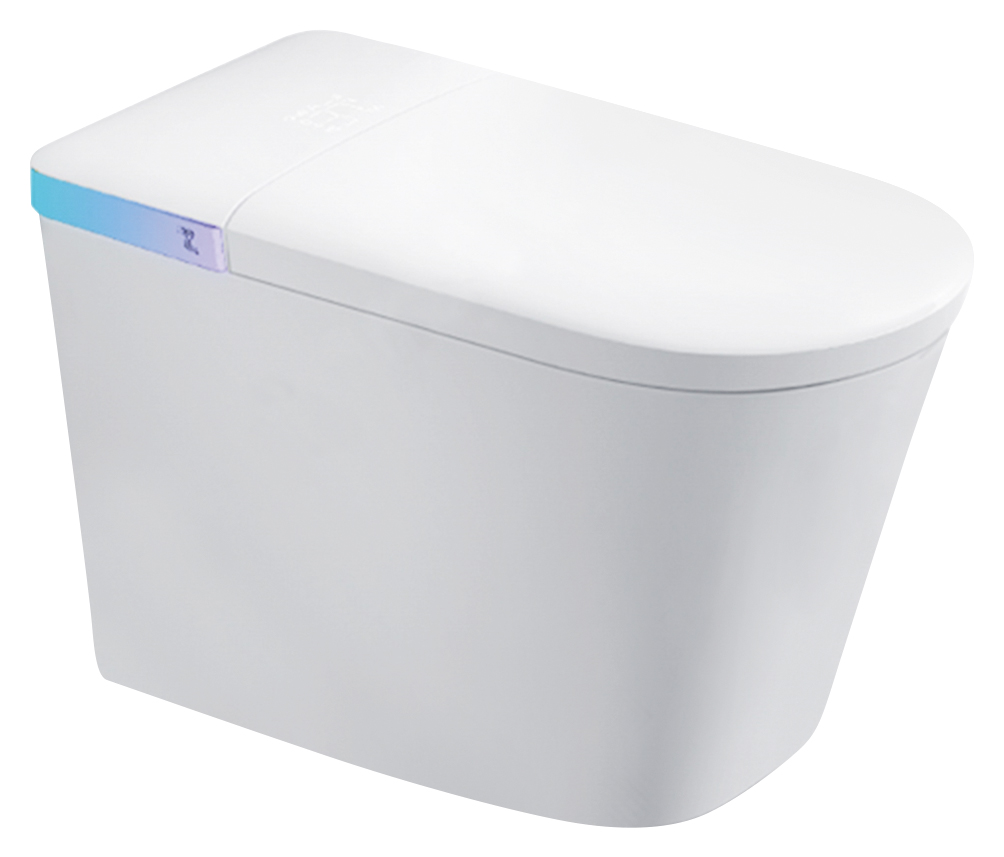
Yes—understanding tankless toilet power outage behavior starts with one distinction: comfort electronics (seat heater, instant wash heater, dryer, and sensor lid) stop immediately when grid power drops, while bowl flushing remains usable if the model includes an emergency battery backup or mechanical bypass.
- Battery specs vary within a series: On MICAWA’s
MB-1865series, direct-valveMB-1865Alists a 9V backup battery, whereas built-in-tankMB-1865ASandMB-1865AJSlist a 12V battery—they are not directly interchangeable. Verify battery voltage on any other model’s spec sheet. - Unplug during sample inspection: Disconnect power on the approved sample and operate the outage flush control. Confirm staff can access the battery bay without demounting the toilet from the floor.
- Treat it as temporary contingency: Place a discreet outage-flush instruction card in hotel guestrooms and log battery checks under annual preventive maintenance so dead batteries are not discovered during a blackout.
How Ceramic Engineering Affects Tankless Smart Toilet Performance
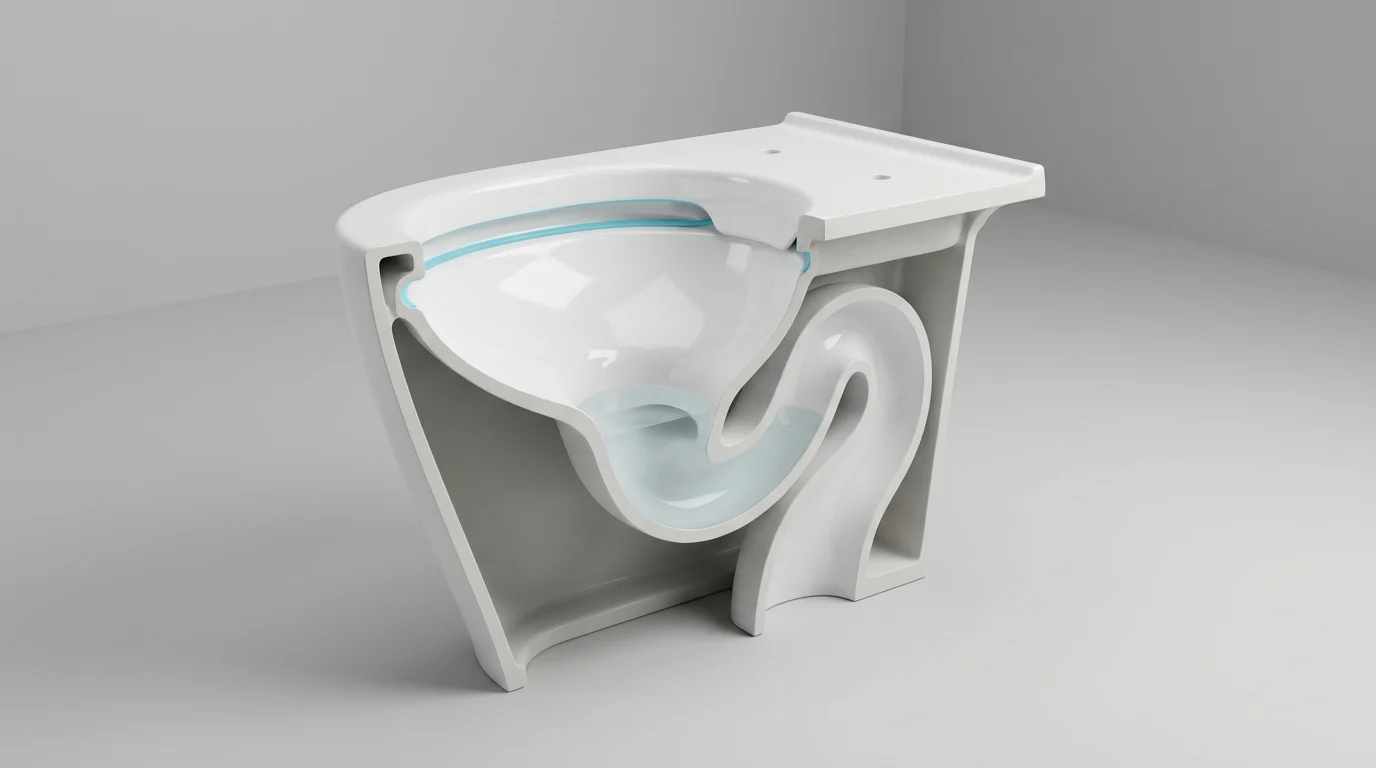
Hardware buyers often evaluate smart toilets as consumer electronics bolted onto a generic ceramic bowl. In manufacturing reality, hydraulic flush performance, component packaging, and long-term seat fit depend directly on how the vitreous china pan is engineered, glazed, and fired.
| Ceramic Engineering Factor | How It Governs Smart Toilet Performance |
|---|---|
| 1. Ceramic Trapway Geometry | Trapway diameter (≥50 mm on listed MICAWA series), bend radii, weir height, and cross-sectional continuity decide how fast siphon suction primes and whether solid waste clears cleanly. Three-layer internal trapway glazing reduces wall friction that unglazed clay leaves behind. |
| 2. Jet and Rim Water Distribution | Flush energy must split cleanly between rim-wash circulation (cleaning the bowl wall without over-splash on rimless models such as MB-1876B) and the bottom siphon jet. Poor port geometry wastes pump or mains momentum in turbulence before siphon initiation. |
| 3. Internal Component Packaging | Compact pans (436–500 mm tall) must carve out protected rear cavity room for concealed tanks, pumps, valves, and air-gap assemblies without weakening structural clay wall thickness around floor bolts or floor traps. |
| 4. Ceramic Shrinkage & Dimensional Control | Slip-cast porcelain shrinks substantially during high-temperature firing (1,280°C / 18 hours in MICAWA’s 123 m tunnel kilns, reaching 0.1% water absorption). Controlling warpage on the flat rear deck and seat-bolt bosses is essential so electronic bidet assemblies seat level without rocking or pinching hoses. |
| 5. Hydraulic & Ceramic Integration | A strong booster pump cannot compensate for a choked bend, rough trapway seam, or misaimed jet channel. Effective flushing requires tuning ceramic mold curves alongside valve and pump delivery curves as one system. |
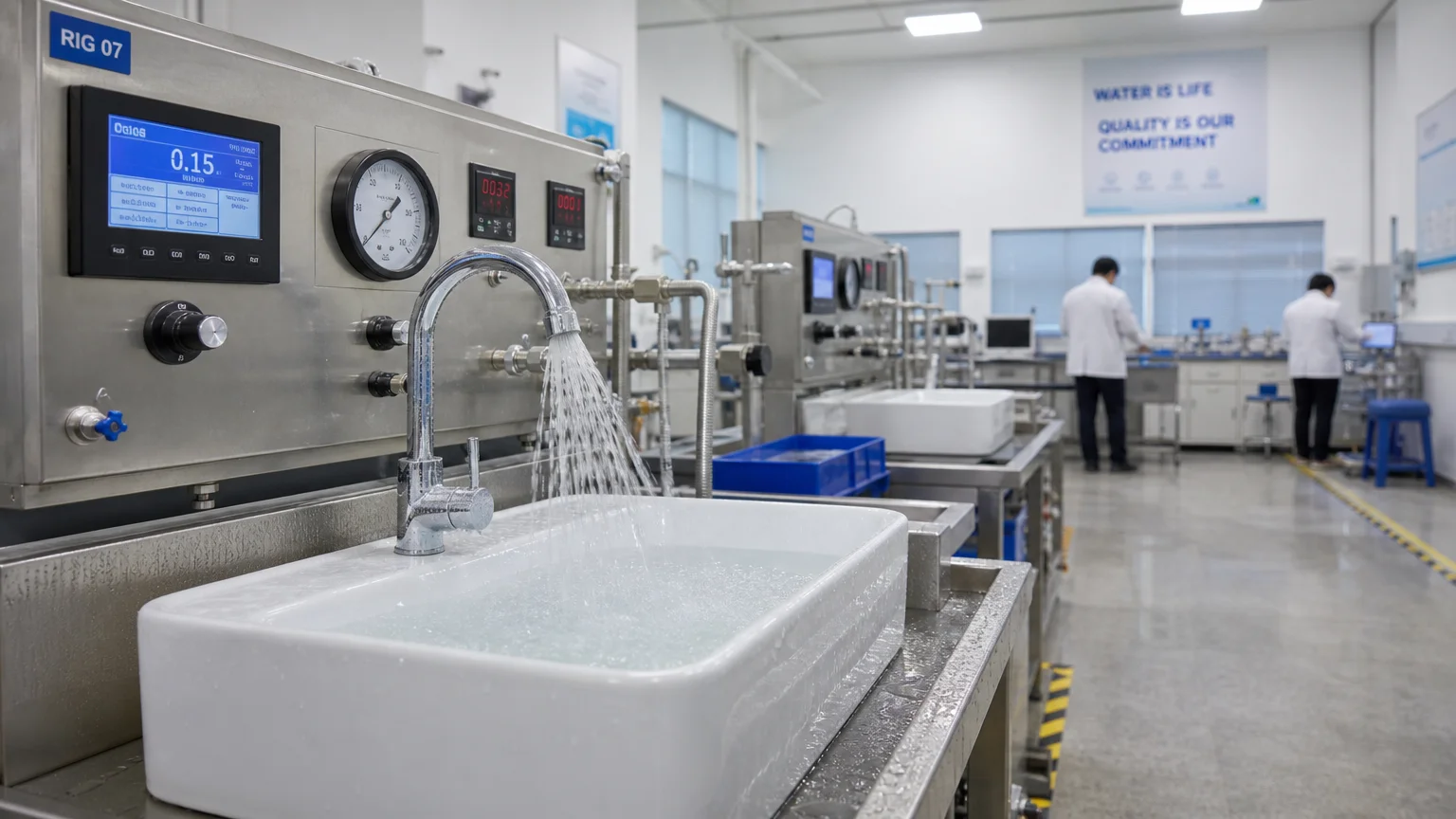
| 6. Factory Performance Testing | Testing circuit boards on a dry bench does not catch hydraulic seal leaks or firing warpage. MICAWA’s QA process evaluates complete assembled smart toilets under live water and electrical loads, alongside category-level ceramic discharge and acoustic checks (confirm exact model test coverage before ordering). |
Tankless Smart Toilet Installation Requirements
Lock down four physical interfaces on the bathroom drawing before ordering—fixing rough-in or electrical coordinates after tiling is far costlier than verifying them pre-production:
- Waste Rough-In (
300 mmvs.305 mmvs.400 mm) & Latest CAD Verification: Current MICAWA catalog specifications list305 / 400 mm(12" / ~16") floor rough-in onMB-1865andMB-1876B, and300 / 400 mmonMB-1960andMB-1871(earlier overview text on the site sometimes rounded 305 mm to 300 mm). Because a nominal 12-inch (305 mm) North American flange sits just5 mmfrom a 300 mm centerline, slotted closet flanges or flexible pan collars can often bridge minor metric/imperial tolerances, whereas mismatched300 vs 400 mmdrains will not align without an offset collar. Always confirm exact bolt-slot clearance and waste-horn centerline on the latest product CAD drawing rather than assuming universal fit—see our 300 mm, 305 mm and 400 mm toilet rough-in guide. - Wall-Outlet (P-Trap) & Wall-Hung Carriers: Floor-outlet models cannot be converted to rear wall drainage on site. Specify a wall-outlet configuration on the
MB-1960series, or specify wall-hungMB-2889ASJpaired with a rated in-wall carrier frame and concealed power feed—see our wall-hung toilet and concealed carrier guide. - Electrical Supply, Cord Reach & Zone Compliance: Standard listed models run AC220V / 50Hz with a
~1.5 mcord and IPX4 splash protection. For110–120V / 60Hzmarkets or jurisdictions enforcing GFCI / fused-spur bathroom zones, confirm exact voltage configuration and market-specific certification scope before quotation via our smart toilet certification checklist. Place the outlet to the side of the ceramic footprint together with the tile set-out plan. - Skirted Angle-Stop & Door Clearance: Keep the water angle stop clear of the rear ceramic skirt so technicians can reach the shutoff and clean the inlet filter, and verify overall depth (
680–720 mm) and height (436–500 mm) against door swings and low vanity shelves.
Request Latest CAD Drawings & Hydraulic Matching
Send your target market, voltage/plug standard, site supply pressure, and drainage layout. Our engineering desk returns the matching CAD dimension sheet and model suffix recommendations before you approve a sample.
MICAWA Smart Toilet Model Comparison
Compare MICAWA’s five catalogued smart toilet platforms below. Note that “zero-water-pressure” refers to models incorporating an internal reservoir or dual-pump drive to reduce dependence on instantaneous mains pressure—always confirm site refill flow and electrical compliance per destination market.
| Series | Dimensions (mm) | Listed Rough-In / Outlet | Hydraulic & Outage Architecture | Key Functional Scope | 40HQ Loading & Spares |
|---|---|---|---|---|---|
| MB-1865 Series A / AS / AJS | 685 × 407 × 436 | Floor, 305 / 400 mm(verify latest CAD) | A: direct valve (0.1–0.75 MPa static, 9V)AS/AJS: built-in zero-pressure tank (12V) | 1080W instant heating, Grade 2 siphon, IPX4, air-gap isolation; AJS adds microwave lid & 360° foam | ~240–270 sets+ 1%–2% modular spares |
| MB-1960 Series 8 tiers, FP–ASJ | 680 × 410 × 475 | Floor 300 / 400 mm or wall outlet | Direct 0.15–0.75 MPa (>3.8 L / 15 s) or S built-in zero-pressure tank | Heated-seat Lite (FP/FS) to voice, UV & foam flagship (AMJ/ASJ); 3–6 L siphon | ~230–260 setsmixed 8-tier loading |
| MB-1871 Series FP / FS / AM / AS | 680 × 420 × 500(43 kg gross) | Floor, 300 / 400 mm | Mains (FP/AM) or built-in zero-pressure tank (FS/AS) | 4.8 L super-vortex siphon; Lite vs. app-controlled wash & dry tiers | ~220–250 sets+ 1%–2% modular spares |
| MB-1876B (MB-1876BJS) | 720 × 410 × 450 | Floor, 305 / 400 mm(verify latest CAD) | Dual-pump “zero-water-pressure” series (confirm site refill & wash supply) | Rimless bowl, 1080W instant heat, 4-way lid, UV nozzle, cold-catalyst deodorizer, 240 mL foam shield | ~220–245 sets+ spares & foam refills |
| MB-2889ASJ Wall-Hung | 590 × 390 × 375 | Wall outlet, concealed carrier | Concealed carrier; confirm pressure & voltage on current spec sheet | Instant heat, radar auto lid, projected foot sensor, foam shield, voice & app control | Project-based, confirmed per carton spec |
All orders follow project-based MOQ. OEM logo branding, 5-layer EPE export packing, multilingual manuals, and destination voltage/certification scope are confirmed at sample sign-off.
How to Choose Smart Toilets for B2B Projects
When specifying across multi-tier hotel or apartment buildings, grouping room grades under a single platform series simplifies drawings and installation—yet sharing one ceramic shell does not make all internal spare parts interchangeable. Verify exact part compatibility across configuration suffixes before building your project’s maintenance stock:
| Component / Spare Part | Same-Series Interchangeability Boundary |
|---|---|
| Ceramic Body | Confirm by mold series and waste-outlet / rough-in interface (e.g., 300 vs 400 mm or floor vs wall) |
| Smart Seat & Cover Assembly | Confirm by upper ceramic deck contour, hinge-bolt pattern, and trim grouping (e.g., F-series vs A-series) |
| Main Control PCB | Varies by functional feature tier (Lite vs Wash/Dry vs Voice/Foam) and hardware revision |
| Solenoid / Inlet Valve | Must match hydraulic path (direct-valve mains assembly vs concealed reservoir fill assembly) |
| Internal Booster Pump & Tank | Not universal across direct-valve and built-in-tank tiers; confirm exact pump SKU and harness |
| Wireless RF Remote | Confirm RF pairing protocol and button layout against the exact sub-model (e.g., Lite models omit RF remotes) |
| Emergency Backup Battery | 9V (MB-1865A) and 12V (MB-1865AS/AJS) harnesses are not interchangeable |
- Prioritize baseline reliability over extra sensors: Guests notice reliable flushing, steady warm washing, and quiet soft-close dampers every day. Treat voice control, UV nozzles, and foam shields as targeted suite upgrades and confirm consumable resupply (such as
240 mLfoam bottles) on the initial PO. - Ship
1%–2%spares per exact suffix & brief housekeeping: Consolidate spare kits by exact ordered suffix in the same container, and follow our hotel smart toilet specification guide to train cleaning staff against abrasive chemicals on sensors and control panels. - Complete-package project context: MICAWA has delivered smart toilets inside coordinated multi-category residential packages including the Changshu Bosideng Apartment Building project (2023) and the Wuhan Dongfeng Sunshine City French Village villas (2020), supplied alongside vanities, shower systems, basins, and faucets.
Next Steps for Your Smart Toilet Schedule
Share your destination market, voltage/plug requirements, water-pressure data, and rough-in schedule for CAD verification, suffix-specific spare-parts lists, and a project-based MOQ quotation.
Technical References
Citing an international standard defines an industry benchmark and does not by itself establish third-party certification of a specific model. Buyers must match each technical claim in an RFQ to model-specific verification evidence:
| Technical Claim in Article | Required Verification Evidence Before Order |
|---|---|
| Water pressure & supply flow | Model-specific installation manual & current technical datasheet |
| IPX4 waterproof enclosure | Corresponding product test report or formal specification sheet |
| Electrical safety & voltage | Applicable standard version & certificate naming exact SKU / electrical rating |
| Backflow prevention / air gap | Internal air-gap structural diagram, test evidence & destination-market water bylaws |
| Flushing performance | Referenced test standard (e.g., ASME / WaterSense / EN 997) & model test result |
| Ceramic water absorption (0.1%) | Factory firing inspection records & ceramic category technical documentation |
| Rated instant-heating power | Complete unit rating nameplate & heating module technical specification |
- U.S. EPA WaterSense Specification for Tank-Type Toilets (1.28 gpf / 4.8 Lpf water-efficiency and solid-extraction testing scope).
- U.S. EPA WaterSense Specification for Flushometer-Valve Water Closets (1.0–1.28 gpf commercial direct-supply flush criteria).
- ASME A112.19.2 / CSA B45.1 — Ceramic Plumbing Fixtures (vitreous china water absorption, glazing, flange interface, and hydraulic flush standards).
- ASME A112.4.2 / CSA B45.16 — Personal Hygiene Devices for Water Closets (integrated bidet backflow, temperature, and electrical interface framework).
- UK Water Supply (Water Fittings) Regulations 1999 — Schedule 1 Fluid Categories (legal basis classifying bidet/toilet hygiene sprays under Fluid Category 5 backflow risk).
- IEC 60335-2-84 — Household & Similar Electrical Appliances: Particular Requirements for Toilets (electrical safety framework for heated and bidet-equipped WCs).
- Kohler Veil K-5401 Skirted One-Piece Smart Toilet Specification Sheet (benchmark example specifying 9 GPM minimum supply flow rate for a direct-supply residential smart unit).
- MICAWA Product & Manufacturing Records (
FOSHAN MICAWA CERAMICS CO., LTD.— Foshan ceramic factory overview, catalogued specifications forMB-1865,MB-1960,MB-1871,MB-1876B / MB-1876BJS, andMB-2889ASJ).
Related Smart Toilet & Plumbing Procurement Guides
Smart Toilet Certification Checklist for Buyers
Verify model-specific electrical ratings, IPX4 scope, and destination-market compliance documents before quotation.
How to Specify Smart Toilets for Hotel Projects
Build guestroom schedules, test sample-room recovery, and structure comparable hospitality RFQs.
Toilet Rough-In Size Guide: 300/400mm, 12" & H180mm
Measure finished-wall floor centerlines and compare 300/305/400 mm S-traps against horizontal wall outlets.
Wall-Hung Toilet & Concealed Carrier Frame Guide
Coordinate steel frame load ratings, fixing bolt centers, and finished floor heights for suspended pans.