Vanity Countertop Buying Guide
Bathroom Countertop Materials: How to Choose the Best Vanity Top
A practical comparison of ceramic, sintered stone, engineered quartz, solid surface, and natural stone vanity tops—helping you pick the right surface, basin joint, and thickness for real bathroom use.
Quick Picks: Best Vanity Top by Priority
Bathroom counters get smaller surface area than kitchen islands, but they take constant humidity, toothpaste, skincare acids, hair dye, and 200°C flat irons. Match your top material to how the room gets used:
- Easiest wipe-down (600–1000 mm / 24″–40″): Pick a one-piece molded ceramic vanity top. Zero rim between deck and bowl means water and soap wipe straight down with no caulk line to darken.
- Double sinks, hot hair tools & slim stone veining (1200–2000 mm / 48″–79″): Go with a 12 mm sintered stone top paired with an undermount glazed ceramic basin.
- Family baths with low-maintenance stone look: Engineered quartz shrugs off toothpaste and makeup with zero sealing—just keep a heat pad under curling irons.
- Seamless ultra-long runs or repairable matte finishes: Acrylic solid surface curves cleanly around wall corners and can be sanded fresh if scratched.
- Quiet statement powder rooms: Natural marble still owns timeless veining when guests mostly wash hands and skip harsh hair tools.
01. Main Bathroom Countertop Materials Compared Side by Side
Retail showrooms across Europe and North America group most bathroom vanity worktops into five core materials (plus budget laminate). Compare what actually affects daily living before falling in love with a slab sample:
| Countertop Material | Stain & Moisture Resistance | Hot Styling Tools (200°C) | Sealing & Seam Cleaning | Best Width & Typical Price Tier |
|---|---|---|---|---|
| One-Piece Ceramic | Non-porous glaze; ignores dye, makeup, and household bleach | Completely heat-safe | Never needs sealing; zero joint between deck and bowl | Best 600–1000 mm (24″–40″); value to mid-range |
| 12 mm Sintered Stone | Non-porous mineral body; impervious to hair dye, perfume, and UV light | Completely heat-safe (no resin binder) | Never needs sealing; clean undermount rim or sleek bevel | 1200–2000+ mm (48″–79″+) & custom sizes; mid-upper tier |
| Engineered Quartz | Non-porous (~90%+ mineral + resin); shrugs off water and spills | Caution: hot irons can scorch resin | Never needs sealing; wipe silicone rim around sink | Any standard or double span; ~$50–$150+/sq ft installed (U.S.) |
| Acrylic Solid Surface | Non-porous; resists bacteria and mild cleaners; scratches sand out | Avoid direct high heat | Never needs sealing; seamless integrated basin option | 600–2400+ mm curved/long suites; ~$40–$100/sq ft |
| Natural Marble | Porous; absorbs oils quickly and dulls (“etches”) from acids | Heat-resistant | Needs water-drop check & periodic sealing | Custom slab cuts; ~$60–$200+/sq ft |
| Natural Granite | Low-medium porosity; naturally resists everyday acid etching | Heat-resistant | Minimal sealing check once dense slab cures | Remnants or full slabs; ~$50–$150/sq ft |
One-Piece Molded Ceramic (Vitreous China)
In compact 600–1000 mm bathrooms across Europe and commercial apartments, molded ceramic tops are the most practical workhorse. The tap ledge, backsplash lip, and washbowl come out of one kiln-fired piece, so there is no silicone joint to trap grime around the sink rim. Most models come in glossy crisp white (such as paired vitreous china basins on MICAWA’s 800 mm cabinets). The trade-off: heavy perfume bottles dropped hard onto a rim can chip glaze, and single-piece ceramic tops rarely go past 1000–1200 mm because wet clay warps slightly over long spans.
Sintered Stone (Large-Format Porcelain Slabs)
Sintered stone presses crushed natural minerals under extreme force and fires them above 1,200°C—creating crisp marble-look veining with zero plastic resin. For bathrooms, it fixes two headaches at once: you can run a ruler-flat 12 mm slab across 1200–2000 mm double-sink consoles, and hot straighteners or bright bathroom sunlight will not discolor the surface. Because it pairs with an undermount sink or mitred well, ask for factory cutouts and proper edge packing rather than cutting thin 12 mm porcelain on site with dry saws.
Engineered Quartz (Mineral + Resin)
Quartz blends roughly 90%–94% ground natural quartz crystals with polymer resins and pigments. Families love it because it looks clean, resists lipstick, toothpaste, and nail polish remover, and never needs sealing. Just watch two limits in bathrooms: leaving a hot hair iron flat on resin-bound quartz can leave a faint yellow scorch mark, and direct window sunlight can slowly warm-tint bright white slabs over years.
Acrylic Solid Surface (Corian Class)
Man-made acrylic solid surface is warm to the touch, completely non-porous, and bonds without visible joints. It shines when you want an integrated matte bowl molded seamlessly into a 2000+ mm double-zone vanity or curved wall alcove. Scratches happen more easily than on porcelain or quartz, yet maintenance staff can buff fine marks away with mild abrasive pads—just keep heat mats handy for hot tools.
Natural Marble, Granite & Laminate Watch-Out
Real marble gives organic veining that factory prints still imitate, and granite handles heat and knocks effortlessly. Yet marble is soft and sensitive to acids found in skincare toners, toothpaste, and tile removers—leaving dull etch spots even on freshly sealed stone. Choose a honed (matte) marble finish if you love the look, or stick to porcelain/quartz for family baths. As for laminate (plastic-wrapped MDF or particleboard), skip it anywhere standing water pools around faucets—one unsealed edge can swell quickly.
Standard check — backing up “stain-proof” & “waterproof” claims: Quality ceramic basins pass ≤0.5% water absorption under ASME A112.19.2 and European EN 14688 (1.5 kN static load, thermal shock, chemical stain, and CE criteria). Sintered porcelain slabs meeting EN 14411 Group BIa verify ≤0.5% absorption via ISO 10545-3 and earn top Class 5 stain resistance (wiping clean with warm water alone) under ISO 10545-14, while acrylic solid surfaces follow ISO 19712-1.
02. Four Countertop-Only Details to Decide Before Ordering
Even after picking your material, four small countertop choices decide whether water drains cleanly, faucets reach the bowl, and the sink stays anchored for years.
1. Sink Mounting: Integrated vs. Undermount vs. Countertop Bowl
- Integrated (molded-in): Best for ceramic and solid-surface tops—zero rim crevices and fastest cleaning.
- Undermount: Best for sintered stone, quartz, and marble. Never let an installer hang a heavy glazed bowl like MP-4717 on silicone adhesive alone—require bonded mechanical stone clips or side support rails underneath.
- Countertop (Vessel) Bowl: Turns a flat blank stone slab into a hotel centerpiece, though the bowl rim adds height—keep total floor-to-rim comfort ergonomic (check bowl depth and width in our standard bathroom sink size guide).
- 2. Countertop Span & Shrinkage Boundary: Molded clay shrinks roughly 10%–13% during kiln firing, so one-piece ceramic tops look straightest from 600 mm to 1000 mm (24″–40″). Once your counter stretches past 1200 mm (48″)—or hits an odd wall-to-wall alcove size—switch to sintered stone, quartz, or solid surface so long edges sit flush against the cabinet below. (Pair countertop span choices with cabinet depth and layout rules in cabinet board materials and wall-hung vs. floor-standing vanities.)
- 3. Thickness, Sheen & Overhang: Slim 12 mm sintered porcelain brings crisp architectural lines without excess dead weight, whereas 20 mm–30 mm quartz or marble delivers classic chunky presence. On finishes, honed/matte stone hides minor marble etching and water rings better, while dark matte solids show dusty soap streaks sooner than light veined gloss. For exposed cabinet ends, allow roughly 10–25 mm (½″–1″) overhang; for wall-to-wall alcoves, deduct ~3–6 mm (1/8″–1/4″) so the counter drops into place without chipping tiled corners.
- 4. Faucet Hole Layout & Backsplash: Lock tap selection before drilling: single-hole (35 mm standard in Europe/modern builds), 4″ centerset or 8″ widespread 3-hole (common in North America), or a blank no-hole slab for wall-mounted mixers. If your counter sits flush against painted drywall or tile edges, add a matching back lip (and side splash in a corner) to keep standing water out of wall joints, following ergonomic clearances recommended by the National Kitchen & Bath Association (NKBA).
03. Which Vanity Countertop Works Best by Real Bathroom Scenario?
Spec sheets look tidy on paper, yet daily life breaks the wrong counter fast. Match your bathroom directly to one of these four real-world scenarios:
| Bathroom Scenario | Top Pick | Strong Runner-Up | Why It Works in Real Life |
|---|---|---|---|
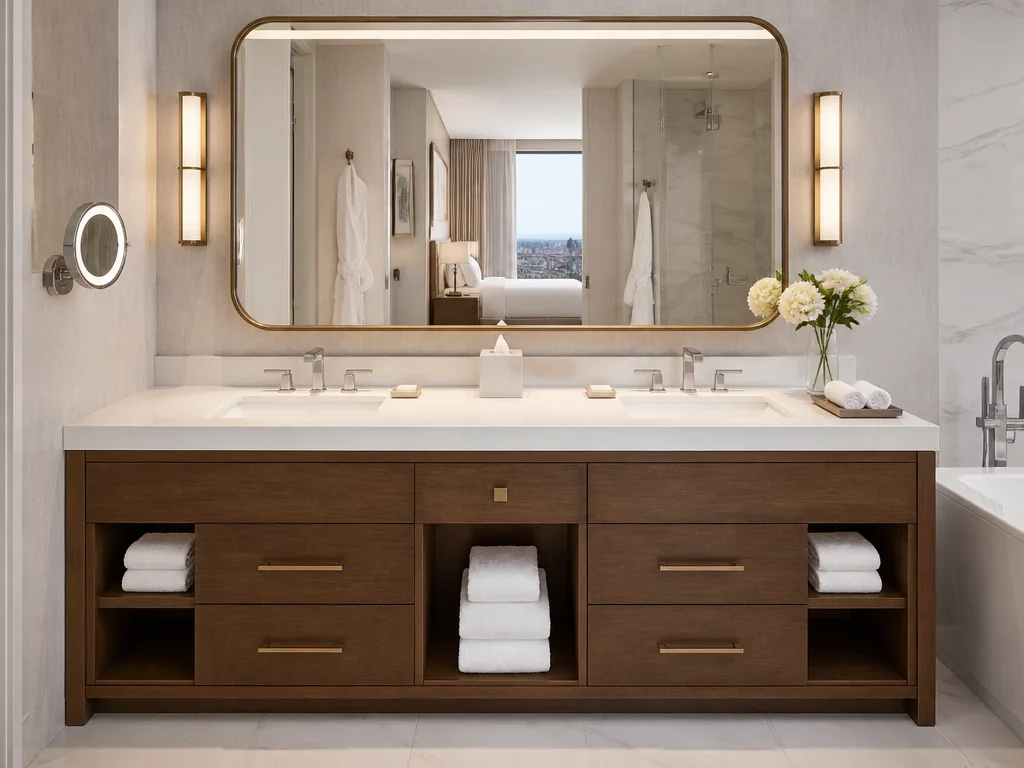
| 1. Busy Double Primary Bath 1200–1800+ mm · Hair tools, makeup & shared sinks | 12 mm Sintered Stone + clipped undermount ceramic bowls (e.g., MXD-110SW or M-1800SW) | 20 mm Engineered Quartz (use heat mat for irons) | Holds straight flat joints across double bowls and shrugs off hot flat irons, foundation, and hair dye with zero sealing |
| 2. Kids’ Bath or Guest Bath 600–1000 mm · Splashes & messy toothpaste | One-Piece Molded Ceramic Top (such as MMY-800SW) | Acrylic Solid Surface with integrated basin | Continuous glaze leaves zero silicone joint to grow dark mildew; handles rough cleaners and costs less to replace |
| 3. Statement Powder Room Low traffic · Guests only wash hands | Honed Natural Marble or Granite remnant | Bookmatched Sintered Porcelain Slab | No daily curling irons or acidic acne washes—lets authentic marble veining shine, while matte honing hides tiny spots |
| 4. Hotel Suites & Extra-Long Runs 1200–2340 mm · Commercial housekeeping & odd spans | 12 mm Sintered Stone (MMY-1200SW, MHM-1500SW) or Solid Surface (Muyu Suite) | Ceramic integrated tops in compact standard keys | CNC sintered slabs trim to odd wall widths with zero tooling fees; solid surface sands fresh between room renovations |
04. Three Simple Care Habits That Keep Vanity Tops Looking New
- Skip acidic cleaners on marble and abrasive powders on solid surface: Use mild pH-neutral soap and water daily. Remember that harsh descalers and citrus oils react chemically with natural marble—even a freshly sealed marble vanity top will still dull (“etch”) from acids, as Natural Stone Institute care guidance highlights.
- Use a heat mat under curling irons on quartz and solid surface: Polymer resins start stressing well below sintered stone’s 1,200°C firing heat; a thin silicone pad protects glossy resin finishes permanently.
- Run the 15-minute water test before resealing natural stone: Per the Natural Stone Institute sealing bulletin, pour a small pool of water on clean stone and wipe dry after 15 minutes—only reseal if the stone darkened underneath.
Compare Countertop Swatches & Vanity Suites from MICAWA
Explore all 49 vanity configurations spanning 800 mm molded ceramic tops, 12 mm sintered stone slabs, and seamless solid-surface suites—or send your room dimensions for material samples and project-based MOQ quotes.
Material Standards & Verified Sources
- EN 14688:2015+A1:2018 — Sanitary Appliances: Wash Basins (1.5 kN load, thermal shock, cleanability, chemical stain resistance, and EU CE DoP).
- ASME A112.19.2 / CSA B45.1 — Ceramic Plumbing Fixtures (vitreous china ≤0.5% boiling water absorption & glaze crazing requirements).
- EN 14411 (Group BIa porcelain slabs) tested via ISO 10545-3 (≤0.5% water absorption) and ISO 10545-14 (Class 5 warm-water cleanability).
- EN ISO 19712-1 — Decorative Solid Surfacing Materials.
- Natural Stone Institute Care Guide & Sealing Natural Stone Technical Bulletin (15-minute water drop test & acid-etching limits).
- National Kitchen & Bath Association (NKBA) (vanity depth and basin ergonomic clearances).
- MICAWA Bathroom Vanity Records (
FOSHAN MICAWA CERAMICS CO., LTD.— MMY, MHM, MXD, M-1800SW, Muyu suites, and MP-4717 vitreous china basin specs).
Related Vanity Planning Guides
Bathroom Cabinet Materials Guide
Compare multilayer solid-wood plywood, waterproof PVC, and edge banding underneath your vanity top.
Wall-Hung vs. Floor-Standing Vanities
Match vanity mounting style to wall structure, floor drains, and project freight planning.
Standard Bathroom Sink Sizes & Cutouts
Check undermount, vessel, and integrated basin widths against standard countertop depths.
Vitreous China vs. Porcelain & Fireclay
See how ceramic glazes, firing shrinkage, and 0.5% absorption shape sink and slab durability.