Mirror and lighting selection for B2B buyers
How to Choose a Bathroom Mirror Cabinet With Lights: Storage, Defogging and Controls
An illuminated mirror cabinet can combine three functions in one product: everyday mirror use, integrated lighting, and concealed storage. Whether you are importing, distributing, private-labelling or specifying for residential projects, the buying decision depends on configuration, electrical requirements, installation dimensions and the documents behind the claim.

1. Bathroom mirror cabinet vs smart LED mirror
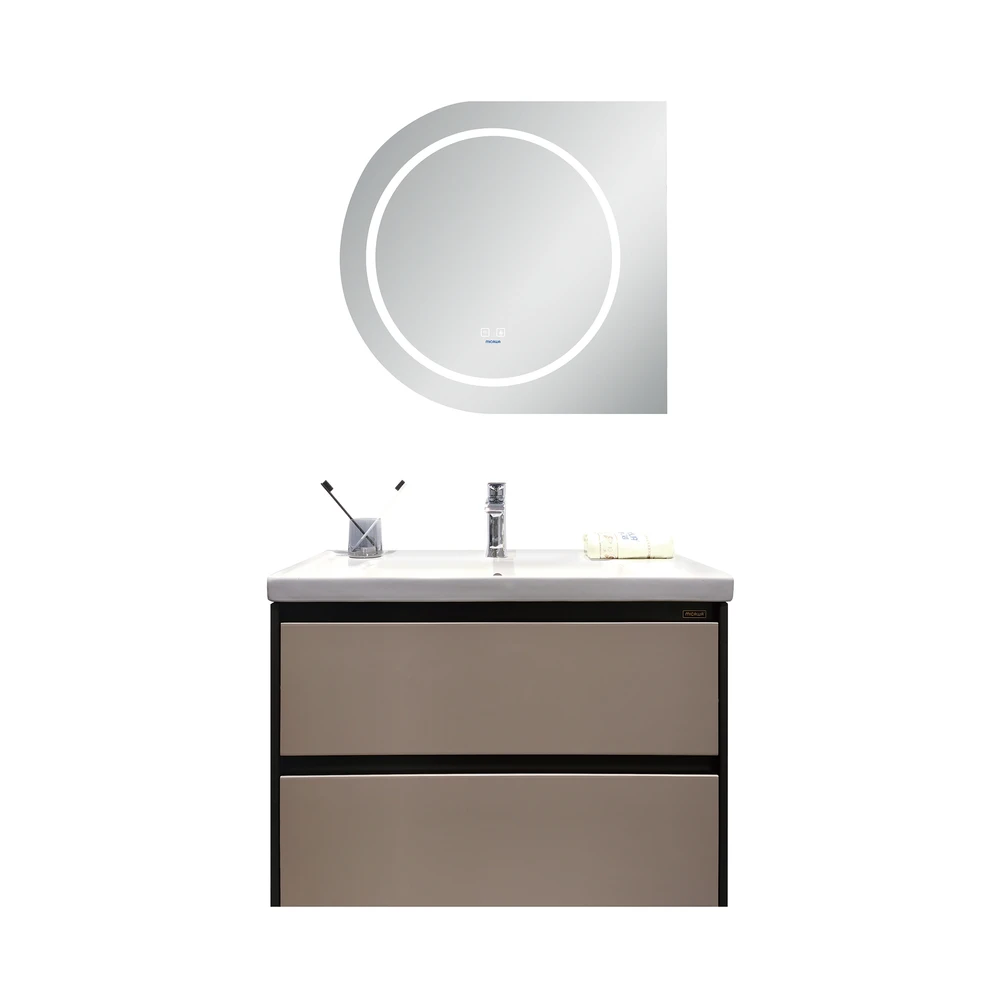
The first step is understanding the product category. Although mirror cabinets and LED smart mirrors often sit in the same bathroom furniture catalogue, their construction and intended functions are not identical.
What is a bathroom mirror cabinet with lights?
An illuminated mirror cabinet combines a mirror with an enclosed or partially enclosed storage cabinet. Depending on the design, it may include mirrored doors, interior shelving, integrated LED lighting, touch or sensor controls, optional defogging and adjustable storage. The advantage is mirror and storage in one wall position, which matters in apartments and compact bathrooms.
What is a smart LED bathroom mirror?
A smart LED mirror is primarily a mirror with integrated electrical or electronic functions: front lighting, backlighting, touch or presence sensing, heated demisting, adjustable modes or a display. It does not automatically include a storage cabinet. This distinction matters when writing product descriptions, quotations and retail listings.
| Feature | LED mirror cabinet | Smart LED mirror |
|---|---|---|
| Main purpose | Mirror, lighting and storage | Mirror and electronic functions |
| Storage | Usually integrated | Not necessarily included |
| Projection from wall | Set by cabinet construction | Often slimmer, design-dependent |
| Defogging | Optional, model-dependent | Optional, model-dependent |
| Maintenance | Mirror, cabinet hardware, electrical parts | Mirror and electrical parts |
| Key buying concern | Storage layout and installation fit | Lighting, controls, electrical configuration |
Buyer recommendation
Do not use “LED mirror cabinet” and “smart mirror” interchangeably in a purchase order. State whether the quoted product includes a physical storage cabinet, and list the exact lighting and control functions required.
2. How to choose LED lighting for a mirror cabinet
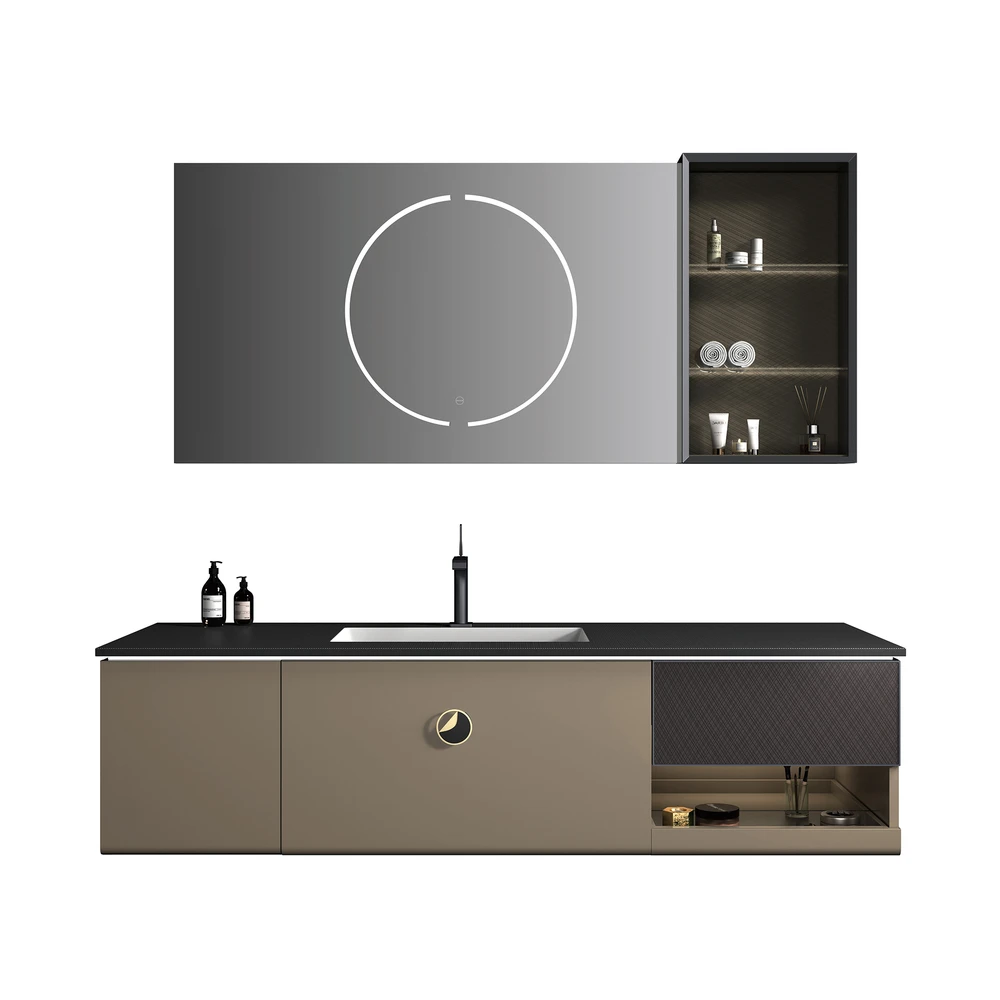
Two products described as “with LED lights” can deliver a very different lighting experience. Position, colour temperature and how the light reaches the user's face matter more than the presence of an LED strip.
Front-lit mirror cabinets
Front illumination directs light toward the user, which helps with shaving, grooming and makeup. When evaluating it, examine the position of the illuminated area, distribution across the face, visible glare, diffuser construction, shadows from nearby fixtures, and actual light output and colour quality.
Backlit and perimeter lighting
Backlighting creates an illuminated effect behind the mirror and can carry a contemporary appearance, but it may not provide sufficient direct facial illumination in every layout. Where mirror lighting is expected to serve as task lighting, evaluate distribution rather than appearance photographs.
| Lighting design | Main benefit | What to verify |
|---|---|---|
| Front-lit mirror | Direct illumination toward the user | Glare, uniformity, facial shadows |
| Backlit mirror | Decorative ambient effect | Whether separate task lighting is needed |
| Front and rear lighting | Direct plus indirect effect | Both circuits, control options, switching logic |
| Upper and lower lighting | Integrated cabinet lighting | Actual light distribution in the installed position |
| Three colour temperatures | Selectable lighting appearance | Exact kelvin values, modes and control behaviour |
Colour temperature and colour rendering
Colour temperature describes the perceived warm or cool appearance of light and is expressed in kelvin (K). “Warm white”, “neutral white” and “cool white” are descriptions, not specifications. A supplier advertising three-colour LED lighting should provide the actual colour-temperature values for each mode.
The colour rendering index (CRI) describes how closely a light source renders object colours compared with a reference source. For grooming and colour-sensitive tasks it deserves attention, and buyers should request the measured CRI for the exact configuration rather than a catalogue adjective. Also request LED input power, light output, control functions, driver information and replaceability or service provisions.
B2B purchasing tip
Ask for a lighting specification sheet and a representative operating sample. Product photographs cannot establish lighting performance, and they are not a substitute for the measured data on the quotation.
3. Anti-fog and demisting technology
Bathroom mirrors fog when warm, humid air meets a cooler mirror surface. A defogging system is designed to reduce that effect, usually with an electrically heated film or pad behind part of the mirror.
- 1. Heating element.Located behind the designated mirror area.
- 2. Activation.Switched on through the specified control, often combined with the light.
- 3. Surface warming.The covered area reaches a temperature that resists condensation.
- 4. Result.Performance depends on coverage, power, room humidity, ambient temperature, ventilation and operating time.
| Specification | Why it matters |
|---|---|
| Heating coverage | Shows which part of the mirror is heated |
| Rated power | Sets the electrical and energy requirement |
| Operating time | Defines performance under stated conditions |
| Control method | Determines how defogging is switched on and off |
| Electrical protection | Supports review for the intended bathroom environment |
| Test conditions | Establishes the basis for any performance claim |
Does every LED mirror cabinet have a defogger?
No. Lighting and defogging are separate functions. A mirror cabinet may offer illumination and storage without a heating function, and an LED smart mirror may include defogging but no storage. Never infer an anti-fog system from the word “smart”.
MICAWA's published bathroom furniture range information describes a high-definition float silver mirror with three LED colour temperatures and graphene demisting that clears the mirror in about 30 seconds. That is a range-level capability statement, not a per-model guarantee. For a specific model, request the tested area, operating conditions and measurement method. Treat “anti-fog” as a technical function with a defined specification, not a universal marketing feature.
4. Touch switches and sensor-controlled mirrors
Modern illuminated mirrors use different activation methods, and the right choice depends on the intended user experience, room environment and maintenance requirements.
Touch-controlled mirrors
A touch control operates the specified function through a touch-sensitive area. Depending on configuration it may handle lighting on/off, mode selection, defogging, brightness and additional functions. A two-button (double-key) mirror has two separate inputs, but what each one controls must be verified for the exact model.
Motion or presence sensing
Some mirrors activate a function when a person enters a detection area. Benefits can include convenience and less contact with the surface. Check detection range and angle, activation conditions, response and shut-off behaviour, installation height, and the risk of unintended activation. “Motion sensor” alone does not identify whether the product uses radar, infrared or another method.
| Control type | Potential advantage | What buyers must verify |
|---|---|---|
| Single touch switch | Simple interaction | Functions assigned to the switch |
| Two-button control | Separate control inputs | Function allocation and behaviour |
| Motion-sensor control | Automatic activation | Technology, range, response, shut-off |
| Multi-function control | Flexible operation | Layout, usability, component reliability |
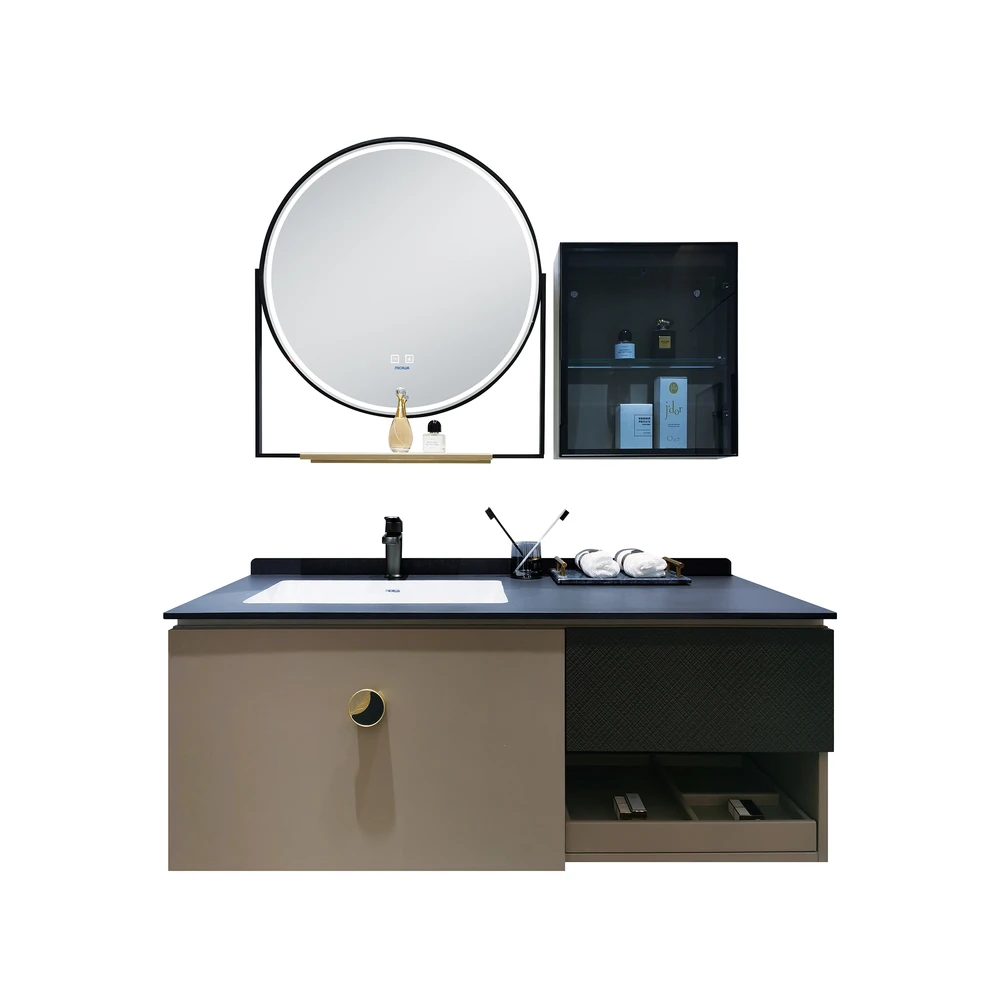
For hotel projects, interface simplicity and consistent operation usually matter more than the number of features. For residential collections, different configurations can serve different price positions. An advanced sensor is not automatically more suitable than a simple switch if its behaviour does not match the project. Residential bathroom furniture programmes and hospitality projects rarely need the same control set, so evaluate a functioning sample in a representative bathroom before approval.
5. Mirror-back storage: choosing a practical cabinet layout
Storage is the feature that separates an illuminated mirror cabinet from a flat LED mirror. In compact bathrooms, concealed mirror-back storage helps organise toiletries while keeping the countertop clear. Storage capacity should not be judged from external dimensions alone.
Cabinet depth
A deeper cabinet adds interior space but projects further from the wall. Check its relationship with the faucet, basin, lighting and circulation space.
Shelf configuration
Confirm number, position and adjustment of shelves, and whether the arrangement suits the height of the products actually stored.
Door movement
Check that the mirrored door opens without hitting adjacent walls, light fittings or furniture, and that the hinge side suits the room.
Electrical separation
Where lighting, sensors or drivers sit inside the cabinet, confirm their placement and service access relative to the storage area.
Surface-mounted vs recessed mirror cabinets
| Installation type | Advantages to consider | Coordination requirements |
|---|---|---|
| Surface-mounted | Straightforward where recessing is impractical | Overall projection, wall support, fixings, cable routing |
| Recessed | May reduce projection into the room | Wall cavity, structure, services, ventilation, feasibility |
Not every mirror cabinet supports recessed installation. Do not specify a recessed arrangement unless the approved product design and installation instructions include it.
Practical rule
External dimensions describe the product envelope, not the usable storage volume. Compare usable internal dimensions, shelf spacing, door clearance, supported shelf loading, accessibility and cleaning access.
6. MICAWA configuration examples: mirror cabinets and smart mirrors
MICAWA's bathroom furniture range includes several mirror configurations built around different lighting, control and storage requirements. The examples below show why a collection can offer multiple mirrors that are not technically interchangeable.
Dimensions refer to the mirror or mirror-cabinet component where stated, not to the complete vanity assembly. Model references and features are taken from MICAWA's supplied product records; electrical ratings, IP classification, CRI and defogging test conditions are not yet published for these models and must be confirmed on the current technical sheet before ordering.
| Model reference | Configuration | Mirror-component dimensions | Documented features |
|---|---|---|---|
| MXD-323HW | Smart mirror cabinet | 800 × 700 × 150 mm | Motion-sensor switch; upper and lower lighting; mirror-back storage |
| MXD-302SW | Two-button smart mirror | 750 × 700 × 30 mm | Two-button control; button functions to be confirmed |
| MJY-1500SW | Smart mirror in a vanity configuration | 1070 × 37 × 650 mm | Single-button touch control; anti-fog; front and rear lighting |
| MJY-1200 | Black-frame mirror configuration | 720 × 40 × 810 mm | Two-button touch control; anti-fog; front lighting |
Example A: MXD-323HW — mirror cabinet with storage
The most direct example for buyers searching a bathroom mirror cabinet with integrated lighting. The supplied configuration combines a 900 × 480 × 475 mm main cabinet with an 800 × 700 × 150 mm smart mirror cabinet, mirror-back storage, a motion-sensor switch and upper and lower lighting. Before selecting it, confirm mounting method, usable internal dimensions, sensor behaviour, electrical requirements and the complete technical drawing. The 150 mm figure belongs to the mirror-cabinet dimension triple, not the vanity projection.
Example B: MXD-302SW — two-button smart mirror
A smart-mirror reference with a two-button interface and a 750 × 700 × 30 mm mirror component. The key question is which functions each button controls. Do not assume one key is lighting and the other defogging; the supplied record does not assign the functions, so this configuration is useful for comparing a smart mirror against an illuminated storage cabinet rather than for assuming features.
Example C: MJY-1500SW — front and rear illuminated smart mirror
A 1070 × 37 × 650 mm single-button anti-fog mirror with front and rear lighting, paired with a 1490 × 555 × 400 mm main cabinet and a separate 420 × 153 × 650 mm illuminated side cabinet. It illustrates how a slim smart mirror can provide lighting and defogging without including storage. The published overall vanity dimensions are separate from the mirror-component dimensions.
Example D: MJY-1200 — black-frame mirror with side storage
A 720 × 40 × 810 mm black-frame mirror with two-button touch control, anti-fog and front lighting, plus a 420 × 150 × 500 mm aluminium-frame glass-door side cabinet with door-controlled switch and illuminated glass shelves. For an order, confirm the final mirror model identifier, lighting arrangement, mounting details and included electrical functions.
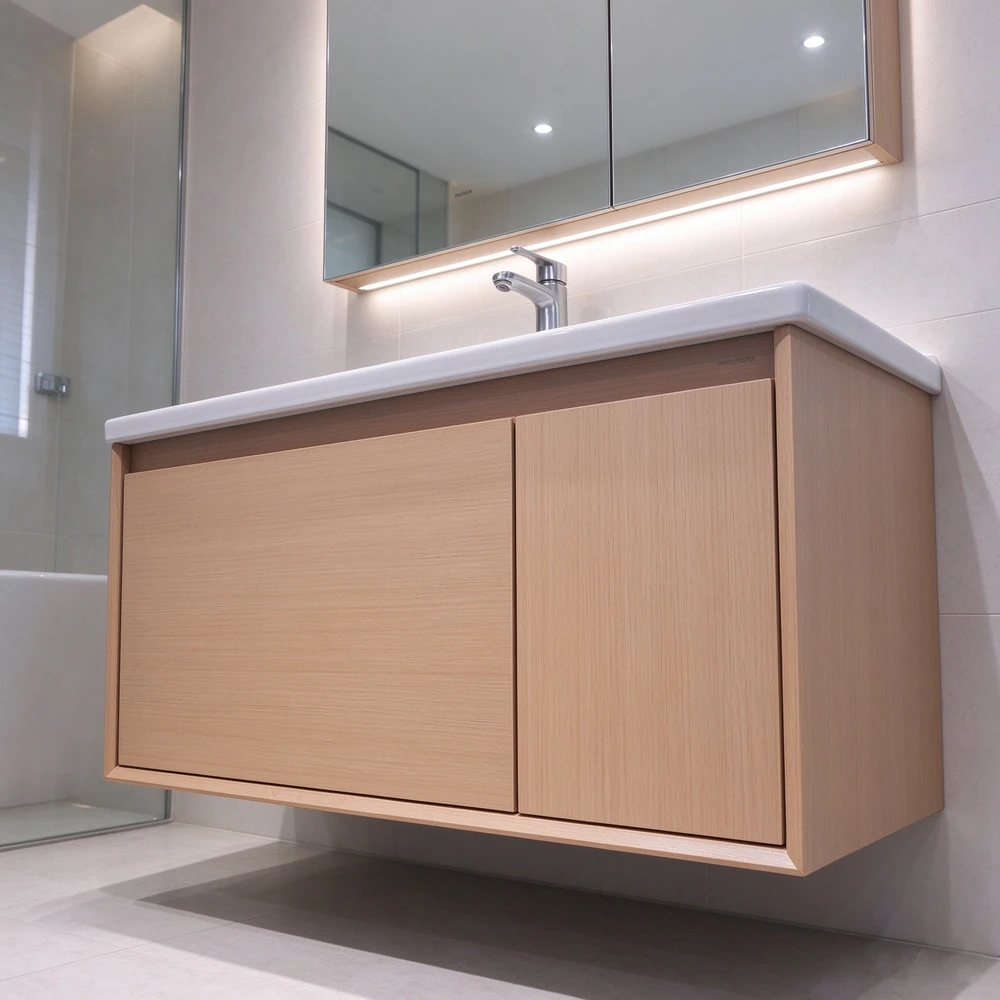
The principle these examples demonstrate is simple: a bathroom furniture collection can offer several mirror configurations without those mirrors being technically interchangeable. Storage, lighting arrangement, controls, depth and electrical functions must each be specified. Browse the full bathroom cabinet and vanity range to compare the cabinet bodies these mirrors are supplied with.
7. Mirror cabinet dimensions and installation checks
Select the mirror cabinet against the real wall space, vanity position and intended use. Nominal dimensions do not always represent the clearance needed to install and operate it.
| Installation item | Information to request |
|---|---|
| Mirror cabinet dimensions | Overall width, height and depth |
| Mounting arrangement | Surface or recessed installation where supported |
| Wall conditions | Substrate, support and fixing requirements |
| Cabinet doors | Opening direction and clearance |
| Power supply | Rated voltage, frequency, power and connection method |
| Cable entry | Position shown on the approved drawing |
| Controls | Access and sensor operating conditions |
| Maintenance | Service access and replacement information |
An electrical mirror cabinet in a bathroom requires an assessment of its intended location and the applicable electrical rules. Showers, baths and other water sources may affect which equipment and arrangements are permitted. Have the electrical installation evaluated and performed by qualified personnel according to local requirements; never assume a mirror cabinet can be installed in every position because it is marketed as a bathroom product.
8. IP rating and electrical safety
An IP rating classifies enclosure protection against solid foreign objects and harmful water ingress under IEC 60529. It is not a complete electrical safety certification, and the appropriate protection level must be determined for the installation and local rules in the destination market.
Request the rated input voltage and frequency, total rated power, product-specific IP rating where applicable, relevant electrical safety documentation, wiring and installation instructions, driver or power-supply information, the plug or connection configuration, product identification labels, and destination-market compliance evidence. Where a product includes both LED lighting and a heated defogging system, ask for the component ratings as well as the overall specification: LED wattage does not represent total product power.
Some mirror cabinets on the market include integrated shaver sockets. That is a separate feature with its own electrical and market requirements, and it should appear in the specification only if the selected product supports it and the documentation is available. Treat every electrical specification as model-specific; never apply one model's protection rating, voltage or certification to an entire range.
9. How to inspect a mirror cabinet sample
For importers, distributors and private-label brands, a functioning sample matters because several important characteristics cannot be judged from images.
A. Mirror appearance
Under agreed inspection conditions, review reflection quality, visible distortion, scratches or marks, edge finish, alignment and frame or cabinet finish consistency.
B. LED lighting
Operate every mode. Check uniformity, flicker, control response, shadows and glare, colour appearance against the approved values, and brightness consistency across units.
C. Defogging
Where included, test under an agreed procedure: heated area, control operation, electrical rating, performance under defined conditions, and shut-off behaviour. An uncontrolled bathroom demonstration is not a standardised test.
D. Controls
Verify each input against the operating instructions. For sensor models, review activation and deactivation in a representative installation environment.
E. Cabinet structure
Review door alignment, hinge operation, shelf installation, storage accessibility, construction, internal finish, and fixing and mounting provisions.
F. Packaging
Mirrors, electrical parts, cabinet corners and decorative surfaces need different protection. Confirm the packaging arrangement and carton identification before mass production approval.
The approved sample, technical drawing, component configuration and packaging specification should all refer to the same product version. The hotel bathroom vanity sourcing guide adds room-type and phased-delivery controls for hospitality programmes, and the bathroom cabinet materials guide covers substrate, edge sealing and finish questions that sit behind the mirror.
10. Choosing mirror cabinets for different B2B applications
Residential apartments
Storage and space dominate. A mirror cabinet with integrated shelving suits apartments where wall and countertop storage are limited; check depth against basin position, lighting and circulation.
Hotels and hospitality
Consistent interface, easy cleaning, coordinated lighting and maintenance access matter. Not every guestroom needs a storage mirror cabinet; the decision follows room configuration, design and electrical requirements.
Wholesale ranges
Organise mirror products into clearly differentiated configurations — standard illuminated, storage-focused, smart-function and premium — so a catalogue does not rely on broad “smart” or “luxury” labels.
Range planning only works if the tiers are based on documented features. A standard tier can be a basic illuminated mirror; a storage tier an LED mirror cabinet; a smart tier a touch-controlled mirror with defogging; a premium tier a coordinated lighting and control configuration. Those are possible directions, not fixed MICAWA tiers.
11. Bathroom mirror cabinet B2B specification checklist
Before requesting bulk pricing, prepare a specification that identifies the exact product and configuration.
Product requirements
- Mirror cabinet or flat LED smart mirror.
- Model reference and overall dimensions.
- Cabinet depth and usable storage.
- Lighting position and modes.
- Colour temperature and CRI.
- Defogging function and performance.
- Touch, two-button or sensor control.
Electrical and installation
- Destination country and installation environment.
- Rated voltage and frequency.
- LED and defogging power.
- IP rating and safety evidence.
- Mounting and wall-support requirements.
- Connection and cable-entry position.
- Installation and service instructions.
Quality and commercial
- Mirror and cabinet construction.
- Approved finish reference.
- Functional sample approval.
- Testing and compliance documents.
- Packaging and carton labelling.
- Quantity by model and configuration.
- OEM or private-label terms.
This checklist prevents the most common comparison error: two products that look similar in a catalogue but differ in storage, controls, electrical configuration and documentation.
12. Why consider MICAWA for mirror cabinet sourcing
MICAWA is a bathroom products manufacturer and complete bathroom solutions provider. The company behind the brand is FOSHAN MICAWA CERAMICS CO., LTD., founded in Foshan, China, in 2000. Its own production facilities cover ceramics, bathroom furniture, smart mirrors, bathtubs, shower screens and faucets, and it reports annual bathroom furniture capacity of 30,000 sets.
Published bathroom furniture capabilities include a high-definition float silver mirror with three LED colour temperatures, graphene demisting described as clearing the mirror in about 30 seconds, and modular mirror-cabinet and drawer storage described as improving mirror-cabinet space utilisation by about 50% versus conventional layouts. These are range-level statements; the specification of any ordered model still has to be confirmed.
For international buyers, MICAWA supports sourcing and OEM/ODM discussions involving vanity and mirror configurations, selected functions, approved samples and project requirements. Product features, customisation options, electrical specifications, certifications, minimum order quantities and availability must be confirmed for the particular model and destination market. See MICAWA's factory and manufacturing capability for the production context.
Frequently asked questions
What is the difference between a bathroom mirror cabinet and an LED smart mirror?
A bathroom mirror cabinet incorporates storage behind or around the mirror, while an LED smart mirror primarily provides illumination and electronic functions. Either product may include defogging or different controls, depending on the specific configuration.
Do bathroom mirror cabinets with lights always have a defogger?
No. LED lighting and defogging are separate features. Buyers should confirm whether the selected model includes a heating system and request its technical specifications.
Is a touch switch better than a motion sensor for a bathroom mirror?
Neither is universally better. Touch switches provide direct user control, while sensor systems can offer automatic operation. The right choice depends on user preferences, operating behaviour, installation conditions and maintenance requirements.
What IP rating should a bathroom LED mirror cabinet have?
The required level of protection depends on the installation location and applicable electrical rules. Buyers should request the product's actual IP classification and relevant documentation, then confirm suitability for the proposed installation. No single IP rating is appropriate for every bathroom location and market.
Can illuminated mirror cabinets be customised for wholesale or hotel projects?
Some configurations may be reviewed for changes to dimensions, lighting, storage, finishes, branding or other features. Availability depends on the selected product, technical feasibility, required testing, sample approval, quantities and agreed commercial conditions.
Related guides
- Bathroom cabinet materials guideSubstrate, edge sealing, finishes and hardware behind the mirror cabinet.
- Hotel bathroom vanity sourcing guideRoom types, dimensional checks, quantities and sample approval for hospitality programmes.
- Bathroom cabinets and vanitiesCompare the cabinet bodies and mirror configurations currently in the range.
Request a mirror cabinet or smart mirror quotation
Share the destination country and buyer type, whether you need a mirror cabinet or a flat smart mirror, preferred dimensions and mounting method, lighting, defogging and control requirements, storage needs, expected quantity, required documentation, and any branding or packaging requirements. If you are considering a specific model, include the reference so its current specification can be checked.
The best illuminated mirror cabinet is not the one with the most features. It is the configuration that provides the right combination of lighting, storage, reliable operation, installation suitability and verified technical information for the intended market.