Project Procurement
Bathroom Fit-Out Fixtures & Sanitary Ware: BOQ & Procurement Guide
A bathroom fit-out project involves more than selecting toilets, basins, faucets, and shower systems. For hotel developers, apartment contractors, and commercial project buyers, the bigger challenge is translating a construction Bill of Quantities (BOQ) into a clearly defined sanitary ware procurement schedule.
A complete bathroom fit-out BOQ may cover plumbing, waterproofing, tiling, fixture supply, and installation. However, these activities do not necessarily belong to the same supplier.
The key is to separate bathroom fixture supply from on-site construction work before requesting manufacturer quotations.
This guide explains how to identify sanitary ware items within a bathroom fit-out BOQ, prepare an illustrative fixture schedule, verify technical specifications, and coordinate procurement with a bathroom products manufacturer.
1. What is a bathroom fit-out BOQ?
A Bathroom Fit-Out BOQ (Bill of Quantities) is an itemized document describing the work, materials, equipment, units, and quantities required to complete a bathroom project.
It is commonly used by quantity surveyors, project managers, procurement teams, and contractors to organize tender pricing and control project scope.
Depending on the contract, the BOQ may include:
- Sanitary ware: Toilets, urinals, ceramic basins, and associated components.
- Bathroom furniture: Vanity cabinets, countertops, and mirror cabinets.
- Faucets and shower fixtures: Basin mixers, shower valves, shower systems, and bathtub fillers.
- Shower enclosures and bathtubs: Screens, doors, panels, and bathtubs.
- Plumbing works: Water supply lines, drainage pipes, valves, and site connections.
- Finishing works: Waterproofing, tiling, sealants, and related installation activities.
These items should not automatically be combined into one manufacturer quotation.
For example, a sanitary ware manufacturer may supply a toilet and its agreed components, while the plumbing contractor remains responsible for waste-pipe positioning, installation, and commissioning.
Likewise, a shower enclosure supplier may provide glass panels and specified hardware, while the fit-out contractor remains responsible for preparing the installation surfaces.
A clear distinction between these responsibilities reduces quotation ambiguity and helps identify missing items before site installation begins.
BOQ vs. fixture schedule: what is the difference?
The full construction BOQ covers the overall works required for the project.
A bathroom fixture schedule is a more focused document that extracts the product items requiring selection, supplier pricing, technical approval, and delivery coordination.
For manufacturer procurement, the fixture schedule should connect each item to:
- An item reference code.
- A product description and required configuration.
- The applicable room type and quantity.
- Installation interfaces and technical requirements.
- The proposed supply responsibility.
- Relevant drawings, approvals, and documentation requirements.
This narrower schedule allows a bathroom manufacturer to evaluate the actual product requirements without pricing unrelated construction work.
2. Which bathroom fit-out items can be sourced from a sanitary ware manufacturer?
Not every line in a bathroom fit-out BOQ belongs in a sanitary ware manufacturer's quotation.
For commercial projects, it is useful to divide the scope into two groups.
A. Bathroom products and fixtures
These are commonly considered for manufacturer-based sourcing:
| Product category | Typical project items | Key procurement considerations |
|---|---|---|
| Toilets & Urinals | One-piece toilets, smart toilets, urinals | Drainage configuration, dimensions, flushing requirements |
| Ceramic Basins | Countertop, undermount, pedestal and wall-hung basins | Mounting method, basin dimensions, waste alignment |
| Bathroom Vanities | Vanity cabinets, countertops, storage units | Cabinet dimensions, material selection, basin compatibility |
| Basin Faucets | Basin mixers and related fittings | Mounting configuration, water connections, flow requirements |
| Shower Systems | Exposed and concealed shower fixtures | Rough-in depth, valve configuration, pressure requirements |
| Shower Enclosures | Sliding or hinged shower screens | Finished opening dimensions, glass, profiles, seals |
| Bathtubs | Freestanding and built-in bathtubs | Drain position, dimensions, installation access |
| Accessories | Selected coordinated bathroom hardware | Finish consistency, mounting and included components |
Final availability, configurations, and inclusions must be confirmed against the manufacturer's current product range and quotation.
B. On-site construction and installation works
The following activities generally remain within the construction or specialist contractor's scope unless a project contract expressly states otherwise:
- Demolition and site preparation.
- Water supply and drainage pipe installation.
- Electrical wiring and connection.
- Waterproofing and substrate preparation.
- Wall and floor tiling.
- Wall reinforcement and structural fixing.
- Fixture installation and final sealing.
- Site testing, commissioning, and handover.
A product quotation should therefore clarify whether it covers supply only, agreed accessories, or any separately contracted service.
Procurement principle
Do not assume that a BOQ description such as “supply and install complete” means the product manufacturer is responsible for both activities. The purchase order, technical schedule, and construction contract must identify the responsible party.
3. Bathroom fit-out BOQ example: sanitary ware and fixtures
Consider an illustrative hotel development containing 120 guest bathrooms:
- 100 standard guest bathrooms.
- 20 deluxe guest bathrooms.
- Every bathroom has one toilet, basin, vanity, basin faucet, shower system, and shower enclosure.
- Deluxe bathrooms additionally include one bathtub and associated bathtub filler.
The following table demonstrates how a construction BOQ can be separated into a product sourcing schedule and contractor work items.
Example bathroom fit-out BOQ schedule
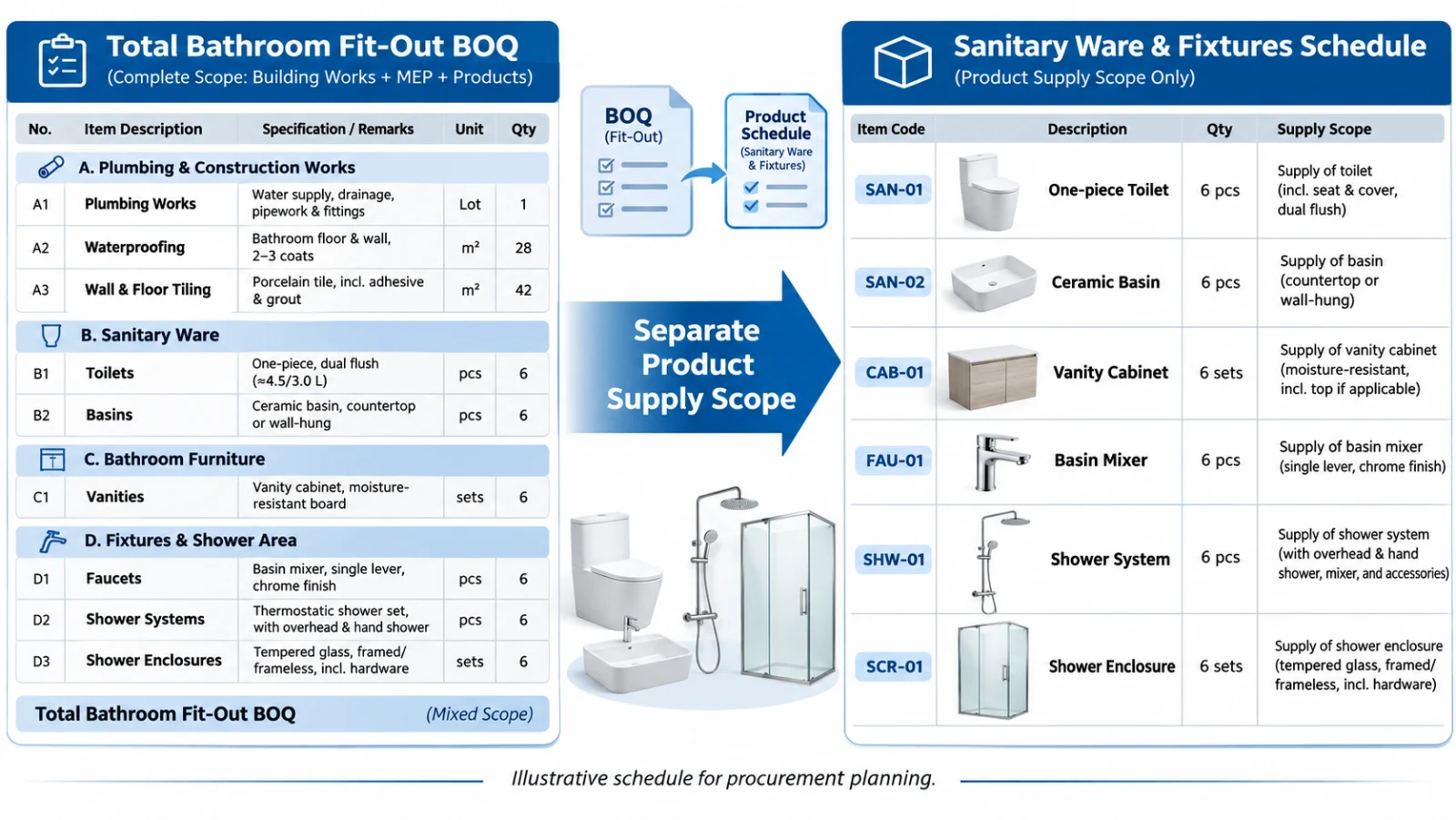
Swipe horizontally to view every BOQ column.
| Item Code | Fixture Description | Unit & Est. Qty | Key Spec & Rough-in Note | Proposed Supply Scope |
|---|---|---|---|---|
| SAN-01 | One-piece ceramic toilet | Set / 120 | Confirm outlet direction, rough-in, water inlet, seat and flush configuration | Product Supply MICAWA product supply subject to quotation; contractor installation |
| SAN-02 | Ceramic countertop basin | Pc / 120 | Confirm bowl dimensions, countertop opening, waste connection and overflow requirements | Product Supply MICAWA product supply subject to quotation; contractor installation |
| CAB-01 | Bathroom vanity cabinet, basin excluded | Set / 120 | Confirm cabinet dimensions, material, wall/floor fixing and pipe clearance | Product Supply MICAWA product supply subject to quotation; contractor fixing |
| FAU-01 | Single-lever basin mixer | Set / 120 | Confirm mounting holes, connection type, flow and pressure requirements | Product Supply MICAWA product supply subject to quotation; contractor plumbing |
| SHW-01 | Concealed thermostatic shower system | Set / 120 | Confirm valve configuration, rough-in depth, inlet connections and operating pressure | Product Supply MICAWA supply subject to model confirmation; contractor rough-in and installation |
| SCR-01 | Sliding shower enclosure | Set / 120 | Confirm finished opening, glass requirements, tray/floor interface and fixing conditions | Product Supply MICAWA product supply subject to quotation; contractor site installation |
| BAT-01 | Freestanding bathtub for deluxe bathrooms | Pc / 20 | Confirm tub dimensions, waste location, floor conditions and access | Product Supply MICAWA product supply subject to quotation; contractor installation |
| FAU-02 | Bathtub filler for deluxe bathrooms | Set / 20 | Confirm mounting type, supply connections and selected bathtub compatibility | Product Supply MICAWA product supply subject to quotation; contractor plumbing |
| PLM-01 | Water supply and drainage rough-in works | Room / 120 | Confirm pipe sizes, routing, isolation and waste positions | Contractor Scope Contractor works |
| WPF-01 | Bathroom waterproofing works | Room / 120 | Confirm approved waterproofing specification, substrate and testing requirements | Contractor Scope Contractor works |
| FIN-01 | Wall and floor tiling works | Room / 120 | Confirm drawings, finish schedule, falls and tile dimensions | Contractor Scope Contractor works |
Illustrative schedule only. The quantities, room configuration, product descriptions, and proposed responsibilities are hypothetical. They are not a completed MICAWA project, an approved product specification, or a commitment to supply every listed configuration. Final responsibilities are determined by contract and approved quotation.
How to calculate fixture quantities
The basic calculation is:
Total required quantity = Quantity per room × Number of applicable rooms
For example:
- Standard and deluxe toilets: 1 × 120 = 120 sets.
- Bathroom vanity cabinets: 1 × 120 = 120 sets.
- Shower systems: 1 × 120 = 120 sets.
- Bathtubs in deluxe bathrooms: 1 × 20 = 20 pieces.
This calculation gives the estimated base quantities only.
The procurement team should separately review spare units, replacement allowances, accessible rooms, public washrooms, mock-up samples, and later construction phases.
Do not merge these quantities into the base schedule without identifying their purpose.
Avoid double-counting product components
One of the most common bathroom BOQ problems is overlapping product descriptions.
For example, a vanity may be quoted as:
- Cabinet only.
- Cabinet with countertop.
- Cabinet with integrated basin.
- Cabinet, basin, mirror, and faucet combination.
If the BOQ contains a separate ceramic basin line, the buyer must confirm whether that basin is already included in the vanity quotation.
The same applies to shower mixers, concealed valves, showerheads, hoses, fixing accessories, and bathtub waste assemblies.
A manufacturer quotation should make included and excluded components visible at item level.
4. Technical specifications to verify before ordering
A product can match the required design appearance and still be unsuitable for the installation conditions.
For commercial bathroom fit-out projects, procurement teams should confirm technical compatibility before approving the final product schedule.
Bathroom fixture technical verification checklist
| Fixture category | Product specification checks | Installation/interface checks | Documents to request |
|---|---|---|---|
| Toilets | Flush type, dimensions, seat, water efficiency | Rough-in, outlet direction, water inlet and space clearance | Model specification, installation drawing, applicable compliance evidence |
| Basins | Installation type, bowl dimensions, finish | Countertop cutout, mounting, faucet holes and waste position | Dimensional drawing, cutout template where applicable |
| Faucets | Body material, cartridge, finish, flow performance | Mounting hole, connection thread, operating pressure | Technical sheet, applicable test or compliance evidence |
| Shower Systems | Exposed/concealed configuration, controls, finish | Valve depth, inlet connections, hot/cold supply and access | Installation instructions, component schedule, applicable evidence |
| Bathroom Vanities | Board or cabinet material, finish, hardware | Cabinet clearance, wall/floor fixing, basin and pipe alignment | Cabinet drawing, material details, packing list |
| Shower Enclosures | Glass type, thickness, hardware, door configuration | Finished dimensions, wall conditions, floor and drainage interface | Glass specification, dimensional drawing, relevant safety evidence |
| Bathtubs | Material, dimensions, waste configuration | Drain location, support conditions, installation access | Technical drawing, installation instructions |
The exact requirements depend on the selected model, destination market, and project specification. Buyers should verify model-level information rather than applying a category-level claim to every product.
Toilet rough-in and drainage compatibility
Toilet rough-in is a critical item in bathroom fit-out coordination.
The required position depends on the toilet configuration, outlet arrangement, and installation drawing.
A mismatch between the selected toilet and the site's drainage position can lead to additional work or a model change.
Before approving the product, confirm:
- Finished-wall-to-drain or other applicable rough-in dimensions.
- Floor-outlet or wall-outlet configuration.
- Waste connector and water inlet requirements.
- Overall toilet dimensions and installation clearances.
- Any concealed components or installation frames required.
Do not treat one commonly used rough-in dimension as suitable for every model or destination market.
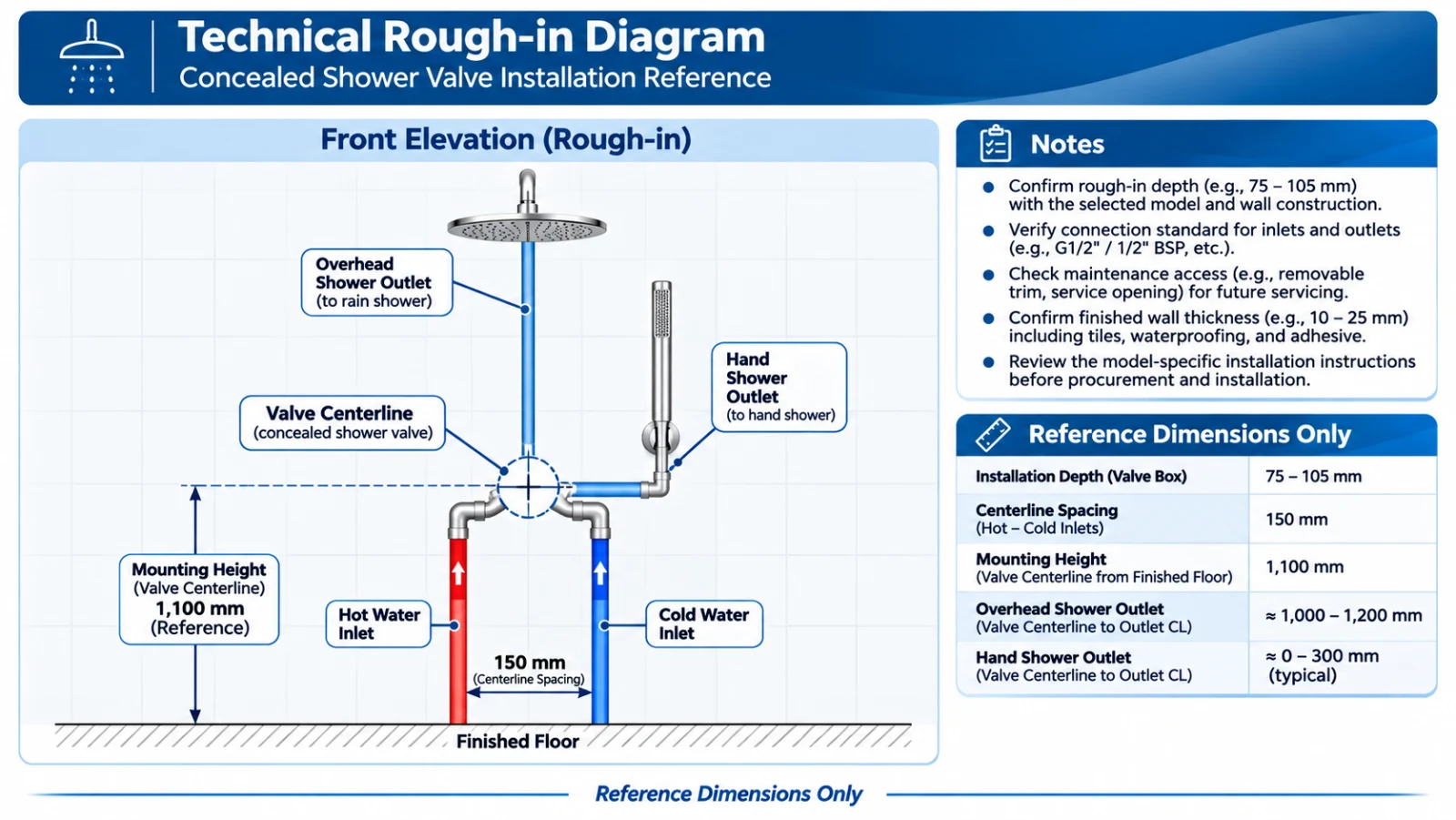
Concealed shower system compatibility
Concealed shower systems require particularly careful coordination because parts of the valve assembly sit inside the wall.
The buyer and installation contractor should confirm the rough-in depth, finished wall build-up, pipe connections, service access, and selected trim compatibility before closing the wall.
Changes after waterproofing or tiling can be significantly more disruptive than adjustments made during the specification stage.
Product compliance and destination-market requirements
Different markets may require different technical documents, approvals, water-efficiency information, or product certifications.
For example, a project may request cUPC-related evidence for specified plumbing products in North America or WaterMark evidence for applicable products in Australia.
These are examples of requirements to investigate, not claims that every MICAWA model holds these approvals.
The buyer should identify the applicable requirements and ask the manufacturer to confirm available evidence for the exact model and configuration.
Any certificate should be checked for its holder, validity, product coverage, and relevance to the target market.
5. Common procurement mistakes in bathroom fit-out projects
Even well-prepared projects can encounter avoidable sourcing problems when fixture schedules are incomplete.
Mistake 1: Quoting products without final installation interfaces
A quotation based only on product photos may not reflect the site conditions.
For example, a selected basin could require a countertop opening different from the one shown on the current cabinet drawing.
Better approach: Attach dimensional and installation requirements to each relevant BOQ item and identify unresolved interfaces before approval.
Mistake 2: Mixing supply and installation costs
If one bidder quotes supply-only fixtures and another quotes supply-and-install, the two prices are not directly comparable.
Better approach: Separate manufacturer product supply from contractor installation and require both parties to state their assumptions and exclusions.
Mistake 3: Approving finishes by name alone
Terms such as “brushed nickel” or “matte black” do not necessarily guarantee an identical visual appearance across product categories or manufacturing processes.
Better approach: Use approved finish samples or controlled references for visibly coordinated products, including faucets, shower fittings, and enclosure hardware.
Mistake 4: Ignoring project phases
A large hotel or apartment project may require different delivery batches for mock-up rooms, standard rooms, premium rooms, and replacement stock.
Better approach: Keep each phase linked to its quantities, approved product revisions, finish references, and packaging requirements.
Mistake 5: Assuming all models have the same certifications
A manufacturer may hold evidence for selected products without the approval covering every model in its catalogue.
Better approach: Review model-specific documents against the destination market and the project's actual technical requirements.
6. Coordinating bathroom fixtures for hotels and apartments
Hotel and apartment fit-out projects can share many product categories, but their room schedules and procurement priorities are not always the same.
Hotel bathroom fit-out procurement
Hotel projects often organize bathroom fixtures by room category.
For example, standard rooms may use one consistent toilet, vanity, and shower package, while deluxe rooms and suites may require different bathroom furniture, bathtub combinations, or finishes.
The purchasing team should identify which items remain standardized across room types and which require separate BOQ codes.
Important coordination points include:
- Room-category-specific fixture schedules.
- Visual consistency across approved finishes.
- Maintenance and replacement considerations.
- Mock-up room approval.
- Phased delivery and packaging identification.
Apartment bathroom fit-out procurement
Apartment developments often involve repeated bathroom layouts across different unit types.
A practical procurement schedule may group products by studio, one-bedroom, two-bedroom, and premium unit configurations.
Important considerations include:
- Toilet and basin dimensions for each layout.
- Vanity storage and installation requirements.
- Shower enclosure dimensions.
- Standardized product choices where appropriate.
- Replacement and maintenance requirements.
For multi-unit residential projects, see MICAWA's Property Development Bathroom Packages application page.
Why multi-category product coordination matters
A bathroom fit-out involves more than ordering each product separately.
The toilet must suit the drainage arrangement. The basin must fit its vanity or countertop. The faucet must work with the basin configuration. The shower system must suit the plumbing layout, and the enclosure must fit the finished shower area.
Where a project sources several bathroom product categories, a coordinated product schedule can make approvals and procurement responsibilities easier to manage.
MICAWA's Complete Bathroom Solutions approach organizes products around the bathroom space, room requirements, finishes, and project positioning rather than a fixed product bundle.
This allows buyers to discuss multi-category bathroom supply while keeping installation conditions and model-specific approvals under review.
7. How to request a bathroom fixture package quotation
Once the sanitary ware items have been separated from the full fit-out BOQ, the next step is to prepare a focused manufacturer inquiry.
You do not need to finalize every model before the initial discussion, but the supplier must understand the intended product scope and the information still awaiting approval.
Step 1: Define the project and procurement scope
Start by identifying:
- Project type: Hotel, apartment, residential development, or commercial facility.
- Destination country and applicable standards.
- Number of rooms and principal room types.
- Product categories requiring manufacturer supply.
- Approximate quantities.
- Required project stages and delivery schedule.
Step 2: Extract the product supply lines
Use separate item codes for toilets, basins, vanities, faucets, shower systems, shower enclosures, bathtubs, and other confirmed product requirements.
Keep installation works outside the manufacturer's supply schedule unless a separate arrangement has been expressly agreed.
Step 3: Identify technical questions
For each product, indicate whether the following information is confirmed or pending:
- Product configuration and dimensions.
- Installation interfaces and relevant rough-ins.
- Material and finish requirements.
- Destination-market documentation.
- Sample and drawing approvals.
- Packaging or delivery preferences.
Unresolved information should remain visible rather than being replaced with assumed specifications.
Step 4: Ask for an itemized supplier response
A useful manufacturer quotation should identify, as applicable:
- Your original BOQ item code.
- Proposed product model or configuration.
- Quantity and quotation unit.
- Included components and exclusions.
- Commercial pricing basis.
- Outstanding technical questions.
- Available supporting documents.
- Sample, packaging, and delivery assumptions.
Any proposed alternative to the original specification should be clearly marked for buyer approval.
For a more detailed guide to assembling the full enquiry package, read the Bathroom Project RFQ Checklist.
Working with MICAWA on bathroom fit-out product supply
MICAWA is a bathroom manufacturer based in Foshan, China, established in 2000.
The company's product portfolio includes sanitary ceramics, bathroom vanities, faucets, shower systems, shower enclosures, bathtubs, and related bathroom products.
For commercial projects, buyers can discuss coordinated product supply according to their room schedules, target market, product specifications, and estimated quantities.
The actual quotation, product configurations, customization options, documentation, packaging, and order terms are confirmed for each inquiry.
Next step
Have an Excel or PDF BOQ ready?
Start by submitting your project basics through MICAWA's Commercial Project Buyers page. The team can then confirm the appropriate next steps for sharing your full BOQ schedule, CAD drawings, and product specifications for a more detailed quotation discussion.
This is a product sourcing and manufacturing enquiry, not an on-site construction or fit-out installation service.
Discuss Your Bathroom BOQ8. Frequently asked questions
What is included in bathroom fit-out works?
Bathroom fit-out works may include plumbing, waterproofing, tiling, sanitary ware supply, bathroom furniture, shower fixtures, enclosure installation, and related finishing activities. The exact scope depends on the contract, drawings, and project specifications.
What is the difference between a bathroom fit-out BOQ and a sanitary ware BOQ?
A bathroom fit-out BOQ covers construction work and required materials across multiple trades. A sanitary ware BOQ focuses on the fixture and product items requiring selection, quantities, technical approval, and procurement.
Can I request a sanitary ware quotation from an incomplete BOQ?
Yes, an initial sourcing discussion can begin with an incomplete product schedule. Identify the confirmed items, estimated quantities, destination market, and outstanding technical decisions. Final quotations and approvals may depend on additional specifications or drawings.
Does a bathroom manufacturer handle on-site fit-out installation?
Not necessarily. A bathroom products manufacturer typically supplies fixtures and agreed components. Plumbing, waterproofing, tiling, fixing, and commissioning are generally coordinated by the relevant project contractors unless separate contractual arrangements apply.
Which documents should be checked before ordering bathroom fixtures?
Important documents may include model specifications, dimensional drawings, installation instructions, approved samples, applicable compliance evidence, and the finalized product schedule. The exact documentation depends on the product and destination market.
Can a hotel or apartment project source multiple bathroom fixture categories from one manufacturer?
Yes, where the manufacturer's product range and confirmed supply capabilities match the project requirements. The buyer should still verify each model, product interface, included component, and delivery arrangement.
Does MICAWA offer the same minimum order quantity for every bathroom product?
No. Minimum order quantities depend on the product category, model, configuration, and project requirements. Confirm the relevant MOQ during the quotation discussion.
How can I send my Excel BOQ or CAD drawings to MICAWA?
Begin with the MICAWA project inquiry page and provide the project type, destination market, product categories, estimated quantities, and contact details. MICAWA's team can clarify how to share supporting BOQ files and drawings during the follow-up discussion.
Final thoughts: turn your fit-out BOQ into a clear product supply schedule
Successful bathroom fit-out procurement begins with a clear separation between construction works and fixture supply.
Before requesting manufacturer prices, project teams should identify the sanitary ware BOQ items, confirm installation interfaces, assign quantities by room type, and document the intended supply boundaries.
This helps buyers compare quotations on a consistent basis and address product-related questions before approval, manufacturing, and delivery.
For hotel, apartment, and commercial development projects, MICAWA supports discussions about coordinated bathroom products and sanitary ware supply.
Share your project requirements to explore the product categories, specifications, and sourcing arrangements relevant to your bathroom fit-out schedule.
Request a Sanitary Ware Package QuotationContinue the project procurement reading
Bathroom Project RFQ Checklist
The nine-document package that turns your fixture schedule into a comparable supplier quotation.
Complete Bathroom Package Checklist
Coordinate room schedules, product interfaces, samples, packing and phased delivery.
Hotel Bathroom Vanity Sourcing Guide
A room-type approach to the most heavily customised part of the bathroom package.